Tuesday, July 08, 2014

About Turning Mysore into Paris - An Open Letter to Mr. Pratap Simha, MP Mysore constituency.

Dear Mr. Pratap Simha
The front page of yesterday eveninger, City Today said that you are all set to turn Mysore into Paris.
Now while it is my dearest wish to sip champagne atop the Eifel Tower while wearing a Chanel original - and what could be better than if I could do that in Namma Mysooru - I reigned in my untrammeled ecstasy to take a few minutes to read beyond the headline and try to understand what exactly you had in mind.
First of all, according to you, this Paris-of-India idea is Mr. Narendra Modi’s pre-election promise. Lovely, really, though I think what he said was slightly different. http://www.thehindu.com/todays-paper/tp-national/tp-karnataka/modi-to-make-mysore-a-global-tourist-hub/article5890071.ece. But, I won’t quibble – after all, who can say ‘no’ to Paris.
Secondly, on carefully perusing your “development agenda” as stated by the newspaper, I noticed that apart from a “think tank” on ideas to develop Mysore, the rest of it is all to do with improving connectivity between Mysore to Bangalore.  And of course having tour guides printed in all Indian and foreign languages, which I hope will include Serbo-Croatian and Swahili because there is no saying from where tourists will flock to = Paris of India.
But, in your pre-election and post election tours of namma soon-to-be-Paris-of-India, you may have noticed that we have a few pressing problems. And I am only bringing them to your noticenot because we locals are inconvenienced – how could I be so selfish
But  because  the tourists are likely to notice.
 Like this one.

Thing is, of late, we Mysoreans have begun to  produce  a lot of garbage. Side effects of development, I’m told
About 400 tonnes of it a day, give or take a few tonnes. And it seems that we – (by ‘we’, I mean we the public as well as the Mysore City Corporation) haven’t yet figured out what to do with all this garbage.  To understand  what I mean, just walk around the city and you will see  piles of garbage lying around much like the one in the picture. Now, I haven’t been to Paris but I’m guessing that mounds of putrid, stinking garbage do not figure as one of its attractions. And yes, I know you plan to  light up Chamundi Hill and the Mysore Palace every evening but I don’t think that will really distract the tourists from the garbage, if you get my drift.

Or this one.

Now, apart from garbage, we Mysoreans have decided that we need a lot of vehicles. On the roads and off them.  (In fact, in many residential areas, there is more parked vehicle than road.) So, vehicular traffic is currently  estimated at about 5 lakh vehicles which makes it about 1 vehicle for every 2 Mysoreans. And every third shop, after a chemist and a bakery is a two-wheeler showroom.
So what‘s the problem?
Er, a small one really. In order to drives all those vehicles, we need roads.  And our roads are….well, let’s just say that we are moving to a situations where there may be more potholes than vehicles. Or Mysoreans. And it isn't as if our ever diligent civic authorities don’t repair the roads. But for some strange, till-now-not-understood-by-science-and-technology, the potholes pop up again. And again.  And again. Bigger and deeper and more pot-holer than the last ones.  And the reason why this might come in the way of our hurtling towards becoming the Paris-of-India is that tourists travel on roads too.
 From their hotels to Chamundi Hill to see all those pretty lights.
And then to Mysore Palace to see more pretty lights. And so on and so forth.
Let me say for the record that it isn’t as if the aforementioned diligent civic authorities are trying. As an example, they planned to convert  5-kilometer stretch of road along which the annual Dussera procession travels into a “Raja Marga”. I’m not sure what exactly that means, but  from the name, it sounds like something really grand. And a tourist-magnet.
The foundation stone for this Raja Marga was laid in August 2010. We are now in 2014 and it is unlikely that the Raja Marga will be completed for this Dussera…er, I mean tourist season.
Then there are overflowing drains, resulting in a delicious monsoon special cocktail of sewage water being mixed drinking water. Talking of drinking water, when it doesn't rain, many parts of the city have no water, drinking or of any other kind.
Did I mention unplanned, uncontrolled urban sprawl? .
Or shrinking lung space?
Or deforestation of Chamundi Hill that you plan to so prettily light up.
It’s a long list. Some of which the tourists won’t notice. (And after all, not every part of Paris is touristy, is it.) But some of it they will. And this may come in the way of namma Mysooru becoming namma Paris-in-India.
So, dear Mr. Pratap Simha. This cri de couer is not on behalf f us Mysoreans. (See, I’m already speaking French.)
It is not because once Mysore was not just one of the most beautiful but one f the most progressive cities.
It is not because we Mysoreans deserve better
But only because the tourists must come. And Mysore must become the Paris of India
Do something.
Yours truly
Ratna Rajaiah


Friday, April 11, 2014

Hasi Aunty and her Sindhi kadi

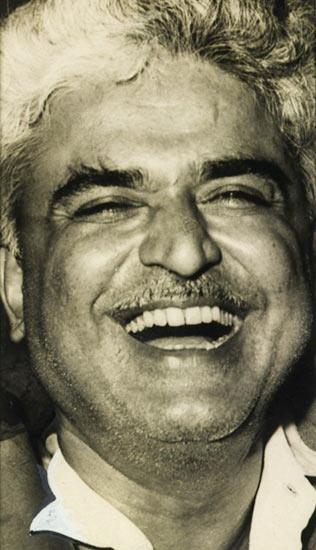
Hasi Malkani
For the world, she was my landlady and I was her paying guest, living for many years in one of the two little but very clean and airy rooms of her flat in Khar, Mumbai.
For me, though, she was my Hasi Aunty. (And if truth be told, we shared the flat, she allowing me access to every part of it with typical generosity)
Hasi.
Meaning laughter.
But if you looked at her life, there was very little that Hasi Aunty to laugh about.
The second eldest of a large brood of 4 sisters and 2 brothers, her mother died when she was just a teenager.
And within a short while of her mother's death, her father decided to marry again - a young girl; one of Hasi Aunty's friends, to be precise.
When she got over the shock, the young Hasi was very clear about her father's decision. If he married the girl, she told him, she'd leave home with her entire brood of brothers and sisters - the youngest, a boy was just two years old. (I'm not too sure, but I think one sister - the one older than her - was married by then.)
But her father was adamant about what he wanted to do.
And Hasi about her decision. So, she left home with her brood - of till now siblings, but from now, her children.
Obviously there was little or no money (she later got a job as a postal clerk) and home was a tiny one room kitchen house in an LIG colony. But, in those very limited resources, she somehow managed to get her all her "children" educated and on their feet and her two sisters married - all before the elder of her two brothers started working. He did very well for himself in the real estate business and by the time I started staying with Hasi Aunty, he was a rich builder with a bungalow in Juhu and had bought his beloved Didi this little flat.
She must have been about 56 years old then. Se never married and was still working in the Mumbai GPO along with her best friend of some 30 years, Sheila. She already had a bad back which necessitated that she wear one of those ghastly back support belts all the time. She also had Type 2 diabetes.
But none of that in anyway came in the way of the full, busy life that she led.
She travelled, had a small  group of good friends (other than Sheila) who gathered twice a week to play cards and eat and generally have a blast. She often chipped in as a supervisor in PUC and SSLC examinations.
And most of all, she laughed. And smiled. And laughed some more. And smiled even more. Always true to her name - Hasi.
You'd think life would give her a break after the really bum deal it dealt her when she was young.
Not so.
 Her youngest brother, her baby whom she reared from age 2, died of a heart attack at age 40. Her eldest sister had a miserable marriage and a younger one got cancer. Then the older brother fell sick and she had to see him go too.Finally, she fell out with best friend Sheila and stopped seeing her completely. (They used to be so inseparable that they were known as a "couple" in office!)
But through all of that and in all the years that I have known her, (I continued to visit her long after I stopped being her paying guest) I have never seen her lose faith in life. Or in her Bhagwan to whom I'm sure she asked nothing but never failed to light a lamp twice a day, once before she started her day and once when the day was done, before she settled down for bit of telly and dinner.
And I have never known her not to smile. Or laugh.
She was, in every sense of the word, truly Hasi.
And of all the things that I learnt from this amazing lady, I learnt to make this delicious kadi, apparently a popular dish of the Sindhi community to which Hasi Aunty belonged.
So, I share the recipe in the hope that when you make it, some of my beloved Hasi Aunty's indomitable spirit - and "hasi' - will seep into your life...

Hasi Aunty's Sindhi Kadi
(To serve about 4)

 1/2 kabuli chana (chole) washed and soaked overnight
About 2 cups mixed vegetables – , washed and cut into about ½ inch pieces
 (I use green beans, carrots, gavar beans, potato and peas. But you can change/add as per your taste. Hasi Aunty used to add bhendi but this may give a slight ‘slimy’ quality to the kadi if you add too many...)
Juice from tamarind the size of a marble (adjust to taste)
2 small tomatoes 
15-20 curry leaves
¾ teaspoon turmeric
1 teaspoon chili powder ((adjust to taste)
2-3 green chillies, chopped large 
(You can skip one chili or the other, depending on your preference and how hot you like your food)
3/4 inch piece of ginger chopped into thin slices or slivers
Salt to taste

1 tablespoon finely chopped fresh coriander

For kadi base
1-2 tablespoons of oil
1 to 1   ½ heaped  tablespoons besan flour (you have to adjust this depending on how thick you want the
kadi. Thicker means more besan)
¾ teaspoon jeera
½ teaspoon methi seeds (optional)
A pinch or two of hing (asafoetida) 


Heat the oil in a thick bottomed pan. Add the jeera. When it starts to brown n swell, add the methi seeds and hing. As they start to brown, slowly sprinkle in the besan flour and brown it to a thick, even, crumbly paste. 
Now this is a tricky part, so make sure that
1. You keep the heat very low
2. You are stirring constantly as you add the besan
3. You add add the besan slowly, otherwise you will get a lumpy, unevenly burnt mess.
When the besan flour has turned a nice golden brown, smooth paste, remove from heat and allow to cool for a few minutes. Now, while stirring all the time, slowly add water till the besan turns into a smooth sauce. 


Once again, this is tricky and so make sure
1. You have allowed the besan to cool a little, otherwise when the water hits it, it will turn in to hot steam and scald you
2. You add the water very slowly and in a steady stream AND you stir all the time. Not doing either will result in a lumpy mess.

When you have a smooth, golden sauce, thin it with water to that desired thickness. 
Then, reserving about half the curry leaves, add the rest along with all the other ingredients except the tamarind juice and fresh coriander.
Pressure cook - two whistles. You can also cook in a open pot till the veggies are just done.

Now add the tamarind juice and half the fresh coriander and simmer for about 10 minutes on a very low heat.
The thing about this kadi is that it tastes better the  more you simmer. (In fact, it tastes even better the next day!) Of course, you have to make sure the veggies don't disintegrate or turn into a pish-pash!
Before serving, add the rest of the fresh coriander and serve with plain, steamed Basmati rice

I love you, Hasi Aunty and I will never forget you...


Monday, January 06, 2014

Precious Parijata


I suppose many people think that some things are really not of very much use. A few days ago, I read a news item that said that 11 subjects had been dropped from a state school curriculum because there weren’t enough students interested in studying them. Among them were Drawing and Painting, Indian Music and Western Music. It’s one way of looking at things, I guess. For example, how will knowing to play the piano or recognizing Raag Khamaj or drawing a crayon sun shakily rising up between some un-mountain-looking mountains help to make your child a better software engineer or a doctor? Has a poem ever been known to increase the GDP or a song made the Sensex soar? And therefore, what is the point of a tree that doesn’t seem to do much but stand around and scatter the ground with a carpet of white-orange fragrance every morning? No fruit, not much in terms of shade either because it’s often not even a full fledged tree. And what silly flowers, many would say! They bloom at night when we are all asleep and in the morning, they have all fallen to the ground.
Which is why the West calls this tree Nyctanthes Arbortristis. Meaning the night-flowering tree of sorrow  (or sadness) because by the time it’s morning, the tree has shed all those flowers like so many cream-and-orange tears. And there’s nothing much you can do with these flowers anyway (sell, wear in your hair, fill a vase with, make into a bouquet to send to your boss/girlfriend/MLA) because they are so fragile that in a matter of hours, they shrivel up into tiny bits of nothingness. Here, in India where this tree probably originated, we call it the parijata. (English – night jasmine, coral jasmine, Indian coral; Hindi – harsinghar, shefalika; Kannada –  parijata; Bengali – shiuli; Malayalam - pavizhammalli, parijat kam; Marathi - khurasli, parijatak; Oriya - ganga shiuli; Tamil - manjhapu, pavazhamalligai; Telugu - pagadamalle, parijatamu)
 According to the Agni Purana, one of the first things that the Sagar Manthan or the churning of the ocean brought up – after Surabhi the cow and Varuni – was the parijata tree. And then, it went to live in Devaloka as one of the 5 divine Kalpavrksas or wish-granting trees that have the power of granting any wish. I haven’t really tried sitting near a parijata tree and wishing for anything but I thought to myself that it’s not for nothing that it was given this pride of place in the heavenly gardens. So, maybe there’s more to this tree than just pretty little flowers….
And there was…
Ayurveda, homeopathy and Unani are all unanimous about the many medicinal properties of the parijata. Almost every part of the tree has been used to treat a wide variety of ailments from rheumatism to dandruff to piles to skin diseases like ringworm. But it’s the leaves that seem to be most commonly used, decoctions of it used by all three systems of medicine in the treatment of all types of fever, especially the persistent type that occurs daily. Ayurveda also uses the leaves to treat sciatica, liver related ailments, arthritis, as a tranquilizer, laxative, purgative and to expel intestinal worms, especially in children.
But what about the flowers, you ask. Ah yes, the flowers. First, indulge me a small eulogy. For me, one of the most wonderful ways of waking up each morning is to rush outside and harvest the parijata flowers. I say “harvest” and not “pluck” because there’s not much to pluck since many are already on the ground, lying there so fragile and defenseless. (According to the Hindu scriptures, flowers found fallen on the ground should not be offered in puja, with two exceptions – the parijata and the bakula!) And the ones still left on tree just need the gentlest tug – anything harder and they despair and disintegrate and leave you feeling the cruelest ogre in the world. And as I gather them one by one, the softest, most exquisite fragrance surrounds me and fills me up every time I breathe – a faint but undeniable presence, just like the flowers. In a few hours, they will be gone, but don’t underestimate these little blooms. Frail and ephemeral as they are, they do more than just fill the morning air with their wonderful scent, packing in a lot into their short lives! The Unani system of medicine uses them as a stomach medicine, to treat flatulence and even as a hair tonic!  In Ayurveda, their essential oil is used in treatments. Traditional folk medicine in Central India uses them to treat gout and adds them to the daily bathwater, not just for the fragrance but also because traditional healers believe that they  “keep the skin smooth and free from all troubles.”
The parijata flower also has non-medicinal uses, befitting one so beautiful and fragrant. Its tiny, tubular orange stalks have been traditionally used to make a saffron-coloured fabric dye that according to one version was once used to dye the delicate Tussore silks of Bengal! Even to this day, in many parts of Bengal, the sari used to adorn the Goddess Saraswati during the ritual puja is still dyed with this dye! “The parijat is an integral component of home gardens in Chhattisgarh. It is a common belief among the natives that the presence of this herb in home gardens keeps the family tension free.” (Pankak Oudhia in www.botanical.com) And rightly so! How can anyone have angry, quarrelsome thoughts after sniffing the fragrance of the parijata gently wafting in with the early morning air?
But even if the parijata was the most “useless” tree in the world, I will still have at least one in my garden. Because picking the parijata flowers teaches you the lesson of gentleness and patience. That some of the most beautiful things in the world are fragile. Like children and love. Grab greedily or handle roughly and the damage is irrevocable.  Touch gently and with gratitude and your life will blessed with their fragrance and with a sense of wonderment. Also, never underestimate Nature or indeed the nature of things. Just because we can’t see the “purpose” or the “use” of a thing, does not mean that it does not have one. So the flautist or the cartoonist in your child may not get him that all-important “percentage” in his PUC or admission into that fancy college. But imagine a world without Lata Mangeshkar or the Beatles or R. K. Laxman’s the Common Man! Or without the parijata.
Source material : Pankak Oudhia’s article in www.botanical.com , Central Council For Research In Homoeopathy (www.ccrhindia.org), Indian Journal of pharmacology and other websites.
                                                            *******

Krishna’s Tree

There are many versions of the story of Lord Krishna and the parijata tree. Here’s my favourite:
Ever since she saw the parijata, Satyabhama had been fascinated by it. When Lord Krishna killed the demon and went to heaven to return the ear-rings of the Lord Indra’s mother, Aditi, which had been stolen by the demon, Satyabhama accompanied him and sighted the parijata tree and insisted on taking it back with her and Lord Indra had no choice but to part with it. The tree was planted in Dwarka in Satyabhama’s palace. But Rukmini was jealous that Krishna had so favoured her “rival”, Satyabhama. So, Lord Krishna arranged the parijata tree in such a way that it would remain in Satybhama’s palace grounds, but the flowers would fall in Rukmini’s garden!
                                                            ***********
Maya Tiwari, Vedic monk and world-renowned practitioner and teacher of Ayurveda in her book, “Ayurveda: The Secrets of Healing”, lists seven sacred daily actions which “when observed, bring complete peace to the body, mind and spirit”. Of these seven, “he fifth action is to play, to revel in the universe’s beauty, to appreciate the flowers, streams, light and love cast within nature……..”

                                                ******

The colour of ancient wisdom

“In the ancient times Buddhist monks and Hindu ascetics dyed their robes a rich fiery color to show that they had renounced the world. This dye was produced from the very same orange centers of the parijat. When the flowers would fall to the ground, people would collect them and separate the orange tube from the white petals and dry them. Once they were dried they could be used for making this saffron-colored dye. At one time an attempt was made to commercialize this dye as it gave a fine color to cotton and silk but due to the labor intensive nature of its collection and the fact that a good means of fixing it were not obtained the concept was abandoned. Perhaps in the future the study of this dye will be resumed and a cottage industry developed where its beautiful color could be extracted.” Plants of India: by Christopher McMahon
                                    ***********


Saturday, November 30, 2013

Watching Squirrels...


We have a neem tree just outside the gate of our house. 
A magnificent towering tree,  a tree cathedral really, because if you stand under it and look up, you'll see the branches making arches that reach up and up and up and up, covered with a delicate lace-work of neem leaves that remind you of stained glass windows through which the sky floats down on you in little bright bits of azure blue...


And on the massive, gnarled trunk of this tree, the squirrels swirl and eddy all day like flashes of furry, brown lightning...
My association with squirrels - if you can call it that - goes back to a favourite childhood story that my father used to tell me………
Lord Rama stood at land’s end, on the last leg of his mission to rescue his beloved Sita from 
the covetous clutches of Ravana. Hanuman and his Vanar Sena were filling the sea with stones, 
building the bridge that would take Rama across to Lanka where Sita was held prisoner. 
And with them, another little army was doing its bit. A small band of squirrels. 
Too small to carry stones, their tiny paws could manage only a few grains of sand. 
But they didn't stop to think about the littleness of their contribution. All that mattered was 
to help their brave, beloved Lord Rama. So they scurried back and forth tirelessly, throwing their tiny clutches of sand into the seemingly bottomless ocean.
And before long, the bridge was built and Rama crossed the sea, slayed Ravana and brought his Sita back home.
And he did not forget the devoted service of the little squirrel. Running his hand gently down its back, he branded it forever with three beautiful silver streaks of gratitude, stripes of honour that the squirrel wears to this very day and remains a symbol of  the selfless labour of love.


So, when I moved to Mysore after my dad's death, I would often watch these squirrels and listen to their shrieks of "cheerp, cheerp, cheerp" somewhere far up in that neem tree and think of him. (According to my research, these ear-piercing shrieks are supposed to be alarms, to warn against danger. When I look around, i don't spot any but then I'm not a squirrel and I have a feeling it is either the marmalade or the grey cat who stalk the branches of the tree, imagining themselves - as I see from their gait - to be no less than a leopard or a tiger in some deep, dark forest...)

Then one day, I happened to see one of the squirrels devouring some rice...

My grandmother would always start her lunch with a prayer and she's put away on her thali, an offering of a tiny portion of whatever was cooked that day for the meal. After lunch was done, that food was put outside under a tree or near a plant and some creature would eat it. I decided to revive this little act of thanksgiving and it was this little portion of rice and sambar and vegetable that the squirrel was eating. 

I was riveted, which was also what prevented me from collapsing with laughter....
You see, the squirrel could fit only a few grains of rice in its paws at a time, but what it lacked in 'spoon-space', it made up by eating at such a ferocious speed that it was like watching a squirrel version of a very hungry, very tiny Chinaman eating rice with chopsticks - fast forward!

Which  is how I started to feed the squirrels.
 Bad idea, my mum said, because apparently my dad had tried to do so countless times but failed, even though he plied them with every possible delicacy from buttered bread to fruit. 

But I was undeterred because the sight of that squirrel gobbling rice was so delightful!
And what did I feed them?
Now according to Wikipedia, this species of squirrel (called the Indian palm squirrel, and a member of the rodent family, I'll have you know) eats mainly fruits and nuts. 
But my squirrels?
Bread. Buttered toast. Idli. Dosa. Rotis of every denomination. Upma. And rice of as many kinds, all the way from just plain steamed rice to pulao, vangi bhath, lemon rice and bisi bele bhath...
Not that I haven't tried to feed them their supposed diet. Watermelon, banana, mango, papaya guava, all lovingly and painstakingly chopped  into attractive squirrel-sized bits and scattered in seductive piles at the base of the tree. Other creatures like cows and buffalos have sneaked a bite in my basence but these squirrels?
No siree.
So, I just gave up and went back to feeding them their - and my favourite - foods
    I fall in love with them more each day, but they are difficult creatures to get close to. I wait and wait with my camera, near the base of the  neem tree, trying to pretend I'm just a wayward branch or a stone, hoping to capture something that is evidence of why they are so utterly adorable and obsessable. 
Alas. 

But whatever I have got, I made into this little video. I hope it will make you a watcher of squirrels too...
https://www.youtube.com/watch?v=qmPddVdYR6I
h

Wednesday, November 13, 2013

Thoughts on Not Having Money


I’m thinking, how did the phrase “as poor as church mice” come about? 
I mean are there mice that are rich, mice that live in Bill Gates’ basement, for example. 
Or mice that hang around in the Sultan of Brunei’s godowns? 
And what is “rich” in rodent terms? 
Or “poor” for that matter? 
What do church mice not have that other mice do? 
I know we make very unkindly references about rats and their mercenary tendencies, but if I am a rat running the rat race, what would I be in the race for? Stock options in the company that makes Kraft Cheese?  (Which, I am told, is now part of the guys who makes Marlboro cigarettes…strange mix, is it not? Tobacco and cheese….ah well.) 14 Cat-stretch limos with my own personal army of Black Cat Commandos? ( Which would be befitting rodent-justice, no?)
And is that the real difference between mice and rats? (We all know the difference between mice and men. We think) Which is that mice, particularly church mice are less money-minded than rats? 
Do rodents have a Nasdaq? 
A Forbes list of the 100 richest rodents in the world
I thought these thoughts while I was thinking about not having money. 
Again, “not having money” is relative, is it not? 
For example, it would different depending on whether I am a church mouse or Mukesh Ambani. 
I am neither so, here’s what I mean when I say I don’t have money. 
I don't have a job. 
And I stopped writing - my weekly columns...oh, let me see now... let's just say " a few years ago".
I wrote a book after that but while lots of people thumped me on the back and crowed what a great book it is, I'm not Arundhati Roy. Or Jhumpa Lahiri. Or that 28-year slip of a lass who won the Booker Man Prize
Who knows, I might just be another Alice Munro when I'm 86, but that is a while away yet
So, in other words, I do not have money coming in every month. 
Or, you could say, I don’t have money. I mean I can pay my Internet bills and buy clothes and the occasional Biotique kajal and everything, but broadly speaking, I don'y have money.
It is good that while I “had money” (I used to be a Mumbai corporate rat), I did not develop any expensive habits – alcohol, Ecstasy, gigolos, diamonds, Lamborghinis …. You could say that I am a low maintenance girl.
So, I have savings and stuff, but I don’t have money.
Now not having money is a dangerous existence. 
Again, dangerous is a relative term. 
So, I’m not talking about free-falling-and-pulling-the-parachute-ripchord-when-you-are-4-feet-from-the-ground kind of danger but swimming in the deep end of the pool when you are used to doggy-paddling in the baby pool. 
It's still scary and I am terrified because till not so long along I lived a good, safe existence with not one but several safety nets under me to break my fall if I ever fell – salary, EPF, PPF, FD’s…you get my drift
So let’s see all that this state of being has done to me.
First of all, I am learning to live with insecurity and to tell you the truth, it’s not that difficult getting used to.
Actually, we all underestimate our quotient of elasticity. 
You can get used to anything. 
Either that or you die.
I think of how many million people live a few millimeters from Mumbai’s suburban  railway tracks on which trains hurtle past every deafening few minutes. I think of how many mothers have and bring up two, three, four babies while cooking-cleaning-housekeeping AND going to work 6 days of the week on the 7.39 Ladies Virar-to-Churchgate special.
So, I'm gotten used to it.
I've learn to live with envy and jealousy when I see people who were colleagues/batch-mates, even subordinates earning in a month what I earn ....er, sorry - not spend - in a year.

I've learnt to how to not to let that envy and jealousy get to me. Initially, it was a deep, burning pain. Now, mostly I don’t notice what it is.

So, you can get used to anything.

Every now and then, I remember a survivor of the 2005 tsunami who I saw on the Oprah Winfrey show. She was an old lady and she had lost everything. Money, home and her entire family of children, grandchildren. All gone. Only she survived.
Aid money had rehabilitated her with a new home but it couldn't give her back the family she had lost.
She was shifting into the house when they interviewed her and even through her tears of gratitude, she said something that I will never forget.
She said she now knew what you need to have in order to live.
Nothing.

Insecurity is a good thing.
Fear is even better.
The feeling that the bottom may fall out of everything any minute soon is a good thing.
And being “a failure” in the eyes of the world is a good thing.
When the safety nets go, the sight of chasm below trying to whoosh up and swallow you starts to clear the fog inside your head.
But the fog is thick, stubborn from years of having taken up residence and it's going to take a while for clear, blue skies

And you start looking for who you really are.

Without the phablets-that-you-change-with-every-new-phablet, the car-bigger-than-your-ego,without the friends (yeah, one of the side-effects of 'having money" is lots of friends), the vacations to I-have-no-clue-where-peoplewithmoney-go-to, the perks, the gymkhana membership.

You start looking for who you really are.

It is not easy. You are not easy to find.

But somewhere in that search, you realize that the tsunami survivor was right.
You really need very little to live. Maybe even to be happy

“Very little” because you don’t need money to have it.
In fact, no matter how much money you have, you can’t buy it.

A good night’s sleep.
A satisfactory crap every morning
A good appetite
And good health 


So….

It’s not that I don’t heave a 1000 sighs of craving when I see that ad for the Samsung Note 3 
It’s not that a thin trickle of acid doesn't sometimes burn a trail someplace inside when I see a used-to-be-my-flunkey’s 6 figure take home or COO designation

But, I weigh the options

Hassan Ali Khan, the Pune- based horse trader implicated in a high profile hawala case not so long ago has several expensive cars including a Porsche, a Bentley and a Mercedes, huge properties in Pune, Mumbai, Bangalore and Hyderabad. And 35000 crore rupees in 10 Swiss bank accounts.

He also has cardiac problems, liver trouble and diabetes and has to be regularly hospitalised. 

So, is he happy? 

I’m thinking 35000 crores sprinkled with a couple of penthouses and garnished with a Porsche and a Bentley is not such a bad thing and if you offered it to me, I wouldn't pshaw it.

But is it better than a digestion good enough to eat 3 dishes of malai-kulfi- falooda AFTER 3 plates of dahi-chat and golappa?
Or the ability to sleep a straight seven hours at night?

I dunno, really
Because I know about the kulfi-paapdichaat-7-hour sleep gig. But not the 35000 crores-Porsche-Bentley-diabetes-dickey-heart-kaput-liver one.
So, I can't say... 
I mean Mukesh Ambani can say "Poor as church mice", but does he really know what poverty is unless he has been and/or has acquaintance with the above mentioned rodent species? 
(Of course, Rahul Gandhi will tell you that even with church mice, poverty is a state of mind and they could easily be tootling around in rodent-Bentleys, munching mice-caviar and sipping musaka-champagne, if they just put their minds to it...)
Am I saying then, that I want to experience 35000 crores-Porsche-Bentley-penthouse-diabetes-dickey-heart-kaput- liver life before i answer?
Yes.
But minus the kaput liver and dickey heart. 
So that, whenever fancy strikes me and the penthouse bores me, I can rush off in my Porrsche to eat  3 dishes of malai-kulfi- falooda etc.etc. 
And not feel a twinge
Or missing a beat on my 8-hour kipper through a rain-washed night.
That's true wealth.


Friday, July 19, 2013

Mother Tongue


"I have become a queer mixture of the East and the West, out of place everywhere, at home nowhere." Jawaharlal Nehru
It’s an old horse, mostly flogged by politicians to win votes or voters’ brownie points. The debate about English versus Indian languages as the medium of instruction in our schools. And I write today conscious about the fact that “convent-educated” continues to be one of the most the coveted attributes of a prospective bride, next only to “fair”. That the “right” English accent can still open many doors that no “desi” accent can including getting you that fancy-salary paying call center job. That without the knowledge of English, higher education as it exists today will be impossible. That I myself am a product of such an education; reading, writing and doing all of my conscious thought in English. I also write wondering why this debate should exist at all. Because, for one, isn’t it obvious that children should be taught to use their minds and their hearts in their own mother tongue? Secondly, in a country where even the “anghuta-chaap” can fluently speak at least 2 languages, why should it not possible to have multi lingual education? And in case it isn’t obvious, too many research studies conducted over the years clearly show that bilingual children perform better in school when the school effectively teaches the mother tongue.
But since the debate exists, let’s get that out of the way first. As you must have guessed by now, I’m throwing in my lot with the Indian languages. So, am I saying that the medium of instruction in our schools should be in an Indian language? Ultimately and primarily – yes. And before everyone gasps in disgusted astonishment, it won’t do harm to just look around at all the world around us. Every single “developed” economy – and let’s not go too far away and stick to the Asian tigers – speaks, reads and writes in its own native tongue. And for the ones muttering about how difficult it is to undo centuries of British colonization that branded the English language as the superior-sahib’s language into the psyche of the nation, and how it’s virtually impossible to have one official language in a country which speaks 14 languages and over 3000 dialects, let me remind them that Singapore, Malaysia and Hong Kong were once British colonies. And Singapore has not 1 but 4 official languages of which one is Tamil. Iincidentally, the name Singapore was derived from the Sanskrit simha (lion) and pura (city).
Besides, some of the greatest Indian minds that shaped not only modern India but also the world were people who had their primary education in their mother tongue and later went on to become proficient in English. I could reel off a long and impressive list but perhaps just one name will do the trick. Mohandas Karamchand Gandhi.
“Up to the age of 12 all the knowledge I gained was through Gujarati, my mother tongue. Then I entered a high school…. Everything had to be learnt through English. The tyranny of English was so great that even Sanskrit or Persian had to be learnt through English, not through the mother tongue. And let me confess to the reader that in spite of all my love for the mother tongue, I do not to this day know the Gujarati equivalents of the technical terms of Geometry, Algebra and the like. I know now that what I took four years to learn of Arithmetic, Algebra, Chemistry and Astronomy, I should have learnt easily in one year, if I had not to learn them through English but Gujarati.… I must not be understood to decry English or its noble literature. The columns of HARIJAN are sufficient evidence of my love of English. But….India has to flourish in her own climate, and scenery, and her own literature. We and our children must build on our own heritage. If we borrow another, we impoverish our own. We can never grow on foreign victuals. I find daily proof of the increasing and continuing wrong being done to the millions by our false de-indianizing education……” Gandhi writing  in HARIJAN, July 1938
Now let me get to the points that I really want to make.
First, that irrespective of what is the “medium” of instruction in school (and we can’t change the system overnight), the responsibility of teaching our children our mother tongue rests first with us parents. And I don’t mean teaching them to just be able to read and write it. We mistake language to be just an alphabet, a script, a conglomeration of words that is a conduit for communication and information. When in fact, it is so much, much more beyond that. It is literature and music and theatre. It is our great epics and folklore. Listen to a tale from the Panchatantra in an Indian language and then listen to it in English. It is like eating a dosa or a chapatti with a knife and fork.  It is with what we feel the summer heat sear our skin, smell the rain’s first kiss on the earth, taste a mango, hear Krishna’s flute, see the colour of his beautiful skin reflected in the night sky. It is our mother’s voice softly crooning us to sleep. It carries in it the fragrance of this land. It is the mirror in which we see and recognize who we are, defined not just by this lifetime but the thousands of lifetimes of our ancestors.  It is as much who we are as is the colour of eyes that we inherited from a grandmother or the walk that we inherited an uncle. So how can we leave the responsibility of introducing our children to themselves to someone else?
Second, I plead the case for our mother tongues for one other very important reason. Because they are some of the most musical, most beautiful, most evocative, richest languages in the world, not to mention the most ancient. How can we not give this precious gift to our children? I wish I could spout passages of prose or poetry to make my point, but I am barely literate, only being able to speak but not read or write my mother tongue and my Hindi comes largely from Hindi films and Hindi film songs. (Which isn’t all that bad because fortunately they come from writers like Gulzar, Kaifi Azmi, Sahir Ludhinavi, Majrooh Sultanpuri and Rajinder Kishan.)  And dim though it is, even by that flickering flame, what I see is spectacular, breathtaking, enthralling. Languages vast and generous like the river Ganges in where there are a hundred choices to describe one thing, each word meaning the same yet not the same. Aakash, aasman, amber, gagan, digh is all “sky”, yet each have a different shade of meaning. Shyam is evening but also Krishna and his beautiful colour. “Piya ” and “saajan” is lover, but the great bhakti poets of our land – Meerabai, Kabir and Surdas – also used it to mean God. Words so concentrated and packed with meaning and expression that in just one word, you can tell a life story, describe the universe. Perhaps that is why on the one hand, we have sahasranamas for every god and on the other just…..“Om”. And perhaps that is why the Sanskrit lexicon is is called Amar Kosh – eternal treasury.
Can you think of a more beautiful way of saying “mother” than “janani”? And can you find an equivalent word in English that is an adequate translation? For that matter, can you translate “Man tadapata hari darshan ko aaj”? Have you ever wondered why English subtitles in Indian films are so ridiculous? How, for example do you translate “jeevan se bhari teri aanken majboor karain jeene ke liye”? Or “chaudavin ka chand ho ya aftab ho”?  How would you explain “sringaar rasa” to somebody who knows only English? Or what Tulsi Das meant when he said, “Tumaka chalat Ramachandra, baaje paijaniya”? Or Meera Bai when she pleaded “Hari tum haro jan ke peed…”? Or  Purandaradasa when he begged, “Karuniso ranga karuniso, Krishna karuniso….”?

Many, many years ago, in my penultimate year in school, a wondrous thing happened to me. Her name was Sister David and she was my English Literature teacher. I still remember the class and the poets – Robert Frost and T S Eliot and William Blake – and the poems.
“Earth’s the right place for love:
I don’t know where it is likely to go better….”
And I still have that poetry book. Because that day I fell in madly, deeply and irrevocably in love with the English language, a love has not faded to this day. And all that preeti, pyaar, prem, lagan, mohabbat for English – even though today I write against it – started from the wonderful introduction that I had to its great literature and poetry. It led me to its songs and cinema and theatre. I wish I had met such a teacher of Kannada or Hindi Literature. I wish that there could be such a teacher of Indian language in every school.
Perhaps a vain hope because thousands of “English-medium” institutions are sprouting up all over the country even as we speak. Sadly, given the quality of the English taught in a majority of them, most of these children will be both inarticulate and for all purposes illiterate in both languages. Look at the average advertising slogan and you will see how dangerously close we are to that.
“Their vocabulary in the mother tongue is so limited that they cannot always finish their speech without having recourse to English words and even sentences.” Gandhiji wrote this almost 70 years ago but it applies to most of the current generation of Hindi film stars. And many VJ’s and TV show hostesses speak Hindi with an accent that the even the average Angrez baddie in a Hindi film would be ashamed to speak in.
Yet, a century ago, there were Indians with a different vision of things. Tagore founded Shantiniketan, Rukmini Arundale Kalakshetra and it is said that the great physicist, S. N. Bose fought for the introduction of Bengali as the medium of instruction and as Professor in Calcutta University in 1945, taught physics to the postgraduate students in Bengali.
You see, it’s really very simple. How can we have self-respect when we don’t know who we are? How can we raise generations of proud, confident Indians if they don’t know who they are, who cannot don’t read their own poetry and song, who haven’t been touched by the magic of their mother’s tongue? Who know their Mahabharata and Ramayana through assembly line serialization on television and English translations, who  never fallen in love with Jayadeva’s Geet Govindam or Bhartrihari’s fabulous love poetry? Who have never seen a Yakshagana performance? It is not enough to declare Tamil and Kannada and Sanskrit as “classical” languages. They must roll off our tongues as easily as our mother’s name. In other words, they must truly become our mother tongues.
I end on a light-hearted note, but one that illustrates the exquisite subtlety of our languages. One of my mother’s closest friends was a Punjabi lady who was eager to make a good impression on her Kannadiga boss. So, after much tutoring from my mother, she went off to work one morning armed with a complete, freshly polished Kannada sentence. When her boss came in, she went up to him and proudly declared, “Neenu beku.” Translation :  I want you. All that the poor lady wanted to ask for was water or ‘neeru” which slipped just by one syllable and became “neenu” - you. My mother says that it took the boss a long while to recover….

                                                *******


Thursday, July 18, 2013

I think and write in English but it is my eternal regret that I don't in Kannada...A cornucopia of verbs

I am fascinated by the cornucopia of avatars of verbs in Indian languages and how, often by using a word that's just a syllable-long, we have narrated the exact (and sometimes entire) relationship with the person being addressed
For example 'ba'. In Kannada, it means 'come'. (Like 'aa' in Hindi)
But it doesn't stop there. When you say 'ba', it means that you are addressing a person who is familiar to you - could a friend or family member. Or stranger but a person younger than you.
Now, let's add another syllable to 'ba' - 'nni' = banni. With that you have added respect and/or politeness to your summons; in other words, we now know that you are addressing someone older/unfamiliar/someone who you respect - it could be one or more of those things. 
But these are unisex verbs and they don't tell us the gender of the person you are talking to. 
So, let's add some other syllable to 'baa'. 'Ro'. So, 'baaro'.
Now we know you are talking to a male - and someone whom you are really , really familiar with. Perhaps not quite the breeds-rabbits kind of familiarity (though with time and enough baaro's, it might get there), but raised by several degrees higher than just 'baa'. So you could be talking to a brother/son/friend/lover - sometimes even a husband!
(The reason for that last exclamation mark is because it is still the practice in the "hinterland" as we superciliously tend to call it, to not take the husband's and to address him in "bahuvachana" like 'banni - Hindi equivalent is 'aaiye'. But like so much else, and with the help of judiciously timed TV serials, it's all changing. The salwar-kameez is nudging out the 'seere' and patidevs are often just "baaro'!)
Now, if you change 'ro' to 're', as in 'baare', we know you are talking to a female, but with whom you share the same degree of familiarity as 'baaro' - sister/friend/sister-in-law. And of course, wife. (No exclamation mark needed this time because this practice is as old as the idli n the dosai...)
The only exception where 'baaro' is used unisexually is with children. When I first came to live in Mysore, I noticed what then seemed strange, but now rather endearing practice of calling daughters also that way...'baaro'
The best way to understand how this treasury of verb avatars work is to watch a fight, especially a you-bumped-my-bumper-you-banged-my-er-fender street fight.
The combatants starts off with 'banni', then as tempers rise and accusations are hurled, it becomes 'ba', and finally, just before the warring parties come to blows and/or are hauled off to the nearest police station, the air is thick with references to your dubious ancestry and 'baaro's'....
I think and write in English but it is my eternal regret that I don't in Kannada...
I cannot end without sharing that most famous use of the verb 'baaro' - Purandaradasa's "Krishna Ni Begane Baaro..."
http://youtu.be/XLwcrrVrOjw

Wednesday, July 17, 2013

Poem - A cucumber in December

A cucumber
In December
Said 
I remember
I remember

Chilling out, 
Lying about
In a
Cool, pink gazpacho
Cuddling a tomato

I remember

T'was summer...
I'd murmur
Songs 
And Wander
Clad only in coriander

I remember

The thrumming thrill 
Of a chill
Chilli
Tickling my knee
In a lemony sea

Then when, I pray
ask, did May
Become
This mint-numbing, freezing
sneeze-wheezing
December?

I don't remember....

Tuesday, July 09, 2013

What does the hibiscus flower have to do with bhendi?


Bhendi.
Lady's fingers.
Or okra, as the Americans call it. The word "okra" is of African origin and means "lady's fingers" in Igbo, a language spoken in Nigeria.
Botanical name : Hibiscus esculentus.
You're wondering about the word "hibiscus, are you not? Well, that is because this vegetable is a member of the mallow family of which the hibiscus is also a member.

Now, there is another indication that the bhendi and the hibiscus are related. Crush the petals of a hibiscus flower between your fingers and they  will be coated with the  a kind of slippery, gooey substance similar to that which comes out when you slice a bhendi.
It's also what makes a lot of people hate this vegetable but this is what makes it one vegetable that should often be part of your diet. You see, the gooey-guck is mucilage, a kind of dietary fibre vital for good health and to prevent or manage many diseases.
And this is how.
For one, like all dietary fibre, mucilage acts as a sponge, absorbing blood sugar and thus lowering it. That's critical to help prevent diabetes and also manage it.
For another, it is this very sponge-like property makes mucilage a great purifier, ridding irritated, inflamed tissues in the body of toxins, allergens etc, especially those that inflame and irritate stomachs and intestines. Also, the gut flora (good bacteria) that live in the our digestive tract and without which many digestive processes would be very difficult, love to feed off mucilage.
Finally, fibre of any kind is a wonderful mover and shaker - of our bowels, preventing constipation etc., etc. And soluble fibre - like mucilage - is particularly beneficial because it is not harsh like insoluble fibre (wheat bran for example) and so nudges er, things along firmly but gently...if you get my drift!
That's all very well, you're thinking, but what to do about the gooey-guck?
Well, that's why I started writing this in the first place.
One option is to fry the bhendis as we do in bhajis. (Some folks even deep-fry their bhendis!) But there is a equally delicious but morehealthy option that I learnt from my mother. And it is to roast them.
And here's how you do it...


Chop the bhendis. Now take a thick pan or kadai and ......


on a low heat, gently roast the bhendis till they char slightly, lose they firmness and are more than half-cooked


Now add them to pre-cooked dal (tuar works best) and make your favourite dal or sambar!

Enjoy!
Incidentally, bhendis are also a good source vitamin C, many of the B vitamins and antioxidants....

Friday, July 05, 2013

The Man Who Loved Aliases!


C. Ramachandra - one of the greatest music directors in Hindi cinema.  (Just to jog your memory - Shola jo bhadke dil mera dhadke, O chand jahan wo jaye and Shaam Dhale Khidki Tale)  I say Hindi cinema because that's where he did most of his work, but he also composed for Marathi, Telugu and Tamil films including this famous song  for SS Vasan's blockbuster -  Vanjikottai Valiban!)
I just discovered that he was influenced by Benny Goodman! But what I know is that he's a fabulous singer, singing as Ram Chitalkar (he acted and sang Marathi films by that name and the "C" in "C Ramachandra stands for "Chitalkar"). One of his most famous songs is a duet with Lataji - Kitna Haseen Hai Mausam - in the film AZAD for which he was also the music director. Another of his great hits is Mohabbat aisi dhadkan hai, originally sing by Lataji for the film Anarkali, but just listen to him sing it here, 28 years after he first composed it! C.Ramchandra Live at BBC Studios,1981
But a lot of his really delightful songs (including one in Punjabi)  are rarely heard and mostly unknown. So, if you want to listen to C.Ramachandra alias Ram Chitalkar as the singer, visit this site
http://chitalkar.tripod.com/
And if you want to know more about more about this multi-talented musician with a penchant for aliases, this is a good starting point! http://www.anmolfankaar.com/features/blog/107-c-ramchandra-and-his-autobiography.html


Tuesday, July 02, 2013

First Blood

"We were the first" 
to show you 
bomb blasts, 
body parts
scams bursting
dams

"We were the first"
to cry "Shame!"
then hold candlelight marches
as we told you
her name
("Shall we call her 'rape victim?'" No! 'Survivor'." "No. The One who knows no fear' because she's dead now..."

"We were the first"
to dangle this juicy
scandal
and bait with that
breaking news
that was often nothing but a 'phus'...
("Warning : the next few images may be disturbing, shocking, licking-you-chops-disgusting..."

As you watch
Drool-drugged
Fool,
Panting, "More! gimme-gimme-gimme more...
More bombs, wars, floods, blood
More terror, rape, plunder, the pounding thunder of
More...."news"

Friday, June 28, 2013

Watermelons in winter...


This morning, a street vendor passed by selling mangoes and 'avarekai'. Was a time when mangoes spelt summertime and 'avarekai' (vaal in Gujarati) was the special vegetable that heralded the onset winter. My mother says that farmers offered the first crop of this gorgeous bean to the Maharajah during Dussera. 
Now, we have avarekai all year round and watermelons in winter....
I mourn the passing of the tradition when fruits and vegetables and flowers were our almanacs and calendars...
"Avarekkai"

Thursday, June 27, 2013

Burnt- brown....

Burnt-brown
Bitter-sweet
Rock-hard
Crumbly-ness
That melts
When you
Touch and rub
And let lie on 
your tongue
and swirl
in bitter-sweet circles
in your mouth
in your head
a jaggery of memories....

Wednesday, June 26, 2013

Go Bananas....

Did you know that the banana can help cure high blood pressure?

Scientists at the Kasturba Medical College in Manipal, Karnataka conducted a study of six popular South Indian varieties of ripe bananas. Their findings showed that the banana inhibits the action of ACE, the enzyme that is responsible for producing Angiotensin-2, which in turn constricts blood vessels and causes high blood pressure. They also found that people who consumed a couple of bananas a day for just a week recorded an amazing 10 per cent fall in blood pressure!
The banana is also one of the best sources of potassium.
Incidentally, one of the best ways to tackle a hangover is with a banana! Have two glasses of water and a banana just before going to bed, or a banana milkshake sweetened with honey – take your pick. Curiously enough, though, in East Africa, banana is used to make beer!
And this is my favourite banana receipe!

Mustardy Curd and Banana Raita (serves 4)

2 medium-sized overripe bananas

3 cups curd, whipped smooth
1 ½ teaspoons mustard seeds ground coarsely
I small chilli chopped
1 tablespoon fresh coriander, chopped
Salt to taste

Peel the bananas and roughly smash them with your fingers so that you get a consistency of paste with chunks of banana in it. Add them to the whipped curd along with the ground mustard, salt, chili and fresh coriander. Chill for about an hour. Serve either with a main meal or just by itself with chappatis – makes a great summer lunch!
VARIATION: Substitute banana with cucumber – same quantity if medium-sized. Grate the cucumber and add to the curd along with the rest of the ingredients.


Monday, June 03, 2013

The cabbage was so pretty, I sent the turmeric away....


This is a gloriously simple cabbage bhaji (poriyal in Tamil, palya in Kannada) and you can make it with any other vegetable
1 small cabbage finely chopped
1 green chili, chopped
1 tablespoon shredded fresh coconut
11/2  tablespoon oil
3/4 teaspoon mustard seeds
1/2 teaspoon jeera
1/2 dried red chili, broken into bits
4-6 curry leaves
Pinch of hing
Salt to taste

Garnish - finely chopped fresh coriander
Heat the oil, add red chili pieces, mustard seeds and after a few seconds the jeera and hing. When the mustard starts spluttering, add the curry leaves and as they start to brown add the cabbage and the chopped green chilies. Saute over high heat till the cabbage starts to turn transparent. (You need to turn the cabbage constantly so that it doesn't burn.) Now add the shredded coconut, salt. Stir well, lower the heat and cover the pan. The cabbage should steam in its own moisture but check after a few minutes and add a dash of water if necessary. When the cabbage is cooked, add the fresh coriander, stir for a few seconds and remove from heat. Serve with chappati/ rice/dal etc etc

TIP. When I was on a diet, I'd add cold cooked rice to this bhaji - just about 2 tablespoons - and it make make a delicious, low-cal "pulao" that worked specially well as packed lunch!

Sunday, June 02, 2013

Why Popeye is so right about spinach...

Palak Raita 
2 small bunches of palak
250 gms curd, whipped to a creamy smoothness

Seasoning
Freshly ground pepper
Salt
Chopped fresh coriander

Tempering
2 teaspoons oil
3/4 teaspoon jeera
1/2 broken dried red chili
Pinch of hing

Wash m cook whole palak leaves in a little water (about 2 tablespoons per bunch). Don't cover the pan or the palak will lose its lovely colour. Allow to cool and then chop. Add to whipped curd along with salt n pepper. Heat oil, add jeera, hing, red chili. When the jeera starts to darken, remove from heat and add to the raita. Stir in the chopped coriander Garnish: fresh coriander. Chill and serve...with anything, even hot, buttered toast!
TIP : You can vary the seasoning and select your favourite : roasted jeera powder, chat masala, freshly ground mustard etc., etc