Wednesday, October 26, 2011

The Making of A Karjikai


Karjikai or karanji as it is known in Hindi is to Diwali what Christmas pudding is to…well, Christmas, naturally. So a few days before Diwali, the making of this delicious but fairly complicated sweet is a must-happen ritual in our house…

First, the stuffing for the karjikai is made. Fine semolina (what is called “chiroti rave” in Kannada) and black sesame are roasted separately. The sesame is then ground corasely and added to the roasted semolina along with grated dried coconut, jaggery, raisins and bits of cashew. The purists may balk at the jaggery because normally, sugar is the sweetener used. But the jaggery is healthier and lends a lovely flavour that sugar doesn’t

Then, the covering is made - maida kneaded with water, oil and flour  along with a dash of homemade ghee – “taste ke liye”!

Then the making of the karjikai begins. Small round shapes are rolled out of the dough and a little stuffing placed just a tad off centre

IMG_4046

Then the “round” is gently folded over the stuffing and sealed. The sealing must be more secure than a chastity belt otherwise, when the kakijai is fried, the stuffing rushes out and the show is over!


IMG_4044

Once all the karjikais are made, they are deep-fried in hot oil.

008And this is the glorious end result!

007

Friday, October 21, 2011

The Song of the Two Dasas

“ Where the voice of the wind calls our wandering feet,
Through echoing forest and echoing street,
With lutes in our hands ever-singing we roam,
All men are our kindred, the world is our home….” 
Wandering Singers by Sarojini Naidu


Two men. I know them by their voices. High-pitched, soaring into the morning air with a kind of raw, gravelly, unpolished sweetness that reminds me of the jaggery. Laced by faint, underlying sound of a harmonium that warbles the story of nimble fingers that fly over yellowed and black key, barely touching them, it seems. The sound always thrills me and I wait eagerly for the arrival of these two men. The songs they sing are familiar ones – songs that have been sung exactly like this for centuries, at this doorstep and at that gate, wandering the length and breadth of this land, rising up like incense towards the heavens…

Haridasa.

“Hari” is one of Lord Vishnu’s many names.  And “dasa” literally means “servant”. But, when the philosophers and the scholars and the poets of the Haridasa movement called themselves “Haridasa”, they were referring to the fact that they were Lord Vishnu’s most ardent devotees or bhaktas. And it was this all-consuming ardour that was the fountainhead of the massive body of literature called Haridasa Sahitya that flourished for over six centuries in India, but especially in South India.

Though historians debate over the date of the origin of this bhakti movement (as early as the 9th century?), it really came into its own in Karnataka starting from the 13th and 14th century. This is the period when the great Haridasas began to roam the land, preaching about and composing praises of their beloved Hari. The language they spoke and composed in was the language of the common man, in symbols of everyday, simple things that everyone understood….

It is said that there are about 151 Haridasas of which some of the most prominent are Madhavacharya, Sripadaraya, Vyasathirtha, Vadirajatirtha, Kanaka Dasa. And perhaps the most famous of them all – Purandaradasa.

These men and their compositions changed the face of Kannada literature and music. (The basic grounding of Carnatic music was designed by Purandaradasa  – everything from the choice of the first raga to be learnt (raga Mayamalavagowla) to all the lessons and exercises like janti swaras, alankaras, geethas; so much so that he is known as the Pitamah of Carnatic music.) But they also gave us one other legacy of a very beautiful musical tradition – that of the wandering minstrel; a tradition that, fortunately, in spite of television and the invasion of dhinchaka-dhin - exists to this very day in Karnataka.

And so, these two men that I wait so eagerly are minstrels, the present day heirs of this tradition. In their singing and their muisc is preserved the precious legacy that Puranadasa and his fellow Haridasas created so many hundreds of years ago. The last few times that these men visited, I was not ready for them. I had no recorder, no camera to capture their wonderful music, But this time, the minute I heard their voices, I rushed around to prepare myself – with a camera and a phone. The camera batteries let me down, but the phone didn’t….

So, here they are with a rendering of that most well-known of Purandaradas’s compositions – Bhagyadalaxmi Baramma


Friday, October 07, 2011

It was December 24th, 1914. Christmas Eve. Across hundreds of miles in Ypres in Belgium, the Germans troops lay in their trenches and within shouting distance, was the enemy – the Allied soldiers made up of the French, Belgian, British and the Canadian. Already, the toll of this trench war had mounted to about a million men, frozen bodies strewn between the trenches. Suddenly, the strangest thing began to happen. The German soldiers began to place lighted candles on the Christmas trees that they had in their trenches and singing Christmas carols. Seeing this, the Allied soldiers began to sing too and shout Christmas greetings across the trenches to the Germans. What followed was perhaps one of the strangest and the most beautiful events in the history of war ….and peace. The shooting stopped and unarmed soldiers came out of the trenches on both sides to shake hands, salutes and even gifts…. It continued into Christmas day and the peace was so “scary” that the commanding officers on both sides threatened the “peace-mongers” with court martial …..but no one seemed to care! And the carol that probably set off the whole event? “Silent Night, Holy Night”. I found this story while surfing YouTube for recordings of this composition…..which is when I stumbled on a recording of Walter Cronkite narrating the story as he hosts the Mormon’s Tabernacle Choir’s Christmas concert. As Cronkite points out, it’s extraordinary how almost 100 years later, this still holds so much meaning – that we humans never learn, not even from the lessons history puts in front of us and that peace is always possible, even in the most impossible circumstances. I also found on a rendering of this incredible composition by none other than the greta Mahila Jackson. The two versions are radically different but no matter how many times I hear this music, no matter who sings it or performs it, it always makes my hair stand on end and at the same time fills my heart with a peace so beautiful it make me want to weep. I am giving below the links to both the recordings – please, please do listen. So, I know I am a day late but methinks its never to late to be wishing that this peace will fill all your hearts, my dear friends, and also the hearts of the people that are right now filled with so much hate and fear! Merry Christmas!

Friday, September 16, 2011

The Voyagers’ Vitamin–Part 2

The Adhesive Factory

So what exactly makes Vitamin C such a vital nutrient?

That’s a difficult question to answer because the arena of this vitamin’s operations is so vast. But, to give you some idea, first the big picture. Of the various types of proteins in our body, collagen is the main protein in the connective tissue that connects and supports all other bodily tissues. There are more than 20 types of collagen in the body – in skin, bone, tendons, muscles, and cartilage, even teeth and it is the scaffolding that supports the internal organs. More than 30% of the body’s protein and more than 75% of the skin is made up of collagen.

Actually, the Greek root of the word says it all – collagen is derived from the Greek “kolla”, which means glue. In other words, collagen is the adhesive that holds the body together. And without vitamin C, the body cannot make collagen.

Take away that adhesive and the body will literally fall apart and ultimately die – which is exactly what happens in scurvy, and why the disease in its final stages is so devastating. But the flip and reassuring side of that frightening fact is that it takes just a quarter cup of lemon juice a day to completely reverse this life-threatening condition!

Now, to fill in the details. Vitamin C is required for at least three hundred metabolic functions in the human body So, other than helping to make collagen, vitamin C is also needed for

· Growth and repair of all bodily tissues

· Healing of wounds

· Repair and maintenance of cartilage, bones, and teeth

· Functioning of the adrenal glands

But all of this does still not include one other very important function….

Lord Protector of Health

Ever since Dr. Linus Carl Pauling advocated consuming large doses of it to prevent all kinds of diseases, Vitamin C has been in the limelight of medical research and the centre of controversy about what it can and cannot do in terms of preventing and treating disease. Some of the latest studies suggest that though much of what Dr. Pauling recommended might not be borne out by research, Vitamin C is indeed one of the body’s most powerful bastions against ill health.

Its disease fighting abilities works on two fronts. First of all, it shores up the body’s own natural immunity by participating in the production of infection-fighting white blood cells and boosting interferon levels the extent that when a disease attacks, while your body may not able to stave off the attack, it will recover much faster. It also enhances the disease-fighting ability of drugs including those used in the treatment of cancer.

Secondly, vitamin C is a renowned and mighty antioxidant and so, its ability to both fight and reduce the risk of many serious ailments has been borne out by research. So, some of the latest studies suggest that Vitamin C could play an important role in reducing the risk of

1. Cardiovascular disease - Vitamin C has proven to be effective both in reducing the risk of and in the prevention of coronary artery disease. This is because it is effective in lowering blood pressure and may also help reduce the bad cholesterol while increasing the level of the good cholesterol.

2. Many types of cancer including cancers of the breast, stomach, lung, oesophagus, cervix, oral cavity, pancreas and rectum

3. Cataract and other aging related eye diseases like degeneration of the retina.

Thirdly, vitamin C also collaborates with other antioxidant vitamins like vitamin E, A and niacin (vitamin B3) so that their combined synergistic effect is far more than if each of these vitamins were working alone.

Naturally, with such an impressive sweep of capabilities, this vitamin has been the cynosure of all eyes, nutritionists’ and health enthusiasts alike. (It is the most popular nutritional supplement consumed in the world today.) Equally naturally, some of that attention is sceptical and cautionary, warning about the need for further research to corroborate many of the over enthusiastic claims made about what this vitamin can do, especially in the area of treating and preventing serious diseases. But even the most cautious and conservative agree that vitamin C is one of the cornerstones of good health.

Thursday, September 15, 2011

The Voyagers’ Vitamin– Albert Szent-Gyorgyi’s Amazing Discovery–Part I


What does shipbuilding and the invention of navigational compass have to do with Vitamin C?

A lot, actually.

The world knew about scurvy for thousands of years. Susruta and Hipoocrates and Pliny described the disease as did the Ebers Papyrus and the Talmud. But it was only during the age of the great sea explorations that began with Columbus’ voyages when scurvy became the dreaded scourge that mercilessly decimated ship’s crews.

Why?

It was because till then, sea voyages were short, since the ships and navigational techniques did not stretch to accommodate longer trips. But during the fifteenth century, the technological advances in the design of the compass and in shipbuilding made possible larger ships and more sophisticated navigational techniques that would allow seafarers longer sea voyages. It also meant that ships’ crews had to go for longer periods of time on food that was mainly “salt pork, biscuit and grog” – in other words, without fresh fruits or vegetables. It is estimated that over a million seamen may have died in the sixteenth and seventeenth centuries from scurvy, earning it titles like the “explorer’s sickness” and “the plague of the sea”.

Naturally, the terrible devastation instigated a search for cures, but it was sporadic and lacked the backing of the governments of the seafaring nations. In 1617, John Woodall, the first surgeon-general to the East India Company wrote “The Surgeon’s Mate”, considered to be the pioneering treatise in the practice of naval medicine. In this, he clearly states that scurvy could be treated by “the juice of vegetables and fruit”, which included lemons and oranges! But despite this, no systematic and sustained effort to find a cure for scurvy was made and ships’ crews suffered terribly. It was only in 1741, when of the 1955 sailors aboard a British convoy of seven ships on a mission to harass Spanish shipping in the Pacific Ocean, only 145 returned, that the British authorities were shocked into action.

Even so, the answers came more than ten years later. In 1753, James Lind, a Scottish doctor, conducted clinical trials that proved that including lime juice in the diet prevented scurvy. In spite of this, it took another almost another forty years for Lind’s findings to be “officially” accepted and in 1795 it became mandatory for British sailors to carry limes on long voyages. (The nickname of “limey” for the British is a result of this practice!)

Of course, even then, the medical community did not know that it was the deficiency of vitamin C that caused scurvy and that the reason why fruits like lemons and oranges were so successful in treating it is because they contained very high amounts of this vitamin. In fact, the concept of a vitamin was first developed only in 1912 by the Polish-American biochemist Casimir Funk. And it was almost two decades later, in 1928, that two teams, one American and one Hungarian, discovered vitamin C. (At the time, it was called ascorbic acid, arising from its anti-scorbutic action or ability to prevent scurvy). It won the Hungarian team of two scientists, Szent-Györgyi and Joseph Svirbely the Nobel Prize for chemistry. ……

Thursday, September 01, 2011

Ode to a Keystone God

Today is Ganesha Chaturthi. In modern day terms, you could say, the birthday of one of the most beloved and well-known deities of the Hindu pantheon of Gods, without whose invocation and blessing no important work is ever begun, so much so that the Hindi idiom for inaugurating anything is “sriGanesha karna”!

We call him by many names, this Lord of All (Vinayaka), each one both a

paen and a prayer. Lambhodara or he of a belly large enough to accommodate the entire universe, the Giver of Boons (Varadavinayaka) and Knowledge (Vidyavaridhi), the Destroyer of Obstacles (Vighnavinashanaya, Vigneshwara). We have grown up listening to and reading the wonderful stories about him. The devoted son (Eshanputra, Rudrapriya Shambhavi, Gaurisuta), who not just lost a tusk defending his father from the wrath of the mighty Parasurama and thus became known as Ekdanta, but who also defined the meaning of filial love for all time to come by circling his parents when asked by them to circle the universe. The divine chronicler who, not happy to just be Vyasa’s stenographer, stipulated that he would do the job only if the sage recited the Mahabharata in one uninterrupted stretch and who in turn fulfilled Vyasa’s counter condition that in that uninterrupted flow, he would not write down anything that he did not understand. (It was in these conditions that the Mahabharata was completed in 3 years!)

And so naturally, this infinte repository of wisdom (Buddhinath, Buddhipriya, Buddhividhata) became the consort of not just Buddhi but also Siddhi, worshipped ever since as not just Vinayaka but Siddhivinayaka. But perhaps the most popular story is the one of how our Lord Ganesha got his elephant head (Gajanana, Gajakarna, Gajananeti). There are many versions and I must confess that my own favourite is the one about him standing guard for his mother Parvati. But as I searched for and read all the versions, I couldn’t help wondering. Why an elephant head and why not that of some other animal?

I know that there will be many answers to this, most of them from religious scholars steeped in erudition and learning. But, I’d like to think of a slightly different – to many, even sacrilegious perhaps – answer and it has to do with the magnificence and wonder of the elephant as an animal and its unique place and importance on our planet.

Just by virtue of its size, the elephant is an awe-inspiring creature; jungle celebrity, a must have for any self-respecting zoo or maharajah’s stable. (In Mysore, the famed Dussera exhibition is unthinkable without the elephants and the mighty Balarama to carry the Goddess Chamundeshwari in the golden howdah!) Naturally, since it is the largest living land animal, weighing anything from 2300 kgs (Asian elephant) to a mind-boggling 6300 to 7300 kg (African elephant) and growing up to 13 feet tall. To keep such a body fit and in shape, it spends 75% of its day eating; chewing all 400 kgs of that food with just 4 teeth!

But the elephant’s size, you could say, is the least spectacular part of this fabulous creature. Look at the trunk – with over 40,000 muscles it’s an astonishingly sensitive and sophisticated multi-tasking organ. It can smell a human at more than 1.5 kilometers, figure out if a thing is rough or smooth, hot or cold, work as a snorkel, allowing the elephant to easily swim underwater, even caress and fondle and ….hold your breath, people - pick up a feather or a pin with the greatest of ease!

All of us walking around with cellphones and marveling at how clever we humans have got, consider this. Elephants communicate via low-frequency "infrasound," below the range of human hearing. In the right weather conditions, these sounds may carry for over a 100 square miles! Till scientists discovered this, they could never figure out how suddenly elephants would congregate around a dead or a wounded member of the clan.

But it’s the non-physical aspect of the elephant that makes it a truly amazing animal.

Remember the old saying that “elephants never forget”? Well, it’s true and the elephant stores inside its head an astounding amount of information on which hinges the survival of not just the elephant but also of the entire ecosystem in which it lives - a constantly updated encyclopedia of migration routes, food sites, emergency water sources in case of drought etc. This incredible memory bank combined with extraordinary intelligence makes the elephant what is known as a “keystone” species. The keystone is the middle stone at the top of a stone arch, holding the other stones in place. Pull out the keystone and the arch will collapse, which is pretty much what happens to an ecosystem if its keynote species dies.

Let’s see how this is in the case of the elephant.

The African elephant lives on the beautiful, rolling grasslands (savannahs) of Africa. But without the elephant that keeps the other vegetation in check by feeding on them, the grass would disappear, replaced by forest. And with no grass to feed on, the antelopes would vanish. And with them would disappear Africa’s pride – the great carnivores like the lion, the leopard and the cheetah. And that’s not the only reason why the elephant is called a keystone species. Both the African or Asian elephants (the only 2 surviving species) find and dig waterholes and forge trails, which virtually all other animals in the region - including humans, like the pygmies of Congo - depend on, especially during periods of drought. Many species of forest trees depend on the elephant for seed dispersal because only it can crack open the hard thick shells which are sometimes ¼ inch thick. Without the elephant, as much as 40% of trees species in some African forests would vanish.

So take away the elephant and entire ecosystems – grasslands and forests in Asia and Africa teeming with the most fabulous array of animal and plant wildlife – will disappear. It’s already happening. In 1930, there were between 5 and 10 million African elephants. Today, there are less than 600,000. At the turn of the 20th century, there were an estimated 200,000 Asian elephants. Today there are probably no more than 35,000 to 40,000 left and the elephant has been declared an endangeredspecies

But however small and dwindling their number, while they still roam our planet, it thrives. So, no wonder then that it was the elephant’s head that became the head of our Lord Ganesha. So this Ganesha Chaturthi, let us ask this Divine Granter of Boons to give us the ability to live with intelligence and humility and grace, the wisdom to understand what is of true and lasting value, the desire to put back into the Divine kitty at least a small fraction of what we take. Let us ask this Vignavinashaka to destroy the obstacles of greed and smallness of vision so that when we look around, we see the infinite expanse of Nature in which there is room for everyone and enough to go around eternally, with some left over.

Happy Ganesha Chaturthi!

*

Monday, August 22, 2011

My Uncle and Salman Khan…

If JanLokpal Bill is passed, I am wondering if my uncle would have got justice?

It was a bright July morning and the streets of Mysore were bustling, actually bristling with morning weekday rush hour traffic. My 78 year-old uncle was part of that traffic, riding to work as he had always done for the last many years on his moped. Now you may want to ask what a 78-year-old man was doing a) driving a moped, b) that too in rush hour traffic and c) going to work in the first place. Part of the answer is that “78-year- old” is a bit of a misnomer because my uncle was a sprightly old gent, arthritic knees being about the only burden of old age that his 78 years has placed upon him. The other part is that the size of his pension didn’t allow my uncle to stay at home.

He reached the gates of his workplace and had slowed down so that he could turn in and park his vehicle, when suddenly a speeding two-wheeler hit him from behind. The impact of the collision knocked my uncle off his moped on to the pavement, which he hit and immediately became unconscious. He was taken to the hospital where his injuries were found to be severe, internal ones in the head resulting in brain hemorrhage and fractures including several ribs. I won’t take you through the rest of the story, which is long and convoluted, and we will just rewind to the end.

My uncle died as a result of his injuries.

The driver of the vehicle that hit him was a 17-year-old engineering old student. He did not have a driving license, not even a learner’s one. Unfortunately for him, he didn’t manage to get away and was caught, arrested and then let out on bail. An FIR was filed and subsequently, my aunt filed a suit against the boy for criminal and negligent driving that caused the death of her husband. The damages that she asked for was Rs. 5,00,000.

This happened in 1998. In the four years that have passed, the following has happened:

Court proceedings started on the case and are still going on. Hearings are routinely postponed because a) the judge is on leave, b) one or the other lawyer can’t make it, c) the defense needs more time to prepare for the next hearing, d) the witnesses do not turn up, e) any combination of the above. (Unscheduled things like bands, agitations, the death of a VIP – which in Mysore could be the secretary of the ------- - also help in the matter.)

Meanwhile, the judge before whom the case originally opened got transferred. This meant that the hearings were further postponed till the new judge caught up. With his cases and his breath, I guess.

My aunt became a stoic little yo-yo, trundling herself to the court whenever she is needed which is roughly about once in 2-3 months.

In the latest twist to the whole thing, the defense lawyer is now apparently all cock-a-whoop, because according to him since in any case, it was all my uncle’s fault, there is no way that my aunt is going to win the case. How and when he arrived at this conclusion may be difficult to figure, but it may have something to do with several of the eyewitnesses mysteriously turning hostile and so on and so forth….

Which also completely seals any chance of an out-of -court settlement. (While my aunt is not the poor, illiterate widow of a poor, illiterate migrant worker who was dependent on her husband slaving away in some bakery thousands of miles away to eat her next meal, the money is definitely welcome.) You’d think there would have been an offer immediately after the accident, and you’d think that it would have been the defendant and his lawyer that would have been in such a hurry to make one, given how loaded the dice was against the boy.

And isn’t it? Just to be sure, let’s check the facts again. The boy was under age, driving without a license and there were enough eyewitnesses to give evidence that it had been the boy’s fault. Surely then, this is an open-and-shut case and shouldn’t the boy and his family, under the advice of their lawyer, be falling all over themselves to compensate and shut my aunt up because her chances of suing and getting a verdict in her favour are very bright? Ah, but you see, that’s the point of people like you and me, illiterate in the ways of legal system in our country….

Meanwhile, what’s happened to the boy? Well, for one, he’s not a boy anymore but an adult man who can drink, drive (sometimes drink and drive, if fancy should so strike him as it does so many other young men), get married and vote, not to mention engineer things since he’s no longer a mere engineering student but a fully qualified engineer. He is also back on the streets of Mysore, riding a two-wheeler. We don’t know whether it is the same two-wheeler that killed my uncle and we also don’t know whether he drives with or without a driving license. But how does that matter and how did that ever matter since it is possible to buy a driving license – much the same way as you would the latest dance mix CD – even if you can’t really tell the difference between the clutch and the accelerator, foot pedals all. And my aunt? Well, she’s grown too, like the boy – only she’s grown older but not wiser. For some strange reason, she continues to hope that there will be a verdict. In her favour. And in her lifetime.

Naturally, I cannot end without answering these questions…

Was the boy rich/famous/powerful? (At 17? Why not – he could’ve have been a child prodigy 15-stringed ukulele player or something…) Nope. The son/brother/nephew of a rich/famous/powerful man/woman/eunuch? Nope. The son/brother/nephew/brother/brother-in-law of the fourth cousin of the husband of a local politician? No. Of a local mafia don? (Same thing, is it not?) Nope. You mean to say that he was an absolute Nobody? Yup. Like you and me? Yup. And he managed to get off scot-free for killing an innocent man with his vehicle, which he was driving without a license? Yup.

So, my point is simply this. You don’t have to be a Salman Khan to get away with murder. All you have to do is just leave it to the Indian legal system.

Sunday, August 14, 2011

Spirit of an Independence Day Past

Sigh. Another Independence Day went by. Freedom, an ad screamed. At last, I thought but it was a soap promising to unfetter me from my oily skin. An India Today poll said that Biharis rated Laloo as the best chief minister they’d ever had, Star News showed little shriveled Oriyas dying after eating paste and the Outlook concluded that India was still a riddle (or is it muddle?), where apparently 68% of married women still needed permission from their husbands to go to the market….

Me – I celebrated Independence Day Eve by riding the evening bus from Bangalore to Mysore. Once a wonderful 3 hour journey through some of the most tranquilly beautiful countryside, it’s now an almost 4 hour harrowing ride through countryside thoughtfully dotted with gaudily lit beer bars and “panjabi dhabas” which provided truck and other drivers the necessary “refreshments” needed to hurtle at 70kmph towards what should be certain death but which is not because you expertly swerve away at the very last nano-second, missing by the sliver-est of a whisker. A kick almost as good as the beer. About midway through this thrilling excursion, there was a loud exhausted, p-s-s-s-s-sh from the nether regions of the bus. The driver slapping his head and exchanging an exasperated look with

the conductor confirmed the joyous news – we had a puncture. As we ambled to a halt, I overheard this interesting exchange

Conductor “Do we have a jack?”

Driver: “We did, but someone took it.”

Even when our jack-less state became clear to all the passengers, I seemed to be the only one aghast. There was nothing left to do but start off again, wobbling at the pace of a bullock cart powered by Prozac till we reached the mid-point bus halt, fortunately nearby. While we refreshed ourselves with chota pegs of tea/coffee in little steel thimbles freshly rinsed in ditch water, the driver diligently went around the other buses halted there asking if any of them had a jack. Naturally, no one did. Why would a barely maintained State Transport bus that regularly pelts through 150 kms of one of the busiest, potholed stretch of roadway in the country need to keep a jack? I mean would an Eskimo stock up on ice cubes?

I looked around to see if anyone else was as alarmed as I was. There was only bonhomie and good cheer. So, to soothe my jangled nerves, I decided to visit the ladies’, tucked away at the end of a long, slushy path. I squelched through, determinedly looking at my feet because looking up would mean a direct view of the interior of the gents’ where somebody had thoughtfully positioned the urinals right next to the open doorway. I managed to make it without seeing anything that good girls shouldn’t. The ladies’ had all the usual mod cons. No lights, a choice of lavatory stalls with either running water or doors that latch. (The rare ones that had both normally also had stylish piles of human excreta in various stages of ageing) I braced myself for the usual nostril-withering stench. There was none - only a faint spill over in from the men’s. Inside, instead of the usual surly (I’d be surly too if I had to shovel other people’s shit for a living!), slatternly “attendant”, stood a smiling, slim young woman in a clean blue saree with little white flowers, eyes shining in the velvety darkness that was her skin and the nightfall. I smiled back tentatively and ducked into the first loo. Surprise again – it was clean! But so that I wouldn’t get too spoiled, the door wouldn’t close. “Don’t worry,” the smiling chocolate-in- blue-sky girl said to me, “I’ll stand guard.” When I emerged, she was still there, the Guardian Angel of the Ladies Loo, white flowers blooming like her smile in the dank darkness. As I pressed a coin into her hand, in her eyes shone something bright and beautiful, something indomitable, something untouched by the filth she lived in and cleaned day in and day out. And free. Maybe it was just the moonlight. To me, it was the spirit of Free India

Friday, August 12, 2011

What's so grandiflorum about this florum?


In my garden, there are 3 beautiful creepers planted by my father that trail their beautiful, delicate dark green feathery selves to the ground like girls drying their hair in the sun. Every year, for just 2 to 3 months, to coincide with the monsoons, they stud themselves with the most exquisitely scented star-shaped white flowers that start as blush-pink-dipped buds in the evening and bloom to pure white virginal stars the next morning. They are my mother’s favourite flower and their perfume is like no other, heady but with an intoxication that is delicate and utterly enchanting. I only knew it by the local Kannada name by which it is popular all over Karnataka.
Jaji.
Till I found its botanical name - Jasminum officinale grandiflorum. Which is the very same jasmine that grows in Grasse and finds its way to the most fabulous perfumes in the world! Its English name is Poet’s jasmine.

It is also happens to be the flower that the Goddess Lakshmi prefers to be propiated with on the festival of Varamahalakhmi

Saturday, April 02, 2011

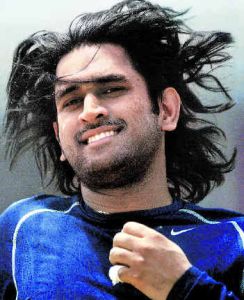
The Importance of Being a Mindblowing Mahiyah…

The Importance of Being a Mindblowing Mahiyah…

This is a question for the ladies. (Though of course, there might be some gentlemen who would like to be included as well, if yer know wot I mean.)
When was the last time you watched a member of the Indian cricket team and felt a gusty (lusty?) sigh escape from your lips as a large, purple, throbbing….(no, sorry boys, but it’s not what you are thinking) thought blurb balloon over your head with just one word in neon lights.
“Hottie!”
No, don’t answer just as yet because here’s question number 2.
When was the last time you spotted the aforementioned member (sorry again, fellas but not what you’re thinking) and wanted to tear out your kurti/hair/Wonder Bra in ecstatic handfuls and then faint dead away because you could not for another minute stand how utterly, devastatingly, to-die-for cute he was? Or because you couldn’t bear the delicious shivers of God-alone-knows-what doing the rumba-salsa-watusi up and down your spine (and whatuchmacallits) whenever he smiled that slow, lazy, doozie smile?
Don’t answer anyway because I know the answer.
You can’t remember. Nor can I.
But do not despair because the long, dark night is over. And as dawn gently breaks over the barren acres of the cutie-pie-less cricketing green, a single brave, blade of hope sprouts…

I have to admit though that the first time I noticed him was because of his name. It reminded me of a song, an old favourite….
“English people sleeping in the sun to get a tan,
Pouring oil upon their faces like a frying pan,
Funny thing about it is they all go rosy red,
Next day when the peeling starts they're crying in their beds.
Oh to be in England
Now that spring is here,
Oh to be in England, drinking English beer.”

After which the singer breaks into a delightful Anglo-Carnatic-gamaka refrain, which goes something like this.

“Dhani-dhani-dhani Dhoni-dhaani dhani-dhani-Dhoni-dhaani…”

So, every time the name cropped up – and it started to do so with increasing frequency because the chap seemed to be some sort of a rising star - that refrain would start to play inside my head and wouldn’t stop. So I thought to myself, who the heck is this Dhoni fellow…
(Blasphemous, you shriek. But I’ll have you know that small as our numbers may be, there are people in this country to whom the word “cricket” first means an kind of insect and then everything else.)

Anyway, I started looking out for “Dhani-dhani-dhani-Dhoni”, which wasn’t hard because he was all over the place. And I tell you, it wasn’t love at first sight.
You see, it was the hair, about which – Mushy’s remarks notwithstanding - I had very mixed feelings. Which were mostly “yuck” (those dirty-gold highlights always make me break into a rash) mixed with a few pinches of “okay-yuck-but-maybe-not-so-bad-and-anyway-it-grabs-your-attention”. But, even then, there was something about the fellow that was….
Dishy?
Cute?
I couldn’t put my finger on it because the hair really did come in the way.
Meanwhile, the dratted refrain continued to warble in my head.
“Dhani-dhani-dhani-Dhoni…”

Then, one hot summer’s night, it happened.
Not quite like the movie, but as far as I was concerned, what was draped so casually on that bar stool could give Clark Gable a run for his money, yumminess-ly speaking…
Oh dear, I’d better begin at the beginning, shouldn’t I?
The barstool was… no, not Saturday night at the Fire&Ice and no, I was not the gorgeous bar butterfly on the neighbouring stool that he couldn’t take his eyes off.
(In any case, I’ve heard the chap gets high on milk.)
It was on the sets of “India Questions”, Prannoy Roy’s show on NDTV on which the fellow was the guest and I was one of the thousands of potatoes watching the show from the comfort of my couch.
Roy’s introduction was gushing. There were comparisons to Sachin. (Just so that we are all on the same page, that would be Sachin, the cricketer, not the actor) There were grand references to the man changing the tide of the game. There was talk about a strike rate that would make even Adam Gilchrist blush.
Gilchrist who, I’m thinking. Isn’t he some Aussie batsman-type? And strike rate would be the number of times you hit the ball?
Just as I was sinking deep in vexed puzzlement and also wondering why the girls in the audience were simpering and fluttering excitedly as if Brad-Pitt-rolled-into-Matt-Damon (the latest Sexiest Man in the World) had just walked in, the camera slowly zoomed in on the Barstool….
To cut a long story short, lightning struck.
And the earth didn’t just move but for the next 45 minutes, it damn near did a cha-cha-cha to the 78-piece orchestra playing somewhere in the strawberry-cream-soaked distance.
It’s difficult to decide what is the sexiest thing about Mahendra Singh Dhoni.
Because he’s not the handsomest of men, nor does he have the greatest body (but more on that later), or the most money, power or any of the other blah-blah-blah that turn women on.

So, maybe it is how easy and comfortable he look in everything.
Success
Jeans (well-worn, workman blue and no-fuss, just the way I like it…)
Pressure
Dirty-goldilocks.
Female fans.
Acne scars. (Beats John Abraham’s by points.)
Jharkand-English accent. (I can’t decide which is cuter - the way he says “wut” for “what” or the way he peppers his sentences with “ki”.)
Or just in his skin.
Maybe it is that he sounds so real, such a regular guy, even when he’s dishing out those careful, politically correct answers at interviews.
Or that he likes bikes (he owns seven) and chocolates and ice cream. (Move over, all you metrosexual sissies. Mahisexual is here.) And subscribes to Gandhigiri – what else would you call looking Shoab Akhtar straight in the eye and giving him a big smile every time he tries to intimidate you on the field?
And talking of smiles, maybe it is that lazy, shy-cheeky, I-know-I’m-kinda-killer-cute grin that would melt Hitler on a bad moustache day.
Or maybe it’s that cool, clear, straight gaze which seems to unerringly home in on parts which other men don’t even know exist.

There comes a moment in a relationship when in a sudden, searing flash, you have a startlingly clear idea of how completely hook-line-and-sinker you have fallen. (But of course Mahi and I are in a relationship – that Padukone babe is just to keep the paparazzi at bay.)
For me, since that Barstool, there have been two.
The first was when he took off his shirt just after winning the Twenty20 finals. No, it was not because he took it off to give it to that little boy and made the entire female half of the nation swoon into an ecstatic “Cho-chweet!”. (I did too, but mine was a more restrained “Awwww!”). It was also not because shirtless, he confirmed what was hinted at in that biceps-hugging T-shirt on Prannoy’s show - great body. (Eat your six-pack, Shahrukh!) It was because he looked so completely unselfconscious about it. As if it was the most natural thing in the world to do your victory lap with your shirt off in full view of a 100 million people. (Give or take a few million.)

The second was at the felicitation ceremony at Wankhede stadium
Everyone including Sharad Pawar had just done their number in aamchi English or Queen’s Marathi. (In most cases, you couldn’t tell the difference.)Then, up walks our dashing lad and when Harsha Bhogle starts to trot out his questions in shudh Angrezi, don’t you know old sock, he announces that since he is a Hindustani, he’d like to answer in Hindi.

Clean bowled.

The ultimate measure of my goner status is that I recently shelled out 199 whole rupees to get my year’s subscription to the Neo Sport channel on my Tata Sky. And life in now jhingalala. In case you’re scoffing, “Piffle!”, I’ll have you know that this is from a person who last watched cricket when “match fixing” was something that Bishen Singh Bedi did to his beard. To whom ODI is something which Britney Spears lost the custody of her sons for doing and who thinks that mostly, cricket is about as riveting as a documentary on the dating habits of an amoeba.
Finally, I thought it might be worth mentioning that there was another Indian wicket keeper who was also famous for his pizzazz, hair (our first Brylcreem model), high cute-pie quotient and love for bikes.
Farokh Engineer.
I tried to make something deeply significant and meaningful out of that but couldn’t. Except, I’d like to say this much.
Man cannot live by bread alone. At least, woman can’t. So, every now and then, we need to have a fella around us who fills us with the insatiable urge to break through security cordons, fling (would “throw” be a more wantonly appropriate choice, I’m wondering?) ourselves on him and kiss him madly, deeply, thirstily before we are dragged away and thrown back to our ho-humdrum lives. More so if we are constantly going to have our KSBKBT’s interrupted by our Bonny Babas in Blue peddling champi-sabun, chaddi-baniayan and danth-manjan. So, you’d better make them cute and the cuter the better and I have to say this.
As far as Mahi goes, I can’t complain.
Gotta go now. Have to figure out what exactly it is that a wicket keeper keeps. I mean, I don’t see him watering those wickets or feeding them biscuits or anything….

Thursday, March 24, 2011

Gubbachi - The Fall of a Sparrow

This happens so often, doesn’t it? There are people you don’t know but who you see everyday – a woman at the busstop, the conductor on the bus, a vegetable seller, a watchman, a neighbour in the building opposite. Complete strangers but because you see them everyday, you take their presence for granted and after a while, you see them without noticing them. Then one fine day, you suddenly realize that you don’t see them anymore. You don’t know when it happened, but they seem to have just vanished. Which is when you begin to look out for them. And when they don’t reappear, you realise that they are gone. You miss their presence and wonder what made them disappear, where they could be right now etc., etc.

Which is exactly what is happening to this little creature. For thousands of years, it has followed us humans around this planet, setting up residence wherever we have and becoming so much a part of the landscape of our daily existence that the second half of its botanical name is “domesticus” which is the Latin word meaning "belonging to the household," (from the latin domus "house’.) Its full name? Passer domesticus. Or more familiarly as we all know it - the sparrow. (To distinguish it from its cousins - since there are around 35 varieties of sparrows - the official name is “house sparrow”). “Chidi” or “gouriya” in Hindi, “chimani” in Marathi and “ chittu kuruvi” in Tamil. But for me, it will always be “gubbachi”, the sparrow’s Kannada name, which, by its very sound, captures the endearing persona of this little bird.

There was a time not that long ago when sparrows were some of the most familiar sights and sounds all over India, in city, town and village. Busily bathing their plump little bodies in the dust. (Dust baths are how many birds to rid their plumage of lice and mites.) Noisily quarreling in nests somewhere up in the rafters or the attics. Excitedly pecking at grain in the courtyards of houses or in marketplaces, grain godowns, even cattle sheds and horse stables. And heralding the end of each day with a brief but cacophonous chirrup-concerto.
There was a time not so long ago when we thoughtfully scattered handfuls of grain for the sparrows to feed on. And according to Mr. Ragoo Rao, nature lover, wildlife enthusiast and long-time sparrow-watcher, no matter how much of a nuisance their droppings were and how untidy their nest building habits and no matter how randomly they chose the sites for their nests (sometimes behind portraits of dead ancestors or in the family grandfather’s clock!), sparrows were always welcome in homes because they were considered a good omen, the Brahmins amongst birds!

Alas, not anymore. Now, more likely than not, like that lady on the bus that you don’t see anymore, you try and remember the last time you saw a sparrow and wonder when and how they disappeared. Sadder still, ask a child or a teenager and they are likely to say, “Sparrow? What is that?” And the sparrow seems to have disappeared not just in India, but across the world, especially in Europe. In Netherlands, the decrease in the sparrow population – according to one estimate, as much as 50% – has prompted this little bird to be declared an endangered species. As it has been in Britain, where the sparrow once used to be such an integral part of the English landscape that it is also called the English sparrow. 30 years ago, 12 million pairs nested in Britain. Today there are no more than 7 million pairs. In London the statistics are even more depressing. In Kensington Gardens, 2,603 house sparrows were counted in 1925. In 2001, just 4 males were left and by the following summer, they had altogether disappeared. By the beginning of the new millennium, the sparrow had virtually vanished from London’s beautiful parks. (Source – The Christian Science Monitor, December 27, 2002)

“I haven’t seen a sparrow in a long time, though my garden has over 80 different kinds of birds." Delhi Chief Minister Shiela Dikshit at the inauguration of ‘Quotes from the Earth’ New Delhi, 04/11/2006
And in India? Well, while we’ve all noticed that we don’t see sparrows anymore, nobody really knows how serious the problem, primarily for lack of any organised bird count. Why? I guess the reasons are many. For one, though it seems like it, the sparrow hasn’t really disappeared altogether. Records of recent sightings have trailed the sparrow in many parts of South India and all along the Western coast, from Kerala through Karnataka, some parts of Maharashtra, Gujarat and Rajasthan, right up into Himachal Pradesh, Jammu & Kashmir even Ladakh. Sightings have also been recorded at various animal sanctuaries like Bandipur in Mysore, the Corbett National Park, Periyar and Ranthambore National Park. But perhaps what is most heartening is that though not seen anymore in many big cities like Bangalore, Coimbatore and Hyderabad, it can still be seen in places like Mumbai, Pune, Ahmedabad, Agra, Cochin etc.
(Source : Indian Wildlife section of Wikipedia - http://www.wildindia.org/birds/viewid.php?bird_id=856 and Aasheesh Pittie, editor, Indian Birds)

According to the IUCN Red List of Threatened Species, the sparrow is still a species of “Least Concern’ i.e. it has the lowest risk of extinction and continues to populate our planet in abundant numbers. So, things are not that bad for the sparrow - as yet.

But perhaps the other main reason for the blurry picture on the status of the sparrow in India is that the disappearance of this little Plain Jane of birds is not glamorous enough to be a “cause”. It’s fashionable to be concerned about the vanishing rain forests of Amazon. (Ironic, when as much harm is being done to our very rainforests in the Western Ghats, listed as one of the world’s 25 biodiversity hotspots!). It’s politically correct to worry about the extinction of the Ridley turtle and the lion-tailed Macaque monkey. But the sparrow – I mean, ho-hum. Isn’t that a bit like worrying about the extinction of the hen or the housefly?


"When I first started studying the sparrow just after the (Second World) War, most of my colleagues didn't think it worthy of even being called a bird. Now it is a high-profile bird." Dr. Denis Summers-Smith, world renowned expert on sparrows.
Be that as it may, the question still remains - do we know why the sparrow is vanishing? Theories abound. (It all started between the two world wars, when the motorcar ousted horse-drawn transportation off the roads, taking away sparrow food, which was the grain spilt from horses’ nosebags or what was left undigested in dung.) Everything from cats, pesticides, global warming, changes in urban architecture that have taken away natural sparrow nesting sites for the sparrows like gables, attics and tiled roofs. Some even blame it on mobile phones (see box). But none of these theories have been supported by conclusive evidence. So much so that in 2000, Britain’s The Independent newspaper announced an award of 5000$ for anyone who could come up with “first properly accepted scientific answer”. Though the award was never claimed, according to Dr. Dennis Summers-Smith, the world expert on sparrows who was on the newspaper’s panel of judges for the award, the most plausible explanation came from Kate Vincent, a post-graduate researcher at De Montfort University, Leicester who studied the sparrows’ breeding habits for 5 years as part of her Ph.d. thesis. Her conclusion was that the sparrow’s decline was largely because their chicks were starving to death!

You see, adult sparrows are granivorous birds - they live on grain and other seeds. But in the first few days of their lives, they feed exclusively on insects. Which just aren’t available in sufficent quantities anymore, especially in urban environments either because there aren’t enough gardens and greenery. Or then, because ironically, these insects may have become the victims of the very thing that is supposed to help save the environment – unleaded petrol. According Dr. Dennis Summer-Smith, there is a possibility that the byproducts of combusting unleaded petrol are toxic substances that kill off insects. (Though even he says that this is “highly speculative and highly circumstantial"!)
And thousands of miles away from Europe, in my hometown of Mysore, Mr. Ragoo Rao, who has been studying the decline of the sparrow since 1988, has come to similar conclusions. That one of main reasons for the disappearance of the sparrow – even from the beautifully lush, green Mysore suburb that he lives in - is because the chicks just don’t have enough insects to feed on. (Lack of grain for adult sparrow to forage on and loss of nesting habitat are the other reasons that he sites.)

“I once had a sparrow alight upon my shoulder for a moment, while I was hoeing in a village garden, and I felt that I was more distinguished by that circumstance that I should have been by any epaulet I could have worn.” Henry David Thoreau

Right. So there aren’t as many sparrows as there used to be. But what is all the to-do about? If there are a few less sparrows, will the Gangotri glaciers melt away? Or the Brahmaputra dry up? Perhaps not in our lifetimes. But the fact is that such is the immeasurable complexity of that immense circuit board that we call Nature that our knowledge of how it functions is probably equal to how much a person with 20/500 vision can see. For example, alarm bells about the effects of global warming have been ringing loud and clear for a long time now. But nobody could predict that in the Monteverde cloud forests of Costa Rica where the gorgeous harlequin frog has thrived for at least a million years, the increase in temperature would make a fungus to flourish that would cause the skin of these frogs to lose its porousness and make them die of dehydration. The last time Alan Pounds, an ecologist who has studied these forests for 25 years, saw harlequin frog was in 1988. So nobody knows the fallout of the decline or extinction of a species however seemingly inconsequential and however abundant in numbers. Or what would be the impact if the sparrow does vanish. (Source : Newsweek, October 16, 2006)
But, to quote from Shakespeare’s Hamlet, “there is a special providence in the fall of a sparrow..…”
In 1906, a small boy, just eight or nine years old wrote his very first bird note. It was about his observations of the sparrow. About a year later, it was his hunt for the identity of another little bird (“it looked like any other female sparrow I sometimes got except that it had a yellow patch on the throat, like a curry stain”) that he and his mates had shot down in a schoolboy prank that took this boy to visit the Bombay Natural History Society. The bird was the Yellow Throated Sparrow and it was a providential visit. Because it kindled in the boy a passion for birds that burned so steady and so bright that he went on to be known as the “Birdman of India” and one of the world’s most renowned ornithologists. His name? Dr. Salim Ali. And so, it was but natural that almost 80 years after his first bird note, when Dr. Ali wrote his autobiography, he titled it The Fall of the Sparrow.
And perhaps there is a special providence in the decline of the sparrow….
Think about it. It is not that long ago that tigers and elephants and hippos and orangutans were so abundant on this planet that we thought nothing of decimating their numbers, much less that one day, there would be the very real possibility of their extinction. If the orangutan disappears from the forests of Borneo and Sumatra, the Nasdaq will not collapse. Nor if the tiger vanishes from the mangroves of the Sunderbans. But these terrible possibilities is making us - however dimly - to comprehend that with every animal that becomes extinct, we disconnect a very important wire in the ecosystem that is ultimately connected to our own existence. The destruction of any species is another death knell for us and the planet. So, perhaps there is a special providence in the fall of the sparrow. To remind us that
“Each man's death diminishes me,
For I am involved in mankind.
Therefore, send not to know
For whom the bell tolls,
It tolls for thee.” (John Donne)
For now, as millions of little gubbachis still continue to add their bird song to the music of this sphere, I end with these beautiful lines from a 1905 Negro Spiritual written by Civilla D. Martin.

I sing because I'm happy,
I sing because I'm free,
For His eye is on the sparrow.
And I know He watches me.

(With grateful thanks to Mr. Aasheesh Pittie, editor Indian Birds and Mr. Ragoo Rao)

******
Blame it on your mobile
According to Dr S. Vijayan, Director of the Salim Ali Centre for Ornithology and Natural History (SACON), a number of studies conducted indicate a positive correlation between the increase in electromagnetic waves and the decrease in the number of sparrows. (“More mobiles, and sparrows take flight” by Ambarish Mukherjee; Business Line, Nov. 30, 2003)


*****
France’s Beloved Little Sparrow
She was not just France’s most beloved singer and a national icon, but an international star whose signature song "La vie en rose" was voted into Grammy Hall of Fame Award, 52 years after she popularised it in 1946. When she died in 1963, just 47 years old, her funeral procession in Paris was the only time, since the end of World War II, that the traffic came to a complete halt. She was discovered in 1935 by Louis Leplée, the owner of a Parisienne nightcub and her dimunitive (4’’8’) and extremely nervous persona prompted him to give her the nickmae. name La Môme Piaf . She kept part of that name and became known to the world as Edith Piaf. Piaf in Parisian jargon means "sparrow".

Did you know
…that because the sparrow’s double call sounds like the word “phillip” it was once also called the "Phillip Sparrow"?
….that more than 50% of all bird species accounting for around 5,400 species are called passerines, getting their names from Passer Domesticus. Or the little House Sparrow.)

Saturday, January 15, 2011

What Legends are for–Bhimsen Joshi

(Wrote this a few years ago when Joshiji had come to perform in Mysore)

“The marvellous richness of human experience would lose something of rewarding joy if there were no limitations to overcome. The hilltop hour would not be half so wonderful if there were no dark valleys to traverse.” Helen Keller

A fortnight ago, Pandit Bhimsen Joshi performed at a concert here in Mysore. So, you’re thinking that this article has strayed here from the Arts and Entertainment section. Not so, not so, dear reader. Because the point of this piece is not music at all, but ….well, let me get straight to the point without much ado.
It was a beautiful, balmy evening, the kind that Mysore is known to tot out proudly, especially during this time of the year because it’s an old tradition and because we know that it’s kind of expected as part of our famed Dussera festivities as much as Balarama the elephant and the golden howdah and the fairy lights on the Mysore Palace. The venue was the Centenary Hall, a heritage edifice of noble proportions that we are as proud of as we are of the weather. The concert was supposed to start at 6 p.m. but what with the holiday mood and everything, it was sort of understood that 6 p.m. was IST or Indian Stretchable Time. But even by this timekeeping, the hall was almost full by 6.30 and there was now an air of eager expectancy as we waited for the maestro.
7 pm: one whole hour past the official starting time of the concert and a bit of a stretch even for us easy going Mysoreans but it was after all both Dussera and a Sunday evening and many of us had anyway got in only about half an hour ago and the organizers had made an announcement that had the reassuring mention of “5-10 minutes” somewhere in it. And so, every one settled into their seats and the air of expectancy stirred itself up again and permeated the hall like a gust of Mysore mallige fragrance….
8 pm: Now, even we were a bit annoyed. The next “coming-shortly-expected-anytime-now-almost-here-please-bear-with-us” announcement was greeted by a ripple of grumbly mutterings and an irate member of the audience got up to make a rather emphatic point about the organizers’ inability to get things together on time. Fortunately, many of us among the audience clutched a card on the reverse of which was a brief life sketch of Pandit Bhimsen Joshi. And so even as we clucked our tongues about the lateness of the hour, we also clucked them indulgently and sympathetically, making allowance for over half a century of a brilliant musical career and a life of 82 long years that must sit heavily and cruelly on a man’s shoulders, however great a legend he may be.
8.15 pm: Finally, the rustle of excitement which told us that Pandit Bhimsen Joshi had indeed arrived. Through one of the open side entrances, I sighted a clutch of people rushing towards the stage entrance and amidst that clutch, somebody being wheeled in wheelchair. Oh-oh, I thought - two hours late, 82 years and in a wheelchair. This doesn’t augur well for the evening ahead. The now much relieved organizers started to make their various announcements and speeches. But nobody was paying much attention to that because we were riveted by the onstage activities. The instruments came quickly in place, along the accompanists, all on a large, low platform. And as the sound checks were done,  a little peculiar looking bright red thing was placed on the platform – a sort of a cross between a legless chair and a throne, the sort that some sadhus and godmen tend to favour. Two hours late, 82 years, in a wheelchair and now he needs help to sit? This really doesn’t look promising, I thought to myself worriedly.
Then, it was time. Another agitated rustle and as the organizers hovered and fluttered like worried hens, a tiny shrunken figure leaning heavily on a cane and helped by two men came onstage. There was a spontaneous standing ovation from an audience that had been waiting for him for over two hours - a measure of his past glory. But was that all past, many must have wondered, as he made the excruciating progress across the ten feet or so to the funny red throne-baithak. He needed help to sit; one man arranging his feet like you would a doll in a show window. Soon he was “ready”. I stared at the unmoving, wizened little version of Pandit Bhimsen Joshi apprehensively. Why does he need to do this, I thought? He is already such a colossus and can well afford to rest on his laurels. Why would he expose this pitiful reduction of himself to the world? How could anyone in this physical condition even speak, let alone sing a 2-3 hour classical music concert? The tanpuras began play and as he got them tuned and the sound playback adjusted to his satisfaction, waving his arms up and down – I saw a spark splutter somewhere. But was it enough? Would he really be able to pull this off after all?
Finally everything was set. A quiet hush descended on the audience. Pandit Bhimen Joshi bent a little towards the mike and folding his hands in a namaskara, rumbled in the famous rumble. It was in chaste Kannada, impossible to translate but loosely, it went something like this. “I humbly beg for your forgiveness for being late. The reasons are not important. That I am late is. Please forgive me.”  
With that, he had us. Wave after wave of appreciative applause washed over the auditorium. After that, even if he did not single a single note straight, it wouldn’t have mattered because he already had our hearts.
Then, he began to sing. Slowly, painfully.  The high notes still impressive but the low notes were painful to hear – barely audible and hoarse. This, from a musical legend who was known to roar masterfully across 3 octaves?  Then, almost magically, the voice began to totter and stagger up like a new-born calf and before we knew what, the legend was back, filling the exquisite night air with his powerful, awesome voice.
Like many people in the audience that evening, I didn’t know what exactly he sang. That the hauntingly beautiful opening bade khayal was in his favourite, signature Puriya Dhanashree followed by its sparkling, enchanting little sibling which went, “Paayaliya jhankar…” I did not know then that what followed was a lovely dadra in Raga Khamaj. Somewhere in between, I gratefully recognized the soaring, inspiring Vadirajaru composition “Hari bhajane maado nirantara”, part of a whole repertoire of Daasaru kirtanas that he had made hugely popular in Karnataka by singing them in his own inimitable style, breaking away from tradition. I didn’t know that the second incredibly sweet bada khayal was in Raga Jaijaiwanti, followed by a pretty, delicate composition in the same raga – “jhanana jhanan jhanan paayal baje.” . But none of that mattered. Because, when more 2 and a half hours later, he ended with the exquisitely simple but stunningly profound Sant Namdeo abhang, “Teerth Vitthala, Kshetra Vittala” in Raga Jogia Mishr, we couldn’t have asked for anything more. We had been transported, moved, delighted, amazed, astonished, entranced and enthralled.
Which makes it time to give you a little background to this concert. The previous evening, Pandit Bhimsen Joshi had performed a jugalbandhi with Dr. Balamurali Krishna in Bangalore. The journey from Bangalore to Mysore is a gruelling 4-hour one, which he must have made only on the next day or the morning of our concert. He is an 82-year old man who, according to one report, is hard of hearing, has failing eyesight, a weak heart, and underwent a crippling surgery for a benign brain tumour a few years ago. Which brings us to that same question. “Why did he need to do this?” He won his first platinum disc in 1986 and has won every possible accolade including the Padma Bhushan. 
The answer is very simple. To do what legends are meant to do. To inspire us. That nothing is insurmountable. Nothing. That nothing is more powerful than the human will. Nothing. That the true victory over disease and physical debility is not necessarily its cure but in finding the strength to carry on despite it. That we have choices– not in what happens to us but in what we make of it.
I have no clue what drives Pandit Bhimsen Joshi to still keep performing. It doesn’t matter. What matters is that I – like perhaps so many others - will never forget the lessons of endurance, indomitable will and sheer, true grit that he taught us that evening.
Just for the record, he performed again the very next evening at the Mysore palace.

Wednesday, December 29, 2010

Year of the Book #45 Raymond Chandler


"Everything a writer learns about the art or craft of fiction takes just a little away from his need or desire to write at all. In the end he knows all the tricks and has nothing to say."

With each passing day of this Year of the Book, I am more and more relieved to know that the notion that writing is one of the hardest things in the world to do, not to mention the loneliest is shared by many writers other than me!

“Hard-Boiled” is the phrase that many have used to describe both Raymond Chandler’s style of writing and the private eye Philip Marlowe who is the protagonist in his novels. But they were admired by writers as varied as W.H.Auden and Ian Fleming and Camus. They also gave birth to the hard-bitten, cigarette-at-corner-of-the-mouth, heart-of-gold hero of American films, epitomized by Humphrey Bogart who played Marlowe in the film adaptation of Chandler’s novel The Big Sleep.

http://www.nysun.com/arts/man-who-gave-us-marlowe/65983/

If you can cut past the poor quality of the recording and Ian Fleming’s British accent, listen to this interview that he did with Chandler

Tuesday, December 28, 2010

Year of the Book #44 O. Henry

“Rejections? Lordy, I should say I did have rejections, but I never took them to heart.”

Did you know that the phrase “banana republic” was coined by William Sydney Porter – which was O.Henry’s real name – in Cabbages and Kings, a book he wrote in Honduras where he hiding from the law who want him for trying to embezzle the bank where he had worked as a teller.

Wow.

Actually, why am I wasting my breath. Because, if you want to meet the master of the short story, the man who wrote The Gift of the Magi and The Ransom of the Red Chief, if you want insights into the art of stotytelling straight from the Henry’s mouth, as it were, read this incredible interview with him done by the New York Times in 1909. (O Henry died a year later.)

“’ll give you the whole secret of short story writing. Here it is. Rule I: Write stories that please yourself. There is no Rule II. The technical points you can get from Bliss Perry. If you can't write a story that pleases yourself you’ll never please the public. But in writing the story forget the public…” 

http://www.greensboro-nc.gov/departments/Library/ohenry/Public+Library/on+himself.htm

http://www.auburn.edu/~vestmon/Gift_of_the_Magi.html

Monday, December 27, 2010

Year of the Book #43 Benjamin Alire Sáenz


imageI did not know of the existence of Benjamin Alire Sáenz till this evening when I was desultorily surfing poetry sites. Come to think of it, I don’t even know how to pronounce his last name.

All I know is that I found this poem and I was hooked

http://www.poets.org/viewmedia.php/prmMID/21689

According to various bios,  Benjamin Alire Sáenz was born in New Mexico, spoke only Spanish till he was in elementary school, yet has done all his writing in English. He studied theology, was a Catholic priest for 3 years. He also won a slew of awards including the American Book Award in 1992 for his first book of poems, Calendar of Dust, the Paterson Prize, and the Americas Book Award…


“I did not grow up speaking English—though English has become my dominant language. I have struggled with words and language all of my life. I have learned that language is used to dominate people. I have learned that every language is a way of translating the world and that no language translates the world without a particular bias. It is difficult for me not to dismiss writers who do not understand the political nature of language. Like everything else, language is a weapon that can be used for ill or for good. “


http://www.benjaminaliresaenz.com/index.php


All of which is great. But as far as I am concerned, what matters is if you can write a love poem which other will read and think – will someone one day love me like that? Apparently Benjamin Alire Sáenz  can….


To the Desert


I came to you one rainless August night.

You taught me how to live without the rain.

You are thirst and thirst is all I know.

You are sand, wind, sun, and burning sky,

The hottest blue. You blow a breeze and brand

Your breath into my mouth. You reach—then bend

Your force, to break, blow, burn, and make me new.

You wrap your name tight around my ribs

And keep me warm. I was born for you.

Above, below, by you, by you surrounded.

I wake to you at dawn. Never break your

Knot. Reach, rise, blow, Sálvame, mi dios,

Trágame, mi tierra. Salva, traga, Break me,

I am bread. I will be the water for your thirst.

Sunday, December 26, 2010

Year of the book #43 Ed McBain

You know, I’m sitting here writing this and thinking – why in the heck’s name isn’t there Ed MacBain in my bookshelf? I don’t know why but it doesn’t in anyway diminish the fact that if there is any mystery writer who I would allow to argue for space in the  Best Crime Writers Ever section with Agatha Christie and Dorothy L Sayers, it would be Ed McBain (1926-2005)image

Or should I say “Evan Hunter”? Or then his real name - Salvatore Lombino?

When I started reading McBain, I didn’t know that he had more than 130 books to his credit, that at the height of the popularity of the 87th Precinct series, he published two novels a year, that he was awarded the Mystery Writers of America Award AND the Grand Master Award, Mystery Writers of America, 1986, for lifetime achievement and was the first American to receive the British Crime writer’s Association Cartier Diamond Dagger.

Or that he wrote the screenplay for Alfred Hitchcock’s film BIRDS…

image

http://www.mysterynet.com/hitchcock/mcbain/

All that I knew is that every time I opened a McBain book, to pinch a line from Jerry Maguire, he had me from the very first line…

It wasn’t that the criminals were more devious or the crimes more ghastly or even that the detectives were more clever. In the words of Nick Kimberely of the Guardian…

“the novels are best considered as an immense saga in which the dilemmas of modern life are played out, but varied with tremendous narrative vigour. Or perhaps they constitute a love-letter, millions of words long, to the city: New York City first of all, but the American city in general."

http://januarymagazine.com/features/mcbainintro.html

This opening para from JIGSAW should make my point.

Detective Arthur Brown did not like being called black

This might have had something to do with his name, which was Brown. Or his color, which was also brown. Or it might have had something to do with the fact that when he was but a mere strip of a boy coming along in this fair city, the word "black" was usually linked alliteratively with the word "bastard." He was now thirty-four years old and somewhat old-fashioned, he supposed, but he still considered the word derogatory, no matter how many civil rights leaders endorsed it. Brown didn't need to seek identity in his color or in his soul. He searched for it in himself as a man, and usually found it there with ease.

He was six feet four inches, and he weighed two hundred and twenty pounds in his undershorts. He had the huge frame and powerful muscles of a heavyweight fighter, a square clean look emphasized by the way he wore his hair, clipped close, clinging to his skull like a soft black cap, a style he had favored even before it became fashionable to look "natural." His eyes were brown, his nostrils were large, he had thick lips and thicker hands, and he wore a .38 Smith & Wesson in a shoulder holster under his jacket.

The two men lying on the floor at his feet were white. And dead.

If you aren’t already hooked, go to http://www.edmcbain.com/default.asp

It’s rare to find a website on a writer as comprehensive and as interesting as this one – and the best part, is you can peep inside many of the books!

Shiva’s Ambassador


Basava the Bull. Shiva’s favoured mode of transport. In Karnataka, he visits our homes ever so often as “Kole Basava”, the spectacularly decorated bull, accompanied by his musician-minder. Sometimes, he just stands mutely, waiting to be rewarded for his presence with anything from a lump of jaggery and a handful of roasted gram to money. (The musician minder prefers the money!)

Sometimes, he will foretell the future, nodding or shaking his head when the minder asks him a question on our behalf. (A few surreptitious tugs of his bridle makes his answers what we want to hear. “Will Amma’s daughter be married by Ugadi?” “Yes, yes, yes"!!” he answers in three emphatic nods!)

And sometimes the musician minder will play a beautiful tune on his folk-nadaswaram. My favourite? “Bhagyada lakshmi Baramma”!

Saturday, December 25, 2010

Year of the Book #42 LEWIS CARROLL

imageSometimes, a writer or a poet looms so large on the literary landscape, that to attempt to say something meaningful about him/her in anything less than a full blown thesis would be foolishness. (Wikipedia not withstanding.)

Lewis Carroll is one of them. Or if we are to go by his real name - Charles Lutwidge Dodgson. So, today, I focus on some of his non-literary achievements

Mathematician & Logician  – Working in geometry, algebra, logic (including symbolic logic) and what we today call psephology, Lewis Carroll wrote at least a dozen books on the subjects, under his real name

Inventor – Among Carroll’s inventions is the nyctograph, a device by which you can write in the dark, without having to switch the light on. This is my favourite because I’ve lost count of all the poems and the ideas that I thought I had neatly stored away in my about-to-fall-asleep brain and couldn’t remember a word of the next morning!

Photographer – His mastery of this art also brought him some notoriety. The many photographs of nude or semi-nude little girls led to many researchers speculating that Carroll was a paedophile

image

http://sites.google.com/site/photographyoflewiscarroll/

http://en.wikipedia.org/wiki/Lewis_Carroll#Suggestions_of_paedophilia

End I must with Lewis Carroll the Poet. In fact, his first piece to be published under the name of “Lewis Carroll” was a poem titled Solitude!

Many like Jabberwocky, The Walrus and the Carpenter, You are old, Father William are part of the Alice books, but many like Phantasmagoria and this whimsical poem are not…

image

A Sea Dirge by Lewis Carroll

There are certain things--as, a spider, a ghost,
The income-tax, gout, an umbrella for three--
That I hate, but the thing that I hate the most
Is a thing they call the Sea.


Pour some salt water over the floor--
Ugly I'm sure you'll allow it to be:
Suppose it extended a mile or more,
That's very like the Sea.


Beat a dog till it howls outright--
Cruel, but all very well for a spree:
Suppose that he did so day and night,
That would be like the Sea.


I had a vision of nursery-maids;
Tens of thousands passed by me--
All leading children with wooden spades,
And this was by the Sea.


Who invented those spades of wood?
Who was it cut them out of the tree?
None, I think, but an idiot could--
Or one that loved the Sea.


It is pleasant and dreamy, no doubt, to float
With "thoughts as boundless, and souls as free":
But, suppose you are very unwell in the boat,
How do you like the Sea?

There is an insect that people avoid
(Whence is derived the verb "to flee").
Where have you been by it most annoyed?
In lodgings by the Sea.


If you like your coffee with sand for dregs,
A decided hint of salt in your tea,
And a fishy taste in the very eggs--
By all means choose the Sea.


And if, with these dainties to drink and eat,
You prefer not a vestige of grass or tree,
And a chronic state of wet in your feet,
Then--I recommend the Sea.


For I have friends who dwell by the coast--
Pleasant friends they are to me!
It is when I am with them I wonder most
That anyone likes the Sea.


They take me a walk: though tired and stiff,
To climb the heights I madly agree;
And, after a tumble or so from the cliff,
They kindly suggest the Sea.


I try the rocks, and I think it cool
That they laugh with such an excess of glee,
As I heavily slip into every pool
That skirts the cold cold Sea.

Goodbye, Atlaji!


Move over Bacchan, the new Abby is here.
When Mr. Vajpayee became PM the first time around in 1996, I remember listening to a scoop of sorts pulled off by Radio Mid-Day called “The PM on FM”. The Prime Minster of India talking about his favourite Hindi film songs. And as I listened, I was smitten. A man who could be moved by the poignant beauty of Bahadur Shah Zafar’s Lagta nahin hai dil mera, who had imagination to make Mere pairon mein ghungroo bandha de, toh phir meri chaal dekh le his campaign promise deserved my undying devotion. I’ve remained a bug-eyed fan ever since. But yesterday, as I read  his name in a newspaper, it hit me! Yes, girls, it’s finally happened. There’s a new Abby Baby on the block and he’s the PM.
Atal Behari. Apart from his initials, other qualifications to be the next Dhak-Dhak of India? Several. Tall(ish), dark(ish),  handsome(ish), a full, distinguished head of sexy, silvery hair, (no hair weaves, no dyes). Not Young (a mature seventy-one) but Angry (he asked Lata Mangeshkar about Aye mere watan ke logon -  “Aankh mein pani hum kyon bharen? Ankh mein angare hona chahiye”). There’s more. Intelligent, charismatic, telegenic. Makes great speeches, writes even better poetry, has the cutest twinkle in his eye, and is a spiffy dresser in the best dhoti-kurta tradition. And the icing on the cake? He’s single. (And willing to mingle, if we go the long list of  BJP allies including an impressive list of  power babes- Sushma, Uma, Jaya, Mamata.).  So….well, what can I say? Move over Amit, Atal is here (Atalji to you hoi-polloi, Atal to me).
Atal’s most endearing quality is that he comes across as human. Versus Sphinx (Sonia), Yeti (Kesri), Miss Piggy (Narsimha Rao), Winnie the Pooh (Gujral) and Rip Wan Winkle (Deve Gowda). He’s a regular guy like you and me. He likes the good life, (kheer and malpua and Chinese food), appreciates a good flick and is partial to a good tune. But most importantly, he has a sense of humour. I willing to trust anyone who has a sense of humour, and by that I don’t mean the kind when you crack up after you’ve just pulled the political rug from under your opponent’s feet and watched him break at least three ribs. True, the political company he keeps sucks. Jayalaitha, Murli Manohar Joshi, Subramaniam Swamy, Sanjay  Singh, dear ol’ Georgie-Porgie.  But look at what’s in the other witches’ cauldrons. Mulayam Singh, R. K. Dhawan. Laloo. Deve Gowda. Karunadhi. Bubble, bubble, toil and trouble and how!
Drool apart, Vajpayee’s the most decent PM material we’ve had in a long time. There’s not too much the average Indian wants out of that august office today. Just someone who we can trust not to demolish this country any further, who has highest coefficient of least-corrupt-most-competent, and has a fairish chance of sticking around for five years. I think Attu shows healthy signs of being capable of all this. We finally have a PM who doesn’t go to sleep while the desh goes down the tube, (Nero just fiddled and those Dilip Kumarish pauses in between sentences are scary sometimes), doesn’t look like a leftover from Dino the Dinosaurs’ dinner and has a little more spine than your average jelly fish. And is cute to boot.
Let me sum it up. What was Atal’s rallying song to his party workers? “Jo wada kiya tha, nibhana padega” My response? “Jab ishq ka sauda kiya, phir kya ghabarana  humko aana padega.” So let’s give him a chance. After all,  if we can let Amitabh act after Mrityudaata, Atal deserves a second bash at PM-giri. Long Live Abby Baby.

Thursday, December 23, 2010

Year of the Book #41 DYLAN THOMAS

If you want to fall in love with words, not for what they mean but for how they sound, as if they were music, read Dylan Thomas (1914-1953).

Rather, hear him.

“The first poems I knew were nursery rhymes, and before I could read them for myself I had come to love just the words of them, the words alone. What the words stood for, symbolised, or meant was of very secondary importance -- what mattered was the very sound of them as I heard them for the first time on the lips of the remote and quite incomprehensible grown-ups who seemed, for some reason, to be living in my world. And those words were, to me, as the notes of bells, the sounds of musical instruments, the noises of wind, sea, and rain, the rattle of milk carts, the clapping of hooves on cobbles, the fingering of branches on a window pane, might be to someone deaf from birth, who has miraculously found his hearing.”

image

Only someone to whom words meant this could have written Under Milk Wood, interestingly enough, not a poem but a radio play in which the main character’s name is “Llareggub”. Which while it may sound very Welsh is actually “Bugger All” spelt backwards

Dylan Thomas’ Voice http://youtu.be/YzyovVVCMP4

Richard Burton’s Voice http://youtu.be/YzyovVVCMP4

“Musical lyricism” is a phrase often used to describe Dylan Thomas’ style of writing and so, little wonder that his public readings of UnderMilkwood and  poems like Don’t Go Gently Into the Night that brought him – especially in America - as much adulation as the writing itself.

http://www.poets.org/poet.php/prmPID/150