Monday, February 06, 2012
"Roz, roz,rozy..."
I admit it. I am a sucker for roses. (And my bet is that most women are.) I know. It’s a bit like saying I love French fries or money, but there’s something about the damn things that is irresistible. Now, I don’t want to throw history at you and defend myself by saying that some of the most gorgeous women that the world has had the pleasure to know and see wouldn’t leave home without their roses. Cleo (Cleopatra to you) used to routinely spray the sails of her barge with rose water and as one story goes, when she was in the process of seducing Mark Antony, she had her palace floors carpeted and her room filled two feet deep with red rose petals. And we all know what happened to that poor Mark….
So women have surrounded themselves with roses in one way or another for centuries. To seduce and be seduced. But what’s the big deal about this relative of the apple? (Yup, members of the rose family number more than 3,400 species of trees, shrubs, and herbs including apples, pears, berries, peaches, apricots, plums, and cherries.) Well, look closely at a rose and you’ll know the answer. Look at the way the petals are arranged in exquisitely complicated whorls, see how even the palest pink or lemon deepens mysteriously inside each whorl, hinting that it is hugging some enchanting secret. And at the centre, even when the rose is in full bloom, there is a core that never unfurls completely, tantalizing you with the promise that inside there might be something even more gorgeous. Something, the petals coyly whisper in their velvety tongues, that will have to be wooed and flattered (not to mention wined and dined) out into the open and even then, you may or may not get the full story. And no two roses are alike. So no rules, please, expect only the unexpected, each rose choosing for itself how many petals to have, how to arrange them and in what manner to bloom and blush. In other words, every lovely blossom a custom made job - the fragrant mascots of Caprice, created by Nature on her day off, probably after a glass or two of honey mead.
Er, did somebody mutter, “just like a woman…”? Absolutely. Just like a woman – a heady, beautiful bafflement that got Adam kicked out of Eden, destroyed the tapasya of even the mighty Vishwamitra, sunk poor Paris’ ships – all 1000 of them, toppled empires and has generally been the reason for managing to squeeze in both Hell and Heaven right here on Earth. Which means that when you send a woman roses, that’s roughly what you are telling her. That she is this gorgeous, irresistible, enchanting, elusive, sexy goddess-siren-nymph-babe whom you will follow to the end of the world, walk on hot coals for and will her your millions. You get my drift? So, when we say we love roses, what we really mean is we like being sent roses. And let me tell you that as an attention grabber, (and we admit that we are easily distracted) it’s foolproof. So fellas, never mind if your idea of an inspired opening line is a grunt that roughly sounds like, “Er, how about it?” or “Wanna hit the sack?” Never mind if your idea of romance is tinkering around together under the hot, stinky, greasy bonnet of your car, swilling beer. Never mind if you think that poetry is for chaps who tweeze their eyebrows and wear lavender coloured underwear. (Yeah, yeah, you’ve heard all about the Metrosexual Male but you’re not falling into that sissy-trap!) And never mind if she’s a dead ringer for Liz Hurley (oh, alright, Heidi Klum, if you must quibble) and the chauffeur of the guy she’s dating probably makes in a week’s overtime what your 6 months’ salary totals up to. Don’t despair. Just send her a few dozens red rose - long-stemmed, naturally. (With roses, I’m afraid it has to be in dozens.) And then see if you don’t get into her little black book, so what if it’s in the “Call only on Emergency” section.
A word of caution. If you are planning to send her anything more than 2 dozen, (anything less than that and you might send her a plastic fly swatter) check to see if they don’t tot up to a number that’s roughly her age. Because even though it’s the Age of the Older Woman - Liz Hurley is 38, Aishwarya Rai is 30, Naomi Campbell is 33 - you don’t want to look like you’re pointing fingers at something that she might be sensitive about. If it is, then just double the dozens. So the 3 dozens you were planning on become 6 and so on and so forth. That way, you’re nowhere near her age (unless of course it’s the other Liz that you had in mind who’s now a lovely 72) and no woman is going to pass up a man who sends her 6 dozen roses without at least a second cup of coffee.
I know what you’re thinking. You’ve heard the whispers. About diamonds. Girl’s best friend, Marilyn breathily cooed (and she should know a thing or two), Liz notched up at least 150 carats of them over 7 husbands (8 if you count the second walk down the aisle with Richard Burton), Oprah wears them all the time and you’ve trying not to notice the way your ol’ lady pointedly clears her throat every time those pesky de Beers and Nakshatra ads come on. (5000 bucks for that tiny speck of coal, just because they polished it up?!) We know what you’re asking. If you send her 60 roses (she’s 35 …or thereabouts) on that dratted anniversary-birthday-who-the-heck-knows-what that’s creeping up on you, will it pass muster? Er, let me put it this way. She won’t be displeased and it will definitely not be the night when she’ll have a headaches.
But.
Roses are roses. And as eternal a paean to our inner goddess they will remain, here’s the thing. Roses wilt. Diamonds, on the other hand, are kinda forever and we women are rather partial to this “forever” business, especially since men aren’t. Which means, we love you and can’t imagine life without you but we trust you only when you put your mouth where your money is. So roses are lovely but when it comes to the crunch, I guess it will have what Dorothy Parker has to say on the subject…
A Perfect Rose
A single flower he sent me, since we met.
All tenderly his messenger he chose;
Deep-hearted, pure, with scented dew still wet--
One perfect rose.
I knew the language of the floweret;
"My fragile leaves," it said, "his heart enclose."
Love long has taken for his amulet
One perfect rose.
Why is it no one ever sent me yet
One perfect limousine, do you suppose?
Ah no, it's always just my luck to get
One perfect rose.
********
Roses and Hindi films go way back. Till showing on-screen kissing became legal in --------, it was the close-up of two roses cozying up together which was the favourite way of signaling a smooch! But the two most beautiful and memorable “roses” in Hindi cinema was played by Waheeda Rehman – first in 1957 as the innocently lovely “Gulabo” in Guru Dutt’s PYASA and then in 1957 as the beautiful Rosie in GUIDE. As legend has it, though R.K. Narayanan, on whose book the film was based, disowned the film, he had no complaints with Waheeda's performance, who won the Filmfare Award for this role!
********
Napoleon's wife Josephine was so besotted by the benefits of rose water – she also considered it a love potion – that she cultivated 250 different types of roses for her daily beauty regimen!
********
The Chinese (5th century B.C.), extracted oil of roses from plants grown in the Emperor's garden – the Emperor himself had over 600 books about roses! But this oil could only be used by the aristocracy - a commoner found in possession of this oil was put to death!
Saturday, January 14, 2012
Sankranti
And to mark this blessed journey, in my part of the world, we have a very special tradition called “yellu beerudu”. Which loosely translated means to “fill with til” or sesame seeds. What happens is that in the evening, after everyone is done with the poojas and the feasting, the women and children toodle off to visit friends and relatives. Where, after the niceties are done, you open your “yellu beerudu” bag and whip out the goodies which you proceed to place in a convenient tray or plate that your hostess has thoughtfully provided. First, you put the “yellu” (Kannada for sesame), which is actually a wonderful mixture of til, roasted gram, peanuts, candied til popcorn and tiny chopped bits of jaggery and desiccated coconut. (These days it’s fashionable to pack your “yellu” in trendy, just-like-Tupperware-but-40-times-cheaper, reusable plastic boxes.) You have now “filled with til” by which, I think, you’ve wished your hostess prosperity and other such nice things. Because til is an ancient symbol of goodness and purity, which is why it is til oil that is always used in pooja lamps and the Sanskrit word “taila” for oil comes from “til”. Then come a few sticks of sugar cane – I guess to sweeten things up a little more. And, finally, what for me as a kid was the highlight of the whole til-fill business. You open a box and carefully take out and place along side the til mixture and the sugarcane, a set of “sakkare acchus”. Literal translation – sugar moulds. Which doesn’t do justice to what they actually are. Tiny, perfect replicas of all kinds of things made by pouring hot sugar syrup into specially carved wooden moulds and left to harden. Parrots, horses, elephants, bananas bunches, gopurams, shankh-chakrams; many joyously lurid green and pink, some just left a creamy sugar-white, the sugar crystals winking softly at you every now and then. My favourite was the miniature traditional tulsi plant pot.
The first task of an avid sakkare acchu aficionado is of course to try and amass as vast a variety of shapes as possible, passing on the boring, the damaged or the triplicates to whiny younger cousins or indiscriminating adults. Once the collection of sakkare acchus is sufficiently impressive in variety, size and dotted with rare shapes, you can now proceed to actually consume some, starting with what you consider to be the most dispensable. The boorish way of the sakkare acchu Philistine is to just scrunch off bits and gobble the whole thing up in a matter of seconds. But a true acchu connoisseur is more leisurely, unhurried, savouring sugary each moment…
You start by gently licking at the acchu, making sure never to disturb the basic shape. Occasionally, and only if you are a brave and skillful practitioner many Sankrantis old, you may even shave off a layer now and then by gently grating the acchu against your lower canines. And thus you carry on till finally, when the acchu has shrunk enough to fit comfortably into you mouth, you gently pop it in. And sink into a sweet, sticky bliss as the acchu disintegrates and the grainy-sugary flood swills around in your mouth.
So, Happy Sankranti dear reader, as I symbolically fill your tray with much prosperity, happiness and joy. But since it is a festival dedicated to the glorious sun without whom neither the til nor the sugarcane nor you or me would be, I also wish you this beautiful suryanamaskara to bless your days and life.
Om Saptaashwarudham, nakshatra malam,
Chaya lolam, chandra palam,
Gagana sanchari
Om Bhaskaraya namaha
He who rides a chariot driven by seven horses,
Garlanded by stars, beloved of Chaya (shadow)
He who rules the moon and rides across the sky
To This Sun, I bow.
Saturday, December 03, 2011
The Raga That Cracks Open Dawn
Early morning ragas have a special magic for me because it is that time when the day gently blooms opens, when everything is so rested, so cleansed, so pure; like a baby’s sleeping breath. And what could be more beautiful that to hear the sound of a raga unfolding in that brightening half-light….
And Raga Bhatiyar is one such raga; a raga so “early morning” that it is performed at dawn.
According to Rajan Parrikar, this raga may have been named after the King of Ujjain, Bharthari or Bhrthari. As the story goes, a Brahmin in Bharthari’s kingdom was given with the fruit of immortality from the heavenly Kalpavraksh; this as a reward for his many years of tapasya and sadhana. The Brahmin – who must have had no use for immortality, as odd as that sounds in this Age of Anti-Ageing elixirs - presented the fruit to his king who, in turn gave it to the love of his life – his youngest and favourite queen.
But alas, the queen loved not the king but the head of the kingdom’s police and so, as a measure of her passion, she gifted it to him. Who – as you will now come to expect in this tale of unrequited circles - was in love not with the queen but a maid of honour in…the king Bharthari’s court! And so, he passed on the fruit to this young lass. Who was much besotted by her boss…or shall we say – the King! When Bharthari saw the fruit back in his hand, he was devastated and decided renounce everything, including his kingdom, to become a santh. His disenchantment with the worldly life poured out as the Vairagya Satakam.
The person to whom Bharthari abdicated his throne to was his younger brother , who went on to become the King Vikramaditya, whose wise and courageous kingship became so famous that many other kings took his name, including Chandragupta II. Now Vikramaditya must have truely revered and loved his elder brother because apparently, the famous ghat at Haridwar called Har ki Pauri (The FootSteps of Shiva) was built by Vikramaditya in honour of Bharthari, who would come to these banks of the Ganga to meditate. This is the point where the Kumbh Mela begins…
http://www.flickr.com/photos/29565196@N02/5839956985/
Vikramaditya is also the “Vikram” in the famed stories of Vikram Aur Baital or Baital Pachisi as they are also known. According to Isabel Burton, wife of Sir Richard Francis Burton, this set of 25 wondrous tales is the germ that resulted in the Arabian nights. These stories also contain details of the lives of the two brothers.
So - what does all this have to do with the raga?
Nothing whatsoever except this…
We don’t really know for sure if Raga Bhatiyar was indeed named after King Bharthari. But in trying to find out, it led me to take a fascinating journey that took me thousands of miles away and transported me thousands of years into the past. And I am the richer for it!
Whatever be the source of its name, Raga Bhatiyar is the usher of a new day, performed to rejoice in the sun slowly rising up over the horizon in a huzzah of golds and pinks. Belonging to the Marwa thaat, this ancient raga not a very popular one. But,when I went hunting for renderings of this raga that enchanted my ears. I found three…
The first is the two sisters Ranjani and Gayatri singing a Sant Tukaram abhang that they composed in this raga
The second is an AR Rehman composition for Deepa Mehta’s film “Water”, sung by the underrated, underutilized and now, literally unsung, Sadhna Sargam
The third is an Akka Mahadevi vachana explained and sung by Nachiketa Sharma, a disciple of Pandit Basavaraj Rajguru
And if your heart still yearns for more of this raga as old and as lyrical as a river, here is a rendition by Ajoy Chakravorty’s daughter – Kaushiki Chakravorty
Tuesday, November 29, 2011
Prayer–A Down To Earth Perspective
| By Hazrat Inayat Khan There is a story of a peasant girl who was passing through a farm while going to another village. There was a Muslim offering his prayers on his prayer-rug in the open. The law is that no one should cross the place where anyone is praying. When this girl returned from the village this man was still sitting there. He said, 'O girl, now what terrible sin have you committed!' 'What did I do?' asked she. 'I was offering prayers here, and you passed over this place'. The girl asked, 'What do you mean by offering prayers?' 'Thinking of God', he replied. The girl said, 'Yes? Were you thinking of God? I was thinking of my young man whom I was going to meet, and I did not see you. Then how did you see me while you were thinking of God?' |
Monday, November 28, 2011
Coming Clean (Or How I found enlightenment in a trash heap)
Development.
Big word.
And one that has always confused me. Used more liberally than salt in French fries, it’s a particular favourite of politicians. But what does it really mean?
It’s a question that has haunted me since….
Well, lemme start at the beginning.
Twenty-five years ago, when my dad decided to move to Mysore after retirement, it was a sleepy little town, dreaming happily of days when it was the glittering capital of a golden kingdom. Nothing much happened here except Dussera, but nobody was complaining. After all, what was there to complain when the Goddess was on Her hill and the sparkling waters of the Cauvery were indisputably ours and the sandalwood flourished and the air was scented by our very own Mysore mallige.
Ah, the Mysore air.
You know, normally Mysoreans are modest folk, preferring to hide their mallige under a bushel. But the one thing – other than palaces and Mysore pak - that did make us puff our chests out and brag was the fact that when we built a house, we didn’t allocate a budget for fans. We didn’t need to. The Goddess and Her verdant hill made sure - with judiciously timed showers - that for large parts of the year, fans were dispensable.
Ten years ago, when I moved to Mysore from Mumbai it was pretty much the same story. But the whispers had already begun.
“Development!” they hissed, “Mysore needs development!”
And strange things began to happen.
First, the invasion of the two-wheelers, spawning furiously like a pestilence of mechanical rodents, the banks playing eager, obsequious midwives with no-questions-asked-no-paperwork loans. And as they gobbled up road, air and parking space, the cars arrived, hatched by VRS and car loan melas. And then the first traffic jams made their Mysore debut.
Development, I wondered?
As I did, Mysore began to sprawl in every direction in an untrammelled epidemic of residential colonies where most of the “houses’ so flagrantly violated every construction bye-law that you could not only smell your neighbour’s fart but also tell exactly how many pods of garlic ent into that avarekai saaru. Perhaps this was “development”, I thought, as I tripped on another mound of rubble and cement because a neighbour was building a “maadi”.
But I wasn’t sure.
Even when the malls and commercial complexes – ghastly, glittering-glassy-eyed monsters – began to appear, uprooting the beautiful old bungalows that we were almost as proud of as the rest of the palace-pak enchillada. And what puzzled me was this. If this development thingie was supposed to mean more jobs for our young folk, then why were so many of them still leaving town for “better prospects”, leaving their old folk to rattle around in these bungalows and ultimately sell them off because they couldn’t maintain them any more?
I wasn’t sure even when forests of mobile towers started growing out of our rooftops and mobiles in place of ears and when the mallige started coming Tamil Nadu. And not even when we had to use fans - sometimes even in winter. You see, since we were running out of urban-sprawl space, we decided that surely one Goddess didn’t need an entire hill all to Herself. So, we started regularly stripping it of its beautiful green cover, even burning some of it. Naturally, the Goddess, in disgust, decided we didn’t deserve those cooling round-the-year showers any more and the famous Mysore air slowly withered and shrivelled up.
Even then, I wasn’t sure.
Till recently, when I have finally found the answer - in garbage.
The area where I live was once a boringly clean neighbourhood. But now piles of garbage and overflowing garbage bins dot it. And that can mean only one thing.
Yup, development.
Here’s how. Development, I’m told, means more money to spend. And more money means more consumption. So much more that our poor Mysore Municipal Corporation can no longer handle the resulting bumper crop of shi…er, I mean garbage that we generate.
I know – you’re outraged that I could write something like this when Mysore has just been declared the second cleanest city in India And compared to most Indian cities, it is still is - one of the cleanest and the prettiest.
But not for long. Mysore’s infrastructure is already stretched to its limits. The JNNURM projects inspire nobody’s confidence and almost every week we’re privy to squabbles between the officials and the city authorities. Potholes are routine, drains overflow with raw sewage every monsoon and every summer we play the roulette of water shortage. If Mysore hasn’t collapsed, it is because the threat of making it a Tier-II city still remains a threat.
This road leads to only one destination.
In other words, it’s time to wake up and smell the garbage.
One Reason Why You May Want To Continue Buying Your Tarkaari from Your Favourite Thelawallah
There was a time not so long ago when you could tell the seasons by what your vegetable and fruit vendors were stocking. For example when carrots and cauliflowers made their appearance, we knew it was winter. Summer welcomed mangoes, green and tart and was so pickle making time. Then as they ripened into luscious, golden glory and the fat prickled hippos of jackfruit waddled in, you could smell in the rain clouds, pregnant and dark with the monsoons in their fragrant flesh.
But now, it’s winter all year around. Or summer. Or spring, depending on what your favourite fruit or vegetable. Personally speaking, after the novelty of having cauliflower all year round wore off, now it is just plain boring. What I mean to say is that things are so much more delectable – be that love or litchis - when you have to wait for them, crave for them and when it’s not always there, waiting patiently for you on that supermarket shelf. So apples throughout the year kind of lose their charm. I like it better when winter is signalled by the golden glow of oranges warming the street corners as the fabulous smoky aroma of peanuts roasting in pools of hot sand sidles up my nostrils to tell me winter is here. I find summer heat more bearable in the company of the crimson-pink, crunchy-cool slices of watermelons and monsoons would be unthinkable without hot roasted corn on the cob, wrapped in tantalising chiffon dupattas of lemon juice, chili powder and salt to sink my teeth into.
But, gratification of the taste buds apart, there are a few other important reasons why it is a good idea to eat what is in season….
Nature knows best…
Robed in pale silk plumes of kasa blooms,
full-blown lotuses her beautiful face,
the calls of rapturous wild geese
the music of her anklet bells,
ripening grain, lightly bending, her lissome form:
Autumn has now arrived, enchanting as a bride. Kalidasa’s Ritusamaharam, translated by Chandra Rajan in “Kalidasa -The Loom of Time”
First, the most important reason – eating seasonally is good for health. Actually, it’s quite obvious isn’t it? Just as you wouldn’t wear heavy woollens in the height of summer or thin muslin in the middle of winter, what you put into your body should match the season as much as what you put on it.
And who understood this better than the great, wise sages Charaka and Sushrutha, because eating by the season or Ritucharya is an important health regimen in Ayurveda. “Ritu” means season and “charya” means regimen or routine. In India we fix the seasons by following the sun. And so we have six not four seasons, each with a beautiful name. When the sun seems to begin to move in a Northerly direction (actually, it is the earth that is moving to circle the sun, but we’d like a little leeway on that), it is the beginning of the season called Shishir (approximately January and February), inaugurated by the festival of Makar Sankranti. Then, as things begin to warm up, it is spring or Vasant (approximately March and April) and that is the reason why Holi is often called Vasant Utsav. And when the sun is at its fiercest and harshest proximity to the earth, it is summer or Grishma (approximately May and June).
Then, the sun seems change course, moving in a southerly direction. As it does, there is reprieve for the parched, breathless earth as the rain clouds gather to dim its intensity and soon, we gratefully welcome the rainy season or Varsha (approximately July and August). This is followed by autumn or Sharad (approximately September and October) which gently cross fades in the crisp cool air and jewel blue skies - winter or Hemant, (approximately November and December).
And as the weather outside changes with each season, so do all organisms. their metabolic activity affected in a specific set of ways. That includes us humans. For example, in the first three seasons, (called adana in Ayurveda), as the sun progressively gets fiercer and stronger and sucks up the moisture, we slowly begin to dry out, loosing vigour and by the time it summer, we feel drained out and low on energy. Then the rains come, giving a chance to all creatures to rejuvenate, revitalize and restock. This is the beginning of the second set of three seasons (called visagra in Ayurveda) and culminates in winter, when we are at our peak in terms of energy and digestive powers.
The best way to deal with the effect of the weather is to eat whatever is in season. And that is exactly what Ritucharya is - simply eating whatever Mother Nature serves up, because like all mothers, she knows best. And so in each season, she stocks her orchards and fields and gardens only with what we need to eat to be healthy and fit.
For example, in summer, we need foods that are low on pungency and easy to digest because this is when our digestive fires are at their weakest, dimmed by the fierceness of the sun. The depletion of fluids and the heat also means that we also need foods that are essentially cooling in nature and high in moisture content. Right away, this means oodles of fruit and look how Nature obliges us with a gorgeous Indian summer fruit festival - watermelons, melons, jamuns, mangoes, litchi and bael fruit to name only a few. Similarly, summer vegetables are also specially designed to top up depleted moisture content in our body and leading the parade is are many members of the gourd family. Cucumbers and many others of the gourd family like bottle gourd (lauki), red pumpkin and snake gourd. And a plethora of soothing, moisture-rich greens like Malabar spinach, amaranth and dill.
Winter, on the other hand is when our digestive fires at their peak and we are burning up more energy because of the cold. So, Nature’s bounty is filled with hearty, warming foods, high in energy. Legumes like peanuts and all kinds of beans and dals, tubers like yam and sweet potato, vegetables like carrots, turnips, cauliflower and radish, warming seeds like sesame and mustard. It is also the time for spices to do their warming, aromatic magic! Incidentally, according to Ayurveda, the healthiest period of the year is November to January. And I’d like to think that it is not just a happy coincidence that many religious festivals are in this period - festivals means heavy festive fare and this is the season that our digestive systems are geared up for it!
So, eat whatever is in season because it has been meticulously custom-built to keep you healthy….
Out of season, out of nutrition
“Shipping is a terrible thing to do to vegetables. They probably get jet-lagged, just like people. “ Elizabeth Berry
Still longing for those out-of-season green peas? Then let me share some data that only corroborates what our ancient sages knew so very long ago. In a 1997 study conducted by the Ministry of Agriculture, Fisheries and Food in London, significant seasonal differences were found in the nutrient content of pasteurized milk. The summer milk was higher in beta-carotene because the cows ate more fresh plants in the summer. Similarly, researchers in Japan found three-fold increase in the vitamin C content of spinach harvested in summer versus winter. Also, nutrients are delicate darlings and deplete easily, affected by temperature, light and time. For example, spinach stored at room temperature loses between 50 and 90 per cent of its vitamin C content within 24 hours of being picked.
So think about it.
If you are gorging a mango in winter, it is has either travelled very long distances from its home town and so is now an exhausted, tired mango with little by way of nutrition, even though it make look otherwise. Or it has languished in some cold storage facility, its nutrients long frozen to death. Or worse still, it was probably picked when it was still immature and when all the nutrients didn’t get a chance to maximize themselves, then gassed or chemically treated to make it artificially ripen and look pretty when it gets to your table. Either way, I don’t need research data to convince you that there can’t be very much nutrition inside that fruit.
Be your farmer’s friend.
If you tickle the earth with a hoe she laughs with a harvest. - Douglas William Jerrold
We are a nation of farmers, 75% of us are economically dependent on agriculture and most our farmers are small or marginal farmers with half of all farms in India being less than one hectare in size. When we eat what is grown locally and in the season, we do many things to help the small farmer and his farm. We encourage farming practices that helps the land to retain its fertility. For example, we help to revive the old Indian tradition of multi-cropping, where many types of crops are grown at the same time (often as many as 21!), providing great symbiotic synergies agriculturally. So, when tomatoes are grown with onions and marigold – all winter produce - the marigolds act as insect repellent while the onion “ploughs” the soil when it is harvested. When mustard is grown along with or Bengal gram (channa), the yield of both crops improves and the chickpea plants fertilise the soil by fixing nitrogen.
Other wonderful things also happen. The fertility of the soil improves and pests and weeds have a hard time. But most importantly, the farmer has greater elbowroom to earn more, feed his own family better and if one crop fails, he always has other to fall back on.
But, because the quantities grown are small and the farmer does not have money to store or transport to far away places, this is only possible if the farmer is able to sell his easily perishable produce locally – at a nearby market or mandi. And that can only happen only if we eat whatever he grows, season by season….
For Taste’s Sake….
“When you eat local seasonal produce, you are ingesting something that basked in the same sun as you did, was bathed in the same rains, and thrived on the same air. Cooking with the season imparts fundamental things – flavour, nutrition and physical and spiritual connection to our farmer, our communities, our ancestors, our earth...” Eco-Foods Guide by Cynthia Barstow
Last but not the least, foods that are in season simply taste great. Why shouldn’t they when they have been recently kissed and caressed by the sun, infused with the blessing of the rain gods and freshly emerged from the vast, bountiful womb of Mother Nature, bursting with nourishment? So, as far as healthy eating goes, it all boils down to a very simple thumb rule. Eat what is in season and eat what grows locally because when you do this you are eating what is fresh off the branch. And that means the maximum amount of nutrition and the maximum amount of taste.
In March 2009, Michelle Obama went public with her agenda to get Americans to eat healthier and it included getting them to eat more fresh, locally grown produce. In this context, she recently said, “When you grow something yourself and it’s close and it’s local, oftentimes it tastes really good.”
Two hundred years ago, the poet John Keats said it more poetically!
“Season of mists and mellow fruitfulness!
Close bosom-friend of the maturing sun;
Conspiring with him how to load and bless
With fruit the vines that round the thatch-eaves run;
To bend with apples the mossed cottage-trees,
And fill all fruit with ripeness to the core;
To swell the gourd, and plump the hazel shells
With a sweet kernel…..”
Wednesday, November 23, 2011
The Raga of the Gurus.....and Western choirs!
I'm not a classical music aficionado but I love music, especially Hindustani classical music and I basically follow my ear to find and listen.
This morning - a gorgeous blue-and-gold winter morning - I was looking for early morning ragas and found this gem of a raga...
Ramkali.
A name that conjures up a fragrant, little, white flower blooming in the soft-grey semi darkness of dawn….
And so it is – a calming, stilling raga that belongs to the illustrious Bhairav thaat of early morning ragas, which is performed just after dawn. And perhaps because of the soothing sound of its swaras, it’s also a raga that is sung usually in summer.
More importantly, this raga is said to uplift the spirit and so is a favourite of yogis and bhakti saints, especially of the Gurus of Sikhism. But it’s special place is in Guru Granth Sahib, where of the 31 raga compositions, Ramkali is the 18th and many of the Granth Sahib’s most well-known celebrated compositions are composed in this raga.
But as I trawled Youtube, listening to so many renderings of the Granth Sahib in this raga, I stumbled on an astonishing thing….
Apparently, the raga somehow caught the ear of Ethan Sperry, an American composer and professor of music and he composed a Raga Ramkali choir piece which has been performed by hundred of choirs, not only in the US but also in Europe!
And so, the gentle, uplifting fragrance of this raga wafts through my mind today as I hope it will yours.
Naturally, I cannot end without doing two things.
One, sharing the great Pandit Bhimsen Joshi performing this raga
And two, answering the question – does Ramkali find a place to sparkle in the massive treasury of Hindi film music? Yes – but apparently in two songs and here is the more famous of them….
Monday, November 21, 2011
Today’s Food Epiphany
It happened as I was eating breakfast this morning, chewing slowly on a bit of hot chappati covered with melted butter…
As I savoured each buttery, delicious mouthful, the thought crossed my mind that….
If a vegetarian diet is supposed to be the healthiest one, then the Innuit people (or Eskimos as we call them) must be the unhealthiest people in the world. And they should be dropping dead like the proverbial flies from heart disease and all the other diseases that are apparently brought on by a diet high on meat and low on vegetables. Make that almost no vegetables. Or fruit. Or any of the foods that are considered indispensable in a healthy diet. But that doesn’t seem to be the case.
And so, this is my question…
Could it be that different sets of people are programmed by a combination of genetics and evolution to accept the kind of food that is naturally and abundantly available in the natural environment in which they and their ancestors have lived for centuries?
Could it be that one man’s food is indeed another man’s poison and vice versa?
For example, we South Indians eat rice in one form or another in almost every meal. But the North Indians lay many ills at the door of “too much” eating of rice (which would be daily?), from flatulence to worms to obesity.
In my own home state of Karnataka, the Kannadigas of Dakshina Karnataka swear by coconut oil and consider peanut oil to cause ‘pita’, while in interior South Karnataka, it is the reverse…
And so, could it be that in severely cold climates, a certain amount of red meat and saturated fats are vital to survive the cold? That judicious amount of this reviled meat coupled with the right life style, need not be the poison it is considered to be?
And I remembered a study by Dr. George Mann, an American scientist, conducted a study among men from the Masai tribe in Kenya and Tanzania who traditionally ate a diet that was more than 60 percent fat – and half of that saturated. The results of the study rocked popularly accepted hypothesis about the causative role of saturated fats in heart disease. Closer home, studies have shown that ghee and coconut oil are not necessarily the dietary villain that they have been made out to be.
And therefore, could it be that a single, blanket diet plan for good health need not necessarily be valid for all us?
I am not for a moment advocating that we start eating red meat by the kilo or jettison those lovely veggies from our plate for French fries. But, maybe instead of blindly adopting “healthy eating” mantras from the West, we need to take our own diets - food that we and our ancestors have eaten – and tweak them to suit our particular lifestyles and needs
Tuesday, November 01, 2011
Wednesday, October 26, 2011
The Making of A Karjikai
Karjikai or karanji as it is known in Hindi is to Diwali what Christmas pudding is to…well, Christmas, naturally. So a few days before Diwali, the making of this delicious but fairly complicated sweet is a must-happen ritual in our house…
First, the stuffing for the karjikai is made. Fine semolina (what is called “chiroti rave” in Kannada) and black sesame are roasted separately. The sesame is then ground corasely and added to the roasted semolina along with grated dried coconut, jaggery, raisins and bits of cashew. The purists may balk at the jaggery because normally, sugar is the sweetener used. But the jaggery is healthier and lends a lovely flavour that sugar doesn’t
Then, the covering is made - maida kneaded with water, oil and flour along with a dash of homemade ghee – “taste ke liye”!
Then the making of the karjikai begins. Small round shapes are rolled out of the dough and a little stuffing placed just a tad off centre
Then the “round” is gently folded over the stuffing and sealed. The sealing must be more secure than a chastity belt otherwise, when the kakijai is fried, the stuffing rushes out and the show is over!
Once all the karjikais are made, they are deep-fried in hot oil.
Friday, October 21, 2011
The Song of the Two Dasas
“ Where the voice of the wind calls our wandering feet,
Through echoing forest and echoing street,
With lutes in our hands ever-singing we roam,
All men are our kindred, the world is our home….” Wandering Singers by Sarojini Naidu
Two men. I know them by their voices. High-pitched, soaring into the morning air with a kind of raw, gravelly, unpolished sweetness that reminds me of the jaggery. Laced by faint, underlying sound of a harmonium that warbles the story of nimble fingers that fly over yellowed and black key, barely touching them, it seems. The sound always thrills me and I wait eagerly for the arrival of these two men. The songs they sing are familiar ones – songs that have been sung exactly like this for centuries, at this doorstep and at that gate, wandering the length and breadth of this land, rising up like incense towards the heavens…
Haridasa.
“Hari” is one of Lord Vishnu’s many names. And “dasa” literally means “servant”. But, when the philosophers and the scholars and the poets of the Haridasa movement called themselves “Haridasa”, they were referring to the fact that they were Lord Vishnu’s most ardent devotees or bhaktas. And it was this all-consuming ardour that was the fountainhead of the massive body of literature called Haridasa Sahitya that flourished for over six centuries in India, but especially in South India.
Though historians debate over the date of the origin of this bhakti movement (as early as the 9th century?), it really came into its own in Karnataka starting from the 13th and 14th century. This is the period when the great Haridasas began to roam the land, preaching about and composing praises of their beloved Hari. The language they spoke and composed in was the language of the common man, in symbols of everyday, simple things that everyone understood….
It is said that there are about 151 Haridasas of which some of the most prominent are Madhavacharya, Sripadaraya, Vyasathirtha, Vadirajatirtha, Kanaka Dasa. And perhaps the most famous of them all – Purandaradasa.
These men and their compositions changed the face of Kannada literature and music. (The basic grounding of Carnatic music was designed by Purandaradasa – everything from the choice of the first raga to be learnt (raga Mayamalavagowla) to all the lessons and exercises like janti swaras, alankaras, geethas; so much so that he is known as the Pitamah of Carnatic music.) But they also gave us one other legacy of a very beautiful musical tradition – that of the wandering minstrel; a tradition that, fortunately, in spite of television and the invasion of dhinchaka-dhin - exists to this very day in Karnataka.
And so, these two men that I wait so eagerly are minstrels, the present day heirs of this tradition. In their singing and their muisc is preserved the precious legacy that Puranadasa and his fellow Haridasas created so many hundreds of years ago. The last few times that these men visited, I was not ready for them. I had no recorder, no camera to capture their wonderful music, But this time, the minute I heard their voices, I rushed around to prepare myself – with a camera and a phone. The camera batteries let me down, but the phone didn’t….
So, here they are with a rendering of that most well-known of Purandaradas’s compositions – Bhagyadalaxmi Baramma
Friday, October 07, 2011
Friday, September 16, 2011
The Voyagers’ Vitamin–Part 2
The Adhesive Factory
So what exactly makes Vitamin C such a vital nutrient?
That’s a difficult question to answer because the arena of this vitamin’s operations is so vast. But, to give you some idea, first the big picture. Of the various types of proteins in our body, collagen is the main protein in the connective tissue that connects and supports all other bodily tissues. There are more than 20 types of collagen in the body – in skin, bone, tendons, muscles, and cartilage, even teeth and it is the scaffolding that supports the internal organs. More than 30% of the body’s protein and more than 75% of the skin is made up of collagen.
Actually, the Greek root of the word says it all – collagen is derived from the Greek “kolla”, which means glue. In other words, collagen is the adhesive that holds the body together. And without vitamin C, the body cannot make collagen.
Take away that adhesive and the body will literally fall apart and ultimately die – which is exactly what happens in scurvy, and why the disease in its final stages is so devastating. But the flip and reassuring side of that frightening fact is that it takes just a quarter cup of lemon juice a day to completely reverse this life-threatening condition!
Now, to fill in the details. Vitamin C is required for at least three hundred metabolic functions in the human body So, other than helping to make collagen, vitamin C is also needed for
· Growth and repair of all bodily tissues
· Healing of wounds
· Repair and maintenance of cartilage, bones, and teeth
· Functioning of the adrenal glands
But all of this does still not include one other very important function….
Lord Protector of Health
Ever since Dr. Linus Carl Pauling advocated consuming large doses of it to prevent all kinds of diseases, Vitamin C has been in the limelight of medical research and the centre of controversy about what it can and cannot do in terms of preventing and treating disease. Some of the latest studies suggest that though much of what Dr. Pauling recommended might not be borne out by research, Vitamin C is indeed one of the body’s most powerful bastions against ill health.
Its disease fighting abilities works on two fronts. First of all, it shores up the body’s own natural immunity by participating in the production of infection-fighting white blood cells and boosting interferon levels the extent that when a disease attacks, while your body may not able to stave off the attack, it will recover much faster. It also enhances the disease-fighting ability of drugs including those used in the treatment of cancer.
Secondly, vitamin C is a renowned and mighty antioxidant and so, its ability to both fight and reduce the risk of many serious ailments has been borne out by research. So, some of the latest studies suggest that Vitamin C could play an important role in reducing the risk of
1. Cardiovascular disease - Vitamin C has proven to be effective both in reducing the risk of and in the prevention of coronary artery disease. This is because it is effective in lowering blood pressure and may also help reduce the bad cholesterol while increasing the level of the good cholesterol.
2. Many types of cancer including cancers of the breast, stomach, lung, oesophagus, cervix, oral cavity, pancreas and rectum
3. Cataract and other aging related eye diseases like degeneration of the retina.
Thirdly, vitamin C also collaborates with other antioxidant vitamins like vitamin E, A and niacin (vitamin B3) so that their combined synergistic effect is far more than if each of these vitamins were working alone.
Naturally, with such an impressive sweep of capabilities, this vitamin has been the cynosure of all eyes, nutritionists’ and health enthusiasts alike. (It is the most popular nutritional supplement consumed in the world today.) Equally naturally, some of that attention is sceptical and cautionary, warning about the need for further research to corroborate many of the over enthusiastic claims made about what this vitamin can do, especially in the area of treating and preventing serious diseases. But even the most cautious and conservative agree that vitamin C is one of the cornerstones of good health.
Thursday, September 15, 2011
The Voyagers’ Vitamin– Albert Szent-Gyorgyi’s Amazing Discovery–Part I
What does shipbuilding and the invention of navigational compass have to do with Vitamin C?
A lot, actually.
The world knew about scurvy for thousands of years. Susruta and Hipoocrates and Pliny described the disease as did the Ebers Papyrus and the Talmud. But it was only during the age of the great sea explorations that began with Columbus’ voyages when scurvy became the dreaded scourge that mercilessly decimated ship’s crews.
Why?
It was because till then, sea voyages were short, since the ships and navigational techniques did not stretch to accommodate longer trips. But during the fifteenth century, the technological advances in the design of the compass and in shipbuilding made possible larger ships and more sophisticated navigational techniques that would allow seafarers longer sea voyages. It also meant that ships’ crews had to go for longer periods of time on food that was mainly “salt pork, biscuit and grog” – in other words, without fresh fruits or vegetables. It is estimated that over a million seamen may have died in the sixteenth and seventeenth centuries from scurvy, earning it titles like the “explorer’s sickness” and “the plague of the sea”.
Naturally, the terrible devastation instigated a search for cures, but it was sporadic and lacked the backing of the governments of the seafaring nations. In 1617, John Woodall, the first surgeon-general to the East India Company wrote “The Surgeon’s Mate”, considered to be the pioneering treatise in the practice of naval medicine. In this, he clearly states that scurvy could be treated by “the juice of vegetables and fruit”, which included lemons and oranges! But despite this, no systematic and sustained effort to find a cure for scurvy was made and ships’ crews suffered terribly. It was only in 1741, when of the 1955 sailors aboard a British convoy of seven ships on a mission to harass Spanish shipping in the Pacific Ocean, only 145 returned, that the British authorities were shocked into action.
Even so, the answers came more than ten years later. In 1753, James Lind, a Scottish doctor, conducted clinical trials that proved that including lime juice in the diet prevented scurvy. In spite of this, it took another almost another forty years for Lind’s findings to be “officially” accepted and in 1795 it became mandatory for British sailors to carry limes on long voyages. (The nickname of “limey” for the British is a result of this practice!)
Of course, even then, the medical community did not know that it was the deficiency of vitamin C that caused scurvy and that the reason why fruits like lemons and oranges were so successful in treating it is because they contained very high amounts of this vitamin. In fact, the concept of a vitamin was first developed only in 1912 by the Polish-American biochemist Casimir Funk. And it was almost two decades later, in 1928, that two teams, one American and one Hungarian, discovered vitamin C. (At the time, it was called ascorbic acid, arising from its anti-scorbutic action or ability to prevent scurvy). It won the Hungarian team of two scientists, Szent-Györgyi and Joseph Svirbely the Nobel Prize for chemistry. ……
Thursday, September 01, 2011
Ode to a Keystone God
Today is Ganesha Chaturthi. In modern day terms, you could say, the birthday of one of the most beloved and well-known deities of the Hindu pantheon of Gods, without whose invocation and blessing no important work is ever begun, so much so that the Hindi idiom for inaugurating anything is “sriGanesha karna”!
We call him by many names, this Lord of All (Vinayaka), each one both a
paen and a prayer. Lambhodara or he of a belly large enough to accommodate the entire universe, the Giver of Boons (Varadavinayaka) and Knowledge (Vidyavaridhi), the Destroyer of Obstacles (Vighnavinashanaya, Vigneshwara). We have grown up listening to and reading the wonderful stories about him. The devoted son (Eshanputra, Rudrapriya Shambhavi, Gaurisuta), who not just lost a tusk defending his father from the wrath of the mighty Parasurama and thus became known as Ekdanta, but who also defined the meaning of filial love for all time to come by circling his parents when asked by them to circle the universe. The divine chronicler who, not happy to just be Vyasa’s stenographer, stipulated that he would do the job only if the sage recited the Mahabharata in one uninterrupted stretch and who in turn fulfilled Vyasa’s counter condition that in that uninterrupted flow, he would not write down anything that he did not understand. (It was in these conditions that the Mahabharata was completed in 3 years!)And so naturally, this infinte repository of wisdom (Buddhinath, Buddhipriya, Buddhividhata) became the consort of not just Buddhi but also Siddhi, worshipped ever since as not just Vinayaka but Siddhivinayaka. But perhaps the most popular story is the one of how our Lord Ganesha got his elephant head (Gajanana, Gajakarna, Gajananeti). There are many versions and I must confess that my own favourite is the one about him standing guard for his mother Parvati. But as I searched for and read all the versions, I couldn’t help wondering. Why an elephant head and why not that of some other animal?
I know that there will be many answers to this, most of them from religious scholars steeped in erudition and learning. But, I’d like to think of a slightly different – to many, even sacrilegious perhaps – answer and it has to do with the magnificence and wonder of the elephant as an animal and its unique place and importance on our planet.
Just by virtue of its size, the elephant is an awe-inspiring creature; jungle celebrity, a must have for any self-respecting zoo or maharajah’s stable. (In Mysore, the famed Dussera exhibition is unthinkable without the elephants and the mighty Balarama to carry the Goddess Chamundeshwari in the golden howdah!) Naturally, since it is the largest living land animal, weighing anything from 2300 kgs (Asian elephant) to a mind-boggling 6300 to 7300 kg (African elephant) and growing up to 13 feet tall. To keep such a body fit and in shape, it spends 75% of its day eating; chewing all 400 kgs of that food with just 4 teeth!
But the elephant’s size, you could say, is the least spectacular part of this fabulous creature. Look at the trunk – with over 40,000 muscles it’s an astonishingly sensitive and sophisticated multi-tasking organ. It can smell a human at more than 1.5 kilometers, figure out if a thing is rough or smooth, hot or cold, work as a snorkel, allowing the elephant to easily swim underwater, even caress and fondle and ….hold your breath, people - pick up a feather or a pin with the greatest of ease!
All of us walking around with cellphones and marveling at how clever we humans have got, consider this. Elephants communicate via low-frequency "infrasound," below the range of human hearing. In the right weather conditions, these sounds may carry for over a 100 square miles! Till scientists discovered this, they could never figure out how suddenly elephants would congregate around a dead or a wounded member of the clan.
But it’s the non-physical aspect of the elephant that makes it a truly amazing animal.
Remember the old saying that “elephants never forget”? Well, it’s true and the elephant stores inside its head an astounding amount of information on which hinges the survival of not just the elephant but also of the entire ecosystem in which it lives - a constantly updated encyclopedia of migration routes, food sites, emergency water sources in case of drought etc. This incredible memory bank combined with extraordinary intelligence makes the elephant what is known as a “keystone” species. The keystone is the middle stone at the top of a stone arch, holding the other stones in place. Pull out the keystone and the arch will collapse, which is pretty much what happens to an ecosystem if its keynote species dies.
Let’s see how this is in the case of the elephant.
The African elephant lives on the beautiful, rolling grasslands (savannahs) of Africa. But without the elephant that keeps the other vegetation in check by feeding on them, the grass would disappear, replaced by forest. And with no grass to feed on, the antelopes would vanish. And with them would disappear Africa’s pride – the great carnivores like the lion, the leopard and the cheetah. And that’s not the only reason why the elephant is called a keystone species. Both the African or Asian elephants (the only 2 surviving species) find and dig waterholes and forge trails, which virtually all other animals in the region - including humans, like the pygmies of Congo - depend on, especially during periods of drought. Many species of forest trees depend on the elephant for seed dispersal because only it can crack open the hard thick shells which are sometimes ¼ inch thick. Without the elephant, as much as 40% of trees species in some African forests would vanish.
So take away the elephant and entire ecosystems – grasslands and forests in Asia and Africa teeming with the most fabulous array of animal and plant wildlife – will disappear. It’s already happening. In 1930, there were between 5 and 10 million African elephants. Today, there are less than 600,000. At the turn of the 20th century, there were an estimated 200,000 Asian elephants. Today there are probably no more than 35,000 to 40,000 left and the elephant has been declared an endangeredspecies
But however small and dwindling their number, while they still roam our planet, it thrives. So, no wonder then that it was the elephant’s head that became the head of our Lord Ganesha. So this Ganesha Chaturthi, let us ask this Divine Granter of Boons to give us the ability to live with intelligence and humility and grace, the wisdom to understand what is of true and lasting value, the desire to put back into the Divine kitty at least a small fraction of what we take. Let us ask this Vignavinashaka to destroy the obstacles of greed and smallness of vision so that when we look around, we see the infinite expanse of Nature in which there is room for everyone and enough to go around eternally, with some left over.
Happy Ganesha Chaturthi!
*
Monday, August 22, 2011
My Uncle and Salman Khan…
If JanLokpal Bill is passed, I am wondering if my uncle would have got justice?
It was a bright July morning and the streets of Mysore were bustling, actually bristling with morning weekday rush hour traffic. My 78 year-old uncle was part of that traffic, riding to work as he had always done for the last many years on his moped. Now you may want to ask what a 78-year-old man was doing a) driving a moped, b) that too in rush hour traffic and c) going to work in the first place. Part of the answer is that “78-year- old” is a bit of a misnomer because my uncle was a sprightly old gent, arthritic knees being about the only burden of old age that his 78 years has placed upon him. The other part is that the size of his pension didn’t allow my uncle to stay at home.
He reached the gates of his workplace and had slowed down so that he could turn in and park his vehicle, when suddenly a speeding two-wheeler hit him from behind. The impact of the collision knocked my uncle off his moped on to the pavement, which he hit and immediately became unconscious. He was taken to the hospital where his injuries were found to be severe, internal ones in the head resulting in brain hemorrhage and fractures including several ribs. I won’t take you through the rest of the story, which is long and convoluted, and we will just rewind to the end.
My uncle died as a result of his injuries.
The driver of the vehicle that hit him was a 17-year-old engineering old student. He did not have a driving license, not even a learner’s one. Unfortunately for him, he didn’t manage to get away and was caught, arrested and then let out on bail. An FIR was filed and subsequently, my aunt filed a suit against the boy for criminal and negligent driving that caused the death of her husband. The damages that she asked for was Rs. 5,00,000.
This happened in 1998. In the four years that have passed, the following has happened:
Court proceedings started on the case and are still going on. Hearings are routinely postponed because a) the judge is on leave, b) one or the other lawyer can’t make it, c) the defense needs more time to prepare for the next hearing, d) the witnesses do not turn up, e) any combination of the above. (Unscheduled things like bands, agitations, the death of a VIP – which in Mysore could be the secretary of the ------- - also help in the matter.)
Meanwhile, the judge before whom the case originally opened got transferred. This meant that the hearings were further postponed till the new judge caught up. With his cases and his breath, I guess.
My aunt became a stoic little yo-yo, trundling herself to the court whenever she is needed which is roughly about once in 2-3 months.
In the latest twist to the whole thing, the defense lawyer is now apparently all cock-a-whoop, because according to him since in any case, it was all my uncle’s fault, there is no way that my aunt is going to win the case. How and when he arrived at this conclusion may be difficult to figure, but it may have something to do with several of the eyewitnesses mysteriously turning hostile and so on and so forth….
Which also completely seals any chance of an out-of -court settlement. (While my aunt is not the poor, illiterate widow of a poor, illiterate migrant worker who was dependent on her husband slaving away in some bakery thousands of miles away to eat her next meal, the money is definitely welcome.) You’d think there would have been an offer immediately after the accident, and you’d think that it would have been the defendant and his lawyer that would have been in such a hurry to make one, given how loaded the dice was against the boy.
And isn’t it? Just to be sure, let’s check the facts again. The boy was under age, driving without a license and there were enough eyewitnesses to give evidence that it had been the boy’s fault. Surely then, this is an open-and-shut case and shouldn’t the boy and his family, under the advice of their lawyer, be falling all over themselves to compensate and shut my aunt up because her chances of suing and getting a verdict in her favour are very bright? Ah, but you see, that’s the point of people like you and me, illiterate in the ways of legal system in our country….
Meanwhile, what’s happened to the boy? Well, for one, he’s not a boy anymore but an adult man who can drink, drive (sometimes drink and drive, if fancy should so strike him as it does so many other young men), get married and vote, not to mention engineer things since he’s no longer a mere engineering student but a fully qualified engineer. He is also back on the streets of Mysore, riding a two-wheeler. We don’t know whether it is the same two-wheeler that killed my uncle and we also don’t know whether he drives with or without a driving license. But how does that matter and how did that ever matter since it is possible to buy a driving license – much the same way as you would the latest dance mix CD – even if you can’t really tell the difference between the clutch and the accelerator, foot pedals all. And my aunt? Well, she’s grown too, like the boy – only she’s grown older but not wiser. For some strange reason, she continues to hope that there will be a verdict. In her favour. And in her lifetime.
Naturally, I cannot end without answering these questions…
Was the boy rich/famous/powerful? (At 17? Why not – he could’ve have been a child prodigy 15-stringed ukulele player or something…) Nope. The son/brother/nephew of a rich/famous/powerful man/woman/eunuch? Nope. The son/brother/nephew/brother/brother-in-law of the fourth cousin of the husband of a local politician? No. Of a local mafia don? (Same thing, is it not?) Nope. You mean to say that he was an absolute Nobody? Yup. Like you and me? Yup. And he managed to get off scot-free for killing an innocent man with his vehicle, which he was driving without a license? Yup.
So, my point is simply this. You don’t have to be a Salman Khan to get away with murder. All you have to do is just leave it to the Indian legal system.
Sunday, August 14, 2011
Spirit of an Independence Day Past
Sigh. Another Independence Day went by. Freedom, an ad screamed. At last, I thought but it was a soap promising to unfetter me from my oily skin. An India Today poll said that Biharis rated Laloo as the best chief minister they’d ever had, Star News showed little shriveled Oriyas dying after eating paste and the Outlook concluded that India was still a riddle (or is it muddle?), where apparently 68% of married women still needed permission from their husbands to go to the market….
Me – I celebrated Independence Day Eve by riding the evening bus from Bangalore to Mysore. Once a wonderful 3 hour journey through some of the most tranquilly beautiful countryside, it’s now an almost 4 hour harrowing ride through countryside thoughtfully dotted with gaudily lit beer bars and “panjabi dhabas” which provided truck and other drivers the necessary “refreshments” needed to hurtle at 70kmph towards what should be certain death but which is not because you expertly swerve away at the very last nano-second, missing by the sliver-est of a whisker. A kick almost as good as the beer. About midway through this thrilling excursion, there was a loud exhausted, p-s-s-s-s-sh from the nether regions of the bus. The driver slapping his head and exchanging an exasperated look with
the conductor confirmed the joyous news – we had a puncture. As we ambled to a halt, I overheard this interesting exchange
Conductor “Do we have a jack?”
Driver: “We did, but someone took it.”
Even when our jack-less state became clear to all the passengers, I seemed to be the only one aghast. There was nothing left to do but start off again, wobbling at the pace of a bullock cart powered by Prozac till we reached the mid-point bus halt, fortunately nearby. While we refreshed ourselves with chota pegs of tea/coffee in little steel thimbles freshly rinsed in ditch water, the driver diligently went around the other buses halted there asking if any of them had a jack. Naturally, no one did. Why would a barely maintained State Transport bus that regularly pelts through 150 kms of one of the busiest, potholed stretch of roadway in the country need to keep a jack? I mean would an Eskimo stock up on ice cubes?
I looked around to see if anyone else was as alarmed as I was. There was only bonhomie and good cheer. So, to soothe my jangled nerves, I decided to visit the ladies’, tucked away at the end of a long, slushy path. I squelched through, determinedly looking at my feet because looking up would mean a direct view of the interior of the gents’ where somebody had thoughtfully positioned the urinals right next to the open doorway. I managed to make it without seeing anything that good girls shouldn’t. The ladies’ had all the usual mod cons. No lights, a choice of lavatory stalls with either running water or doors that latch. (The rare ones that had both normally also had stylish piles of human excreta in various stages of ageing) I braced myself for the usual nostril-withering stench. There was none - only a faint spill over in from the men’s. Inside, instead of the usual surly (I’d be surly too if I had to shovel other people’s shit for a living!), slatternly “attendant”, stood a smiling, slim young woman in a clean blue saree with little white flowers, eyes shining in the velvety darkness that was her skin and the nightfall. I smiled back tentatively and ducked into the first loo. Surprise again – it was clean! But so that I wouldn’t get too spoiled, the door wouldn’t close. “Don’t worry,” the smiling chocolate-in- blue-sky girl said to me, “I’ll stand guard.” When I emerged, she was still there, the Guardian Angel of the Ladies Loo, white flowers blooming like her smile in the dank darkness. As I pressed a coin into her hand, in her eyes shone something bright and beautiful, something indomitable, something untouched by the filth she lived in and cleaned day in and day out. And free. Maybe it was just the moonlight. To me, it was the spirit of Free India
Friday, August 12, 2011
What's so grandiflorum about this florum?
In my garden, there are 3 beautiful creepers planted by my father that trail their beautiful, delicate dark green feathery selves to the ground like girls drying their hair in the sun. Every year, for just 2 to 3 months, to coincide with the monsoons, they stud themselves with the most exquisitely scented star-shaped white flowers that start as blush-pink-dipped buds in the evening and bloom to pure white virginal stars the next morning. They are my mother’s favourite flower and their perfume is like no other, heady but with an intoxication that is delicate and utterly enchanting. I only knew it by the local Kannada name by which it is popular all over Karnataka.
Jaji.
Till I found its botanical name - Jasminum officinale grandiflorum. Which is the very same jasmine that grows in Grasse and finds its way to the most fabulous perfumes in the world! Its English name is Poet’s jasmine.
It is also happens to be the flower that the Goddess Lakshmi prefers to be propiated with on the festival of Varamahalakhmi
Saturday, April 02, 2011
The Importance of Being a Mindblowing Mahiyah…
This is a question for the ladies. (Though of course, there might be some gentlemen who would like to be included as well, if yer know wot I mean.)
When was the last time you watched a member of the Indian cricket team and felt a gusty (lusty?) sigh escape from your lips as a large, purple, throbbing….(no, sorry boys, but it’s not what you are thinking) thought blurb balloon over your head with just one word in neon lights.
“Hottie!”
No, don’t answer just as yet because here’s question number 2.
When was the last time you spotted the aforementioned member (sorry again, fellas but not what you’re thinking) and wanted to tear out your kurti/hair/Wonder Bra in ecstatic handfuls and then faint dead away because you could not for another minute stand how utterly, devastatingly, to-die-for cute he was? Or because you couldn’t bear the delicious shivers of God-alone-knows-what doing the rumba-salsa-watusi up and down your spine (and whatuchmacallits) whenever he smiled that slow, lazy, doozie smile?
Don’t answer anyway because I know the answer.
You can’t remember. Nor can I.
But do not despair because the long, dark night is over. And as dawn gently breaks over the barren acres of the cutie-pie-less cricketing green, a single brave, blade of hope sprouts…
I have to admit though that the first time I noticed him was because of his name. It reminded me of a song, an old favourite….
“English people sleeping in the sun to get a tan,
Pouring oil upon their faces like a frying pan,
Funny thing about it is they all go rosy red,
Next day when the peeling starts they're crying in their beds.
Oh to be in England
Now that spring is here,
Oh to be in England, drinking English beer.”
After which the singer breaks into a delightful Anglo-Carnatic-gamaka refrain, which goes something like this.
“Dhani-dhani-dhani Dhoni-dhaani dhani-dhani-Dhoni-dhaani…”
So, every time the name cropped up – and it started to do so with increasing frequency because the chap seemed to be some sort of a rising star - that refrain would start to play inside my head and wouldn’t stop. So I thought to myself, who the heck is this Dhoni fellow…
(Blasphemous, you shriek. But I’ll have you know that small as our numbers may be, there are people in this country to whom the word “cricket” first means an kind of insect and then everything else.)
Anyway, I started looking out for “Dhani-dhani-dhani-Dhoni”, which wasn’t hard because he was all over the place. And I tell you, it wasn’t love at first sight.
You see, it was the hair, about which – Mushy’s remarks notwithstanding - I had very mixed feelings. Which were mostly “yuck” (those dirty-gold highlights always make me break into a rash) mixed with a few pinches of “okay-yuck-but-maybe-not-so-bad-and-anyway-it-grabs-your-attention”. But, even then, there was something about the fellow that was….
Dishy?
Cute?
I couldn’t put my finger on it because the hair really did come in the way.
Meanwhile, the dratted refrain continued to warble in my head.
“Dhani-dhani-dhani-Dhoni…”
Then, one hot summer’s night, it happened.
Not quite like the movie, but as far as I was concerned, what was draped so casually on that bar stool could give Clark Gable a run for his money, yumminess-ly speaking…
Oh dear, I’d better begin at the beginning, shouldn’t I?
The barstool was… no, not Saturday night at the Fire&Ice and no, I was not the gorgeous bar butterfly on the neighbouring stool that he couldn’t take his eyes off.
(In any case, I’ve heard the chap gets high on milk.)
It was on the sets of “India Questions”, Prannoy Roy’s show on NDTV on which the fellow was the guest and I was one of the thousands of potatoes watching the show from the comfort of my couch.
Roy’s introduction was gushing. There were comparisons to Sachin. (Just so that we are all on the same page, that would be Sachin, the cricketer, not the actor) There were grand references to the man changing the tide of the game. There was talk about a strike rate that would make even Adam Gilchrist blush.
Gilchrist who, I’m thinking. Isn’t he some Aussie batsman-type? And strike rate would be the number of times you hit the ball?
Just as I was sinking deep in vexed puzzlement and also wondering why the girls in the audience were simpering and fluttering excitedly as if Brad-Pitt-rolled-into-Matt-Damon (the latest Sexiest Man in the World) had just walked in, the camera slowly zoomed in on the Barstool….
To cut a long story short, lightning struck.
And the earth didn’t just move but for the next 45 minutes, it damn near did a cha-cha-cha to the 78-piece orchestra playing somewhere in the strawberry-cream-soaked distance.
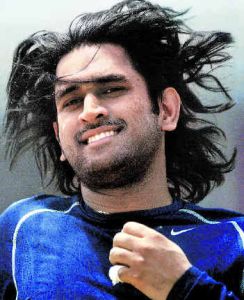
It’s difficult to decide what is the sexiest thing about Mahendra Singh Dhoni.
Because he’s not the handsomest of men, nor does he have the greatest body (but more on that later), or the most money, power or any of the other blah-blah-blah that turn women on.
So, maybe it is how easy and comfortable he look in everything.
Success
Jeans (well-worn, workman blue and no-fuss, just the way I like it…)
Pressure
Dirty-goldilocks.
Female fans.
Acne scars. (Beats John Abraham’s by points.)
Jharkand-English accent. (I can’t decide which is cuter - the way he says “wut” for “what” or the way he peppers his sentences with “ki”.)
Or just in his skin.
Maybe it is that he sounds so real, such a regular guy, even when he’s dishing out those careful, politically correct answers at interviews.
Or that he likes bikes (he owns seven) and chocolates and ice cream. (Move over, all you metrosexual sissies. Mahisexual is here.) And subscribes to Gandhigiri – what else would you call looking Shoab Akhtar straight in the eye and giving him a big smile every time he tries to intimidate you on the field?
And talking of smiles, maybe it is that lazy, shy-cheeky, I-know-I’m-kinda-killer-cute grin that would melt Hitler on a bad moustache day.
Or maybe it’s that cool, clear, straight gaze which seems to unerringly home in on parts which other men don’t even know exist.
There comes a moment in a relationship when in a sudden, searing flash, you have a startlingly clear idea of how completely hook-line-and-sinker you have fallen. (But of course Mahi and I are in a relationship – that Padukone babe is just to keep the paparazzi at bay.)
For me, since that Barstool, there have been two.
The first was when he took off his shirt just after winning the Twenty20 finals. No, it was not because he took it off to give it to that little boy and made the entire female half of the nation swoon into an ecstatic “Cho-chweet!”. (I did too, but mine was a more restrained “Awwww!”). It was also not because shirtless, he confirmed what was hinted at in that biceps-hugging T-shirt on Prannoy’s show - great body. (Eat your six-pack, Shahrukh!) It was because he looked so completely unselfconscious about it. As if it was the most natural thing in the world to do your victory lap with your shirt off in full view of a 100 million people. (Give or take a few million.)
The second was at the felicitation ceremony at Wankhede stadium
Everyone including Sharad Pawar had just done their number in aamchi English or Queen’s Marathi. (In most cases, you couldn’t tell the difference.)Then, up walks our dashing lad and when Harsha Bhogle starts to trot out his questions in shudh Angrezi, don’t you know old sock, he announces that since he is a Hindustani, he’d like to answer in Hindi.
Clean bowled.
The ultimate measure of my goner status is that I recently shelled out 199 whole rupees to get my year’s subscription to the Neo Sport channel on my Tata Sky. And life in now jhingalala. In case you’re scoffing, “Piffle!”, I’ll have you know that this is from a person who last watched cricket when “match fixing” was something that Bishen Singh Bedi did to his beard. To whom ODI is something which Britney Spears lost the custody of her sons for doing and who thinks that mostly, cricket is about as riveting as a documentary on the dating habits of an amoeba.
Finally, I thought it might be worth mentioning that there was another Indian wicket keeper who was also famous for his pizzazz, hair (our first Brylcreem model), high cute-pie quotient and love for bikes.
Farokh Engineer.
I tried to make something deeply significant and meaningful out of that but couldn’t. Except, I’d like to say this much.
Man cannot live by bread alone. At least, woman can’t. So, every now and then, we need to have a fella around us who fills us with the insatiable urge to break through security cordons, fling (would “throw” be a more wantonly appropriate choice, I’m wondering?) ourselves on him and kiss him madly, deeply, thirstily before we are dragged away and thrown back to our ho-humdrum lives. More so if we are constantly going to have our KSBKBT’s interrupted by our Bonny Babas in Blue peddling champi-sabun, chaddi-baniayan and danth-manjan. So, you’d better make them cute and the cuter the better and I have to say this.
As far as Mahi goes, I can’t complain.
Gotta go now. Have to figure out what exactly it is that a wicket keeper keeps. I mean, I don’t see him watering those wickets or feeding them biscuits or anything….