Tuesday, September 05, 2006

Let it be…….


There’s a neem tree outside my house. You wouldn’t think this of it as you see it tower majestically over almost all the other tree in the lane, with its rather incongruously pretty mane of pale-green arrow-shaped leaves but it’s an unassuming tree. Except for the first few years after my dad planted it as a tiny sapling and watered it lovingly to its current glory, it has stood there pretty much minding its own business, not asking for much – attention or water or anything. We only notice it seasonally. A few weeks in winter when it sheds its all leaves in thick, raspy, mud-coloured snowdrifts and then covers itself rather coyly in beautiful glossy pink little leaf-lets that giggle prettily in the sun. Then in summer around Ugadi (our New Year) when we jealously guard it from passersby who come to divest it of its leaves - now neem-green and waxy-shining - and for its tiny, creamy white flowers that you are supposed to eat with jaggery (bevu-bella) on Ugadi day to remind you that life is a bittersweet affair. And finally just before the rains, when the tiny cream blossoms, now grown up to fat, green fruit like green berries, lure a whole host of birds including gaggles of parrots who noisily visit the tree, bickering about who gets the choicest pick and covering the ground near my gate with indigo-black guano like some strange organic ink-blots.
For the rest of the time, the neem tree mostly keeps to itself, not even asking to be watered. A few months ago I noticed that termites has started to cover its trunk like warty mud snakes. I dimly remembered that termites were the death knell for anything wooden and getting rid of them became an obsession. I was damned if I was going to let some termite army get at my dad’s tree. I tried everything. I poked open the “snakes” manically every morning with a stick, even though I’d be half-blinded by the debris of mud-covered termite (Or is it termite-covered mud?) I desperately rained bucketfuls of water on them. (Which was rather fun as the mud came down in thick rivulets choked with half-drowned termites…) But still the snakes came and by the dint of some hideous termite magic, every morning there’d be a new insidious termite-mud snake on the tree. It was when the snakes started climbing out of reach into the branches that I gave up. My mother tried to console me. All the trees are covered with them she said, as if that was a consolation. I became a tree-termite census taker. What my mum said was true - lmost all the trees in neighbourhood had those hideous mud snakes. But so what? It didn’t make the fact that my neem tree was infected any less horrible. I continued to scour for newer, more terrible weapons against the mud-snake pestilence. Someone suggested choona mixed in water, another said turmeric worked like magic, yet another talked about making a decoction of tobacco leaves in boiling water. I tried all of them and watched helplessly as the snakes took over my tree….

Then one day, I went to my dad’s bank. When he died two years ago, amongst all his financial investments left in meticulously documented and updated condition was one fixed deposit. Mysteriously incomplete, because it did not have any nomination. Which meant that until we either found some record of a nomination made by my dad, the deposit could not be transferred to me or my mum and the money would lie locked in the bank - a dead investment. It was just 20,000 rupees but it niggled. The bank and I patiently went down its trail, tracing each renewal to the previous and that one to its ancestor. But the trail stopped suddenly; cold, scentless, barren of clues. I turned the house upside down, scouring every scrap of paper because it bothered me that a perfectionist like my dad could have thus blotted his copybook. There had to be something, somewhere…. The bank manager for some strange reason seemed to share at least half my enthusiasm and hunted with equal fervour. But it was no use, we both separately hit an unrelenting, mysteriously silent dead end. Exhausted, I gave up and had almost forgotten about it for six months….
Till that day. I had gone to the bank to renew some other deposits that had matured. The bank manger – and my co-hunter- reminded me about the left over FD. I remembered but I was puzzled. Because I didn’t have anymore FD’s left to renew. So where could this one have gone? Absentmindedly I rifled through the lot that I had just handed over for renewal. And there it was, with the manager’s damning remarks at the back. I gave it to him. This can’t be it, he said, because this has already been transferred to your name. This is the one, I insisted, look at your own handwriting at the back. It can’t be, he said, a little more firmly, because… I know, I know I thought, this one has been transferred to my name and that one couldn’t…. But I continued to insist, now bleating like a desperate sheep. Finally, fixing me with a gimlet gaze, he flipped the FD over and looked at it. If bank managers were allowed to balk this is how they’d be trained to do it. He obviously recognized the writing and the FD. Quickly he started accessing stuff in his computer, refusing to look at me for a long time, checking and rechecking. Finally, if bank mangers are allowed to gulp nervously, he gulped. “This is the one and it has been transferred to your name.” How could that happen, I squeaked with incredulous joy. I don’t know but it’s been done by someone else not me, he said, wanting to clear his slate and pointing at the signature. It could’ve have Michael Jackson’s signature and I wouldn’t have known any better or cared. All that mattered is that the dratted thing had cleared itself up, just like that. I came home joyously and told Mum the news…
The next morning, I stood by the neem tree, the memory of the magical FD fading at the sight of the mud-snakes. Suddenly a shower of something fell on my head. I looked up. Nothing. I walked away and came back with a bucket of water. Maybe watering would help to drown the mud-snakes. As I bent to pour the water, suddenly another shower of that something. I looked up again. And this time I saw it. A squirrel, frantically nibbling away at the mud-snakes, termites and all. I could hardly believe my eyes. I went rushing into the house to check with if squirrels were bonafide vegetarians. And then stopped to think….who cares? What mattered is that the mud-snakes were clearing up. Just like that. Just like that FD…..
Right now, the roof of our house in crumbling away. We have to get it fixed but we have been putting it off, the prospect of living covered in concrete-‘n-cement rubble and/or being swindled by unscrupulous contractors so daunting that my mother even went so far as to tell me, “So what if we put it off? The neighbours did till the rain started coming in through the roof and they had to collect in uckets….”Me, I’m just hoping that one fine morning, we’ll wake up and find the roof fixed – just like that. Like the FD and the mud-snakes……

Saturday, September 02, 2006

The Lord of Nothingness


The final day of the Mahamastakabhisheka at Shravanabelagola.
Like the turmeric and coconut water and sandalwood paste and milk and all the kashayas and churanas that have cascaded down in ecstatic torrents, so much has been said and written - and so eloquently - these last few weeks about it. And where words have failed, hundreds of breathtaking images have completed the task. Which makes this a very difficult piece to write. Because write about it I must. (Not only am I a Jain but my mother was christened Sunanda, after Lord Bahubali’s mother and my parents were married in the year of Mahamastakabhisheka!)
But what shall I write? My head whirls, tossed about in the swirling torrents and confused, I ask – what shall I say about you, Bahubali? What shall I say that has not been already said about you a millions times over? What shall I say that is not about the wondrous spectacle that made a world that virtually ignores you for the rest of the time sit up and gasp and take notice, but goes beyond that?
Shall I tell them that when, more than a thousand years ago, the sculptors scooped your likeness, head downward, from that massive rock called Indragiri hill, it was as if you there inside all the time, waiting for the right moment to rise out of the rock. According to one version of the story of how Chamundaraya, the great Jain minister and general of the Ganga kings came to commission the statue, Chamundaraya’s mother who was a great bhakt of Bahubali wanted to go to a place called Paudanapura where apparently a Bahubali statue, some 525 bow lengths tall, stood. Mother and son set off but as they slept one night on the smaller Chandragiri hill next to Indragiri, the goddess Padmavati appeared in a dream to both of them and said, “Here on the larger hill, is a stone image of Gommata Jina which was worshipped by Lord Rama, even Ravana and seen by Mandodari. It is covered with stone. Purify yourselves, and …shoot an arrow to the south… Before the sounds dies away, the image will appear.”
And when it did, it was so beautiful, Bahubali, so breathtakingly perfect that some say that Chamundaraya asked for the forefinger of your left hand to be made unnaturally short so that the imperfection would ward off the evil eye!
Shall I tell them the eternally still pose that your statue stands in is called “kaayotsarga”, literally meaning to abandon the body (kaaya). In yoga, there is a similar pose called tadasana. Shorn to the basics, it is just standing absolutely still - the seemingly simplest and yet the most difficult thing in the world to do. Because to do so, first the body’s weight has to be perfectly balanced on both feet, the spine erect and perfectly aligned, but at ease and every part of the body completely relaxed and still. When that is done, the mind forgets the body and abandons it. (Or the body releases the mind, depending on whether you’re starting with the chicken or the egg.) And then, the mind lifts away in search of other things - stillness, peace….
In the last two weeks, we have ooh-ed and aah-ed as hundreds of litres and kilos of all other kinds of wondrous things have poured down you in glorious floods, drenching everything – you, your ecstatic devotees dancing at your feet, even the hill on which you stand. But, the very first abhishek to consecrate your statue was quite a different story, wasn’t it, Bahubali? When the grand ceremony began and Chamundaraya poured the same prodigious quantities of milk on your head, for some strange reason, it would not go beyond the navel. Again and again, the distraught Chamundaraya, tried but in vain. Till a poor old woman turned up. In her hand was a small gulla kayi (a special variety of round green brinjal) whose insides had been scooped out to make a bowl. In it was a little milk. She asked to be allowed to pour that milk on your head. Chamundaraya laughed in derision at the temerity of a poor old nobody who thought she could achieve what even he, the great minister and general, couldn’t. But he allowed her to pour her pathetic little cache of milk anyway.
What happened next was amazing. Not only did the milk go beyond the navel, not only did it drench your staute from head to toe much the way it has these past few days, it is said that it flowed down the hill and became a beautiful white pond. It was then that Chamundaraya realized that the obstacle to the abhisheka was his own arrogance and ahankara at his achievement of having made this magnificent statue possible. And who was the old woman? Some say she was the Goddess Padmavati, others that she was the celestial nymph Kushmandini. Whoever she was, exactly opposite and facing the statue, stands to this very day, the figure of an old woman holding a gulla-kayi in her hands, a befitting reminder that, beyond all the hype, beyond the stunning extravaganza, beyond the superlatives, your message, my Bahubali, is actually something very simple.
Humility.
So, yes, Bahubali, it is true that you are considered the first Kewala Gyani who attained Moksha etc., etc. But, for many of us, those are just fancy words – kewala gyani, moksha, enlightenment – that we pay lip service to or then relegate to dusty libraries and theological debates. But, if we simplified that – and what could be simpler that you who wears nothing but the sky - yours is the story of the surrender of the human ego, that boasts, “I am”. Therefore everything must be mine.
You were once the dazzling Prince Bahubali, mighty warrior, learned scholar, patron of art and music, son of King Rishabhanatha of Ayodhya whose court was so magnificent that Lord Indra himself descended from Indraloka to grace this fabulous court with his presence and his famed Apsaras. Prince Bahubali - so handsome that they called you Manmatha, the Conqueror of Hearts, so manly and strong that they looked at your mighty arms and shoulders and called you Bhujabali.
And nobody could have loved his elder brother more than you, Bahubali. And the mighty Bharata, Emperor of the World and Conqueror of all the six continents loved you, his younger brother, no less. Yet that love was too small to accommodate your egos. Bharata said I am the Emperor of the six continents, I am your lord and so you must give me Paudanapura.’
And you said, I am Bahubali. I love and respect you as my elder brother but I am the king of Paudanapura.”
And each ego feared that that the other would swallow it up. And that fear begat many children - jealousy, anger, arrogance, revenge, lust for power - who became the armies that waged the war between you two brothers. A war that raged in your hearts. And when, at last you were on the brink of what seemed like victory, your brother helpless and high above your head waiting to be tossed to oblivion by your mighty arms, you realized that “I am” was actually an incomplete sentence.
But the complete sentence evaded you for thirty longs years, as you stood, having abandoned everything, even your body. Everything except a last shred of “I am”. “ I am standing on two feet of land that is my brother’s, not mine……” It was only when Bharata fell at your feet and said, “This land is neither mine nor yours…..” that the sentence got completed.
“I am nothing”.
So, ultimately, it doesn’t matter what I tell them about you, Bahubali. None of the history, the facts, the myths, the legends. None of the explanations of significance of all the rituals that took place over these last 10 days, the debates about moksha and ahimsa and Jainism. It doesn’t even matter whether they know that the statue that atop that hill is your statue, Bahubali
What matters is this.
The moment the water hit the top of 58 feet of granite and transformed into a million little diamonds that swallowed the sunlight and flew off into a peerless blue sky, the granite, the towering granite surrendered humbly. To milk that rushed down, shooting ripples of white lightning into it and turning it into marble. To the sugarcane juice whose sticky sweet embrace turned it into translucent green like a lemon lollipop. To rice flour and the churnas that wrapped it from head to toe in gigantic clouds of delicate white mist which then settled as softest white down on the granite so that suddenly it was not stone at all, but living flesh that you wanted to reach out and caress. To turmeric and saffron who fought to turn it into gold. To the blood-crimson sandalwood that melted it into such indescribable fragrance that drenched the air, every conscious thought. And then finally to the flowers – millions of them, frantically trying to kiss this thing which was till now that must have been inscrutable, unyielding granite but now was….nothing.
And through it all, you stood, my Bahubali, unmoved, unaffected, smiling your sweet, gentle, mysterious smile as if to say, “All this is nothing. Because I am nothing.”
Sources : Homage to Belagola by Saryu Doshi, Jainism the World of Conquerors by Natubhai Shah
********

Bahubali and Yoga.
According to ancient Jain scriptures, yoga and meditation are considered as essential part of the Jain way of life, for both ascetics and lay people. Even later day Jain scholars and monks have written detailed expositions on yoga and mediation. For example, Subhachandra (10th century AD) has elaborated on meditation, including specifying the poses for it. Padmasana, ardhapadmasana, vajrasana, viraasana, sukhasana, kamalasana. And the pose in which the statue of Bahubali stands – kaayotasarga.
Like many other meditative poses, this meditative pose is now being used in alternative therapies to treat hypertension, heart disease etc.

Bahubali and a Natyarani

She was a dancer so accomplished they called her “Natya Saraswathi”. A raconteur so gifted that they called her Vichitra Suthradhare. In the fabulous Chennakeshava temple at Belur, just 86kms from Shravanabelagola, a stunning statue of her stands in front of the main shrine and the walls around are decorated with 42 gorgeous, voluptuous Madanikas or celestial nymphs, all inspired her legendary beauty. Singer, musician, poetess and a woman of extraordinary charm, wit and intelligence - in fact, the perfect candidate to become the chief consort or “Pattamahadevi” of the great Hoysala king, Vishnuvardhana. Which she did. But along with her worldly accomplishments, queen Shantala was a devout Jain and probably worshipped regularly at the statue of Bahubali. Because not only did her husband’s general build the stunning suttalaya around the statue, but she alos built a Jain temple on the adjacent hill in 1123 A.D, around 40 years after the statue came up….

The divine brinjal
For the looks of it, just a brinjal, but in fact, this gulla-kayi is no ordinary vegetable. According to popular legend, it was instrumental in humbling the great Chamundaraya and was the container for the milk that inaugurated the first abhisheka in Sharvanabelagola! It also has another divine connection.
The great the 17th century philosopher, poet, reformer and head of one of the 8 Udipi Mattas, Sri Vadiraja Tirtha, created the paryâya system by which the Sri Krishna Udipi Temple is managed in rotation by each of the eight Udupi Matha heads for a period of 16 months. As the story goes, he gifted the seeds of the gulla to the people of Mattu in Udipi district and it became famous as "Mattu gulla'', growing mainly in this area. Ever since, during the Paryaya festival, when the charge of Udipi Sri Krishna Temple changes hands, it has been a tradition for the people of Mattu village to send cconsignments of gulla for the festival. This paryaya festival in January, 20 gunny bags of gulla did the honours!

Bahubali and Marathi
How do we know that Chamundaraya was responsible for Bahubali’s magnificent statue at Shravanabelagola? By the inscription at the feet the statue that reads, 'Chamundaraye karaviyale’. But the other unique thing about inscription is that it is in Marathi and is the earliest known inscription in this language to be discovered!

Monday, August 28, 2006

What is this love-shove

What’s this love-shove?
I saw the saddest thing yesterday
Sheryl Crow on Larry King Live.
Sheryl Crow, 44 years old.
As Wikipedia describes her, 9-time Grammy winning American blues rock singer, guitarist, bassist and songwriter.
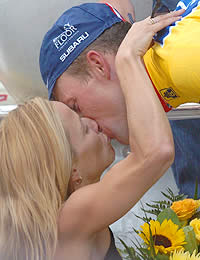
Of late, her newsworthiness has been for reasons other than her music. She was diagnosed with early-stage breast cancer in late February 2006. And in the same month, her much publicised 4-year romance with Lance Armstrong came to an end. Who would think they’d spilt. I mean, they were stuff that fairytales are made of, two brilliant haevenly bodies brought together by the gods and the world watched this celestial mating with envious sighs, the Mills&Boon climax on the Oprah Winfrey show.
For those of you who may not know, Lance Armstong is famous not just because he is champion racing cyclist, but also because he won the Tour de France a record 7 consecutive times from 1999 to 2005 - several years after being diagnosed and treated for testicular cancer that spread to his brain and lungs. His triumph over cancer was so amazing and empowering that he founded The Lance Armstrong Foundation to support cancer survivors and victims and the bright yellow Livestrong wristband became a world wide symbol of this.
So, you’d think, in spite of everything, Lance would rush to be by her side, right? As Larry King who asked the same question, put it to Sheryl, “just as a friend,…would have been a big help, having gone through his cancer was, worse than yours? He was going to die, right?”
Here’s Crow’s answer….
CROW: "You know, actually, interestingly enough, the person that was the most helpful -- helpful for me was Doug Ulman, who works for him…"
In other words....no.

It was one of the saddest things that I ever heard.
I know. I am judging somebody else’s private life. But isn’t there a little more to love? A little more beyond the first electric, breathless months, years – something that lasts and endures at least a few centimetres into the “thin”? If friends are for fair weather and foul, shouldn’t lovers be for at laest a bit of the storm?And I wondered….….what is this love-shove?
My parents were married for 47 years.
I don’t think my father could even remember their wedding anniversary. Many years ago, my mother was diagnosed with breast cancer. Not in the early stage. And she went through the works. Surgery, radiation, chemo. At times, my mother says things were so bad during the chemo that she couldn’t stand her own body and would ask my dad to leave the room. He didn’t. Not for a single minute of those 15 long years when she fought her terrible battle, did my father ever leave the room.
There was little said between them.
About the disease.
Or about love.
But he was there for her, by her side.
And so, I wondered again…
What is this love-shove?

Thursday, August 24, 2006

The Magic of Words

It’s only words………
“Once upon a time, there was a noetic young boffin called Jcak Fruit, who fell in love with a bobby-dazzler called Molly Coddle. And espoused her. It was a fervid, fecund union; full of sweet, sapid moments that fructified into three beautiful, pinguid little Fruits; a girl Passion and two boys Kiwi and Bread.
And Moll, being a Lucy Stoner, wouldn’t mess with her miss, and even though she had become a Missus, continued to be Miss
Molly Coddle. Which was a good thing because Molly, being a winsome (and lose-some, when she was dieting) wench, was constantly being cuddled and coddled by her uxorious Jack.
One fine gloaming, the Fruits went a-roaming, Jack all gussied up in his best philibeg and molly looking quite splendiferous in her new guttated, virid samfoo. Soon, they reached a bustling bistro where they shared a syllabub and a hautboy charlotte.
And as the sun sank wearily into the pulchtridinous purple eiderdown of a sky, stealing the nitid aurum from Molly’s hair, Jack felt his spritzig philter the cockles of his cardiacus, getting him into quite a tizwas as he thought how frabjous it would be to canoodle his dolly at this very moment, but what a caboodle there would be if he did.
Soon……..”
Words. I love them. People think that working with words is a craft. Penmanship they call it. Like enbroidery or petit point. Just a matter of arranging colours and threads in the most pleasing patterns and sequences. But it doesn’t quite work like that. Because words are living things, wilful creatures of whimsy.So you don’t craft words, you grow them. Sow your thoughts actually, finding that nice patch of soil where the little green shoots can stretch and reach the sun’s good morning kiss, watering them with patience and every now and then, helping out with that tricky bit of flowering or fighting off the odd bout of blight. Then, you just wait. Because how exactly the mango will swell with golden flesh or how sunnily the sunflower will smile isn’t going to be in your control. And oh yes, I almost forgot. For a bumper crop, you will have to give then your heart. And if you do, they’ll burst forth in riotous bloom like happy little children. And take over the page, your book and your life. Sometimes as angelic little genies, slaves to your every command, your every wish. Shaping a phrase, carving a line even before you have finished thinking it, with such breathtaking speed and beauty that you will be besotted, bewitched and infatuated into wishing yourself a life where you do nothing but live, breath and eat words.
And sometimes they will turn into stubborn, cantankerous little devils, staring at you with unblinking, defiant eyes; lower lip stuck out in tremulous mutiny. Then, you will have no choice but to let them run amok in chaotic, clamorous gibberish all over the place till something will snap inside your head and you scream, “Shut up!”
They will. And skulk away in sullen silence into the furthermost corners of your brain, refusing to come out or talk, leaving you flogging a few exhausted smudges and blots up and down a worn-out, weary piece of paper. Then, after a while, after you’ve atoned and begged for forgiveness; after you’ve wheedled and whinged in ingratiating coos; after you’ve almost sold your soul to them, they’ll saunter out. First throwing a cursory tantrum to guage how total the rout and then, when certain that you’ve totally repented your churlish, boorish behavior, they’ll relent. And tumble out in an exultant, noisy flood; chattering and giggling, eyes gleaming with excitement as they flit from this thought to that, plucking the choicest phrase which they’ll then arrange on themselves like so many iridescent jewels and then parade up and down the page, showing off their gorgeous little selves for all the world to see. Beautiful, maddening, fascinating words.
(Did you know that the word “pizzazz”, meaning a combination of flamboyance, panache and vigour is an onomatopoeic coinage by that famous American fashion editor, Diana Vreeland? Onomatopoeic? Ah, now that’s a whole new can of words………….)
“…………….the noctilucent moon rose, yawned delicately and wrapped the starry night around her naked, nacrine (nacreous) shoulders. And as Jack began to titinnabulate a soft cavatina on his glockenspiel, a horrisonant ululation lacerated the sable darkness…….”

Sunday, August 20, 2006

Pain


George Eliot said Pain is no evil unless it conquers us.

And we allow pain to conquer us all the time.
I learn this everyday in my yoga practice.
As I explore my way into an asana, pain visits.
Sometimes like a searing meteor across my consciousness.
Sometimes like a red-hot throbbing hotspot, i don't know where.
And if i allow it, pain is greedy, gobbling up everything - me, my brain, my thoughts even my consciousness. Till the horizons of my mind are stained with pain.
And if i allow it, pain is a noisy rolling shutter, slamming down on me,
Nervous, jittery, terrified,
ThatI may figure out...
That pain is only a mirage, an illusion.
Look at it through the gaze of your breath
Soft and slow and steady like the rhythm of the sea
Now and calm and here...
Then the pain dissolves, melts, evaporates
Like a thought....
Till
In the distance
I can see
Me
Beautiful me
Powerful me
Limitless me
Standing with one foot gently resting on the chest of pain
Lying vanquished at my feet
Technorati Profile

Sunday, August 13, 2006

The Man from Khandwa


"Sitting the wall of the studio, I saw a man wearing a muffler and a cap and holding a black stick. He was imitating everyone who passed, just like a monkey. 
When we went into the studio, the man jumped off the wall and came into the recording room. Jo jo gane gatey the, unke satyanash karte huey, woh khud gana gane lage. When I asked him why he was doing this, he said, "I am an orphan. Nobody looks after me. Please give me a chance." 

And saying this, R. D. Burman burst into laughter, just as I did after reading this interview (Filmfare, June 1984) because I could visualize the scene so clearly. And that man sitting on the wall. Kishore Kumar. Or as his fans so adoringly still call him after his unforgettable performance in Padosan - "Guru". And this is the persona most popularly associated with him. The lovable, endearing prankster who with that wonderfully mobile face that never stayed still for a moment, those sparkling mischievous eyes of a child, those eyebrows that danced almost as marvelously as his body and most of all, that incredible voice, pranced his way into our hearts with such delightful songs as Hum toh mohabbat karega, Nakhrewali, Ankhon mein tum, Ik ladki bheegi bhagi si and C-A-T cat, cat mane billi. As Kishoreda himself put it so beautifully in a song, "Matawala naam hai, masti se kaam hai, masti nighahon mein hai!"

But today, I speak of other Kishore Kumars...
It doesn't matter that many of the films that Kishore Kumar wrote, produced, directed, even edited and most importantly composed not just the music but also some of the lyrics vanished as duds into the box office incinerator. (He found time to do this while singing around 3000 songs and acting in 100 films). Because the few that survived became indestructible testimonials to the fact that behind that no doubt adorable comic faƧade was a brilliant musician and a poet. Jhumroo (1961), which not he only produced and directed but also composed its stunning music. Many remember only the vintage Kishore "Main hoon jhum-jhum-jhum jhumroo". But Kishore also composed the immortal "Koi hum dum na raha", the lilting, carefree "Matwale hum, matwale tum" and that unforgettable number that always wafts as sweet and fresh as an evening breeze, "Thandi hawa, yeh chandini suhani." These exquisite compositions are amazing for another reason - Kishoreda also wrote the lyrics for all these songs. And who can forget the sight of Kishore carrying little Amit (who acted as Kishoreda's mute son in the film) on his shoulders as he sang to him,Aa chalke tujhe main leke chaloonEk aise gagan ke taleJahan gum bhi na hoAaanson bhi na hoBas pyar hi pyar pale (Door Gagan ki Chaon Main - 1964)

I speak of these songs not only they are such an integral part of any tribute to Kishoreda but also because they showcase what to me is his most beautiful and often forgotten side - Kishore Kumar the poet who could write lines such as
"Aise main chal raha hoon
Pedon ki chaaon mein
Jaise koi sitara
Badal ki gaon mein."

And the musician who could compose such ever sweet, evergreen melodies as Koi laut de mere beete hua dil, Bekarar dil tu gaye ja and Panthi hoon main us path ka, the last 2 songs from another of his more successful home productions - Door ka Rahi (1971). And most of all, these songs showcase a voice as sweet and true as a child's laughter that sang some of the most wonderful songs, sometimes wistful, sometimes playful, sometimes filled with the melancholy but always filled with melody and enchantment, touching your heart the way no one could. Chota sa ghar hoga (Naukri 1954), Jeevan ke safar mein rahi (Munimji 1955) Dukhi man mere (Funtoosh 1956), Hum hai rahi pyra ke (Nau do gyarah, 1957), Gaata rehe mera dil (Guide, 1965), Woh shyam kuch ajeeb thi (Khamoshi 1969), Yeh dard bhara afsana (Shreeman Funtoosh 1965) and Kora kagaz tha yeh man mera (Aradhana 1969) to name only a few.
Many of these songs were composed by the one man who as far back as 1951, when most had dismissed Kishore as a voice "jis mein woh baat nahin", recognized a potential that made Salil Chowdhury later admit, "To Dada Burman goes the credit for having spotted the spark in the boy so early. Each one of us composers otherwise underestimated the tremendous potential of Kishore". A potential that Salil realized fully only 9 years after this "boy" had romped and whooped and pranced and yodeled for him (Aankhon mein tum) in Half Ticket (1962). When Kishoreda sang the classic Koi hota jis ko apna hum apna keh lete yaaron for Salil in Gulzar's Mere Apne.

But perhaps the man who really understood Kishore was R D Burman. Pancham and Kishore were kindred spirits, soul brothers and their coming together was a magical meeting that happens perhaps just once in a lifetime. In that same 1984 Filmfare interview, Pancham also said of Kishore that he was the best male singer the industry had. "He is flexible. He can sing a classical song better than any of the others. I know because I have worked with all of them. He can sing a funny song or a sad song; no one can beat him in versatility. He has never learnt music but his ability to grasp is the secret of his success."
Between 1970 and 1975, R. D. Burman - then at the dizzying height of his dazzling career - scored music for an astonishing 75 films of which at least 25 were Hindi cinema's greatest hits, not just cinematically but also musically. From Kati Patang all the way through Amar Prem, Seeta Aur Geeta, Mere Jeevan saathi, Yaadon ki Baraat, Namak Haram to Aap ki Kasam, Sholay and Aandhi. And in almost every one of them, Pancham exploited every cache of honey, every sweet nook and cranny of Kishore's voice to its fullest. For every Jai Jai Shiv Shankar, he got Kishore to sing a Zindagee ke safar mein ( Aap Ki Kasam); for every Chala jata hoon (Mere Jeevan Saathi) that the man from Khandwa yodeled for him, he made him sing a Diye jalte hain (Namak Haraam); for every Ek Chatur Naar that he made Kishore prance through, he gave him a Kehna hai (Padosan); for every O saathi Chal (Seeta aur Geeta), there was a O maanjhee re (Khushboo), for every Yeh Shaam mastani, there was a Chingaree koi dhadke, for every Soocha na, hai re samjha na (Bombay to Goa), there was a Musafir hoon yaaron (Parichay); for every Aaya hoon main tujhko le jaaoonga (Manorajan), there was a Phir wohi raat hai raat hai pyaar ki (Ghar).

But perhaps the one song that demonstrates Kishoreda's musical genius is "Tum Bin Jaaon Kahan". R. D. Burman composed it for Pyar Ka Mausam in 1969 and scored two versions. One, picturised on the hero, Shashi Kapoor was sung by none other than the great Mohamed Rafi. And the other, picturised on the hero's father, Bharat Bhushan was sung by Kishore. The measure of Kishoreda's virtuosity is not only that his version - along with the film - became such an immortal hit that not many even know of the existence of Rafi's version. But also that in this fact. As in all songs, between the verses there is a musical interlude. In Rafi's version, it is a pretty enough piece played on the mandolin. But in Kishore's version, he yodels it. And as he does, the interlude transforms, soaring and taking flight, painting the air with such poignant aching that the lyrics "Tum bin jaoon kahan" take on a new meaning. Till today, this yodeling interlude remains the most memorable part of a song that any discography of Kishore is in complete without.

And that is the final seal of Kishore's incredible virtuosity - his yodeling. Not only that he yodelled so wonderfully that when his brother Anoop Kumar came home one day and heard yodeling in the house, he thought that somebody was playing the records that he had bought during a recent visit to Austria. Only to discover that it was Kishore who had learned how to yodel from Anoop's Austrian records! But that Kishore used the yodeling like an extension of his phenomenal voice, to convey everything from pain to passion. Which takes me a full circle to where I began this article.The opening of Thandi hawa is a yodeling sequence, but "yodel" is a such bad label for what is the coolest, sweetest sound that seems to come out of nowhere, gentling echoing in the night sky, sprinkled with the most delicate, exquisite trickles of what must be moonlight rippling on water but is in fact the piano. And throughout the song, every now and then, this yodeling reappears, like a lovely gust of thandi hawa.

As that electric Kishore-Lata duet, Jai Jai Shiv Shankar (Aap ki Kasam 1974) ends with a fabulous folk rhythm piece and the sound of the dholaks build up to a crescendo, you can hear Kishoreda's delighted voice shouting, "Bajao, bajao! Imandari se bajao!" (Play, play, play with honesty!) And that just about sums up what makes Kishore Kumar's music - as a singer, music director and lyricist - so indescribably beautiful. It is because he never told a single musical lie. Every note was sung or written with honesty, ringing pure and true and clear without the faintest artifice. He made music as a child would - straight from the heart, with unbridled joy and delight. And such music can go to only one place. Our hearts. If Truth ever starred in a film, it would choose Kishore Kumar - as playback singer, music director and lyricist.Har dil ke pyar humSabki bahar humHumko bahaaronse kyaSabse naina mila-mila keDilki kaliyan khila-khila keChalte chale leherake humMatwale hum, matwale tum..

Wednesday, July 26, 2006

Little drops

Little drops of water
Little grains of sand
Make the mighty Ocean
And the pleasant land

There are approximately 1.6 million species of living organisms on this planet. It is estimated that within each human being there are between 500 to 1000 different species of bacteria. Which makes the balance of power between bacteria and humans something like this. The bacteria outnumber human cells at least by ten times, a vast majority of them populating the large intestine. And in case you are going, “Pshaw, of what consequence are a few trillion trillion silly bacteria other than scurrying around carrying nasty diseases and infections”, consider this. If many of those bacteria did not colonize our innards and live there, we would have difficulty digesting potatoes, rice, chapaties, dal, fruits and vegetables and milk….let’s just say most of our daily lunch or dinner. We would succumb innumerable infections and allergies, our immune systems would crumble and we would have no Vitamin K and many of the B vitamins.
Which not only makes the human race of around 6 billion an infinitesimally miniscule fraction of the wondrous and copious life on earth, but also in some measure dims our arrogance that we are the most superior and important species on this planet. (Some would even say the universe!) But, my point is telling you all this is only this. That in the grand scheme of things, in the cosmic pond, every single living being has been assigned a role to play. For some, it may be making Vitamin K inside someone else’s gut. For others it may be to discover uranium and win a Nobel prize. Or to collect garbage. Or be the world’s richest human being. Or a cook in a canteen. And for still others it may doing nothing more than living out life one day at a time in as decent a manner as possible.
Which makes it time to tell you a little incident that happened a few weeks. One of the great joys of living in a small town is that almost everything comes right up to your gate. Fruits, vegetables, rangoli powder, vacuum cleaners, bedsheets, encyclopedias, even ladies’ “unmentionables” And flowers. For the average South Indian, life without a daily supply of flowers is like a bath without water. Unthinkable. And my household is no different. Now most people buy their flowers in the morning when, along with liquid bird calls and the shrill cries of “soppu” (greens), the air is filled with the cries of flowers sellers. Jasmine and marigold and kanakambara and chyrsanthemum. Others buy it the previous evening, wrapping it in damp cloth or even popping it in the fridge to last the night.
Like we do. We also bought our flowers in the evening because this particular flower seller is one of the few who sells a local variety of jasmine called “jaji” which is my mother’s favourite flower. Which, while researching for this column I was astonished to discover, is the French jasmine used to make some of the most famous perfumes in the world. Anyway, to cut a long story short, of late the flower seller’s appearances had become erratic and one fine day, he simply vanished. So I started buying from another flower lady on my way back from yoga class. Then, about a month ago, the regular flower man surfaced again. But the new flower lady’s flowers were excellent and liberal and she was also a very nice lady. So, we bought from the evening flower man only on the days that I did not go for yoga or took a different route. He knew about it but he didn’t seem to mind because apparently the flower lady was a friend with whom he would often be chatting when I landed up to buy the flowers, sometimes even measuring and cutting the flowers for her!
A few days ago, it was a no-yoga evening and I was buying flowers from the flower man. He is a taciturn, impassive-faced young fellow and normally our interaction is strictly business, limited to me silently placing the money on his flower platter and him measuring out the flowers and putting them into my basket. Occasionally a smile may be exchanged or a brief mumbled conversation about the price or quality of flowers – nothing more. No pleasantries, nothing personal. The purchase over, I turned to go back into the house when suddenly I heard him burst out, “Amma, the day that you don’t buy flowers from me, they just don’t seem to sell!” The voice wasn’t loud but the intensity of the emotion made it seem so. I whipped around, taken aback. “I have been noticing this, Amma. Yesterday I had to go up to (he mentioned a slightly distant locality) and even then I couldn’t sell any flowers.” The eyes were wide and as intense as his voice, his normally bland expression replaced by something that stunned me. “Yours is the first house that I come to and do “boni” (auspicious first sale).” Which is when I remembered that whenever I handed the money to him instead of putting it on the straw platter, he’d cup both his hands and take it in a way that I thought was odd.
I was speechless, stunned beyond words and I just smiled weakly at him and went back into the house. As I told my mother about the incident, I felt my throat constrict with tears and my hair stand up. And I remember thinking - why am I so moved, so affected? Maybe because it was so completely out of the blue. But it was also because it happened at a time when I was questioning a lot of things in my life – the meaning of success, the loneliness of walking the path of one’s choice, the purpose of being a writer, of life etc., etc. And suddenly, here was my answer. To a complete stranger, one with whom I had no connection but the occasional commercial interaction, my existence mattered. My being or not being there made a difference in one whole human being’s life.
Self worth is very important thing because it breeds one other very important thing. Contentment. Because self worth is the realization that just as you are, just as your life is, you are of value and that value has nothing to do with your net worth. I have met people who, by the usual yardsticks of measuring worth, are nobodies. Yet their sense of themselves, their sense of self worth radiates around them like a force field. A few days ago a news item appeared in the papers about a new index of progress called the Happy Planet Index. Using 3 factors of life expectancy, human well-being and ecological footprint of a country, it has found that the happiest place on this earth is a tiny South Pacific nation called Vanuatu. When told of the news, a representative of the country’s online newspaper said, “People are happy here because they are satisfied with very little. Life here is about community and family and goodwill. It’s a place where you don’t worry too much. Most people here live day to day the only things we fear are cyclones or occasional earthquakes.” Incidentally, I don’t want to be a party pooper or anything but in the list of 172 countries measured by the index, America came 150th and Britain 108th. India? We came 61st….

A few days a beautiful prayer arrived in my e-mailbox, sent by a friend. It is attributed to St. Theresa who is also called the saint of Little Ways because she believed in doing the little things in life well and with great love. So, dear friends, I end with by sharing this prayer with you….
May today there be peace within.
May you trust your highest power that you are exactly where you are meant to be.

May you not forget the infinite possibilities that are born of faith.
May you use those gifts that you have received, and pass on the love that has been given to you.
May you be content knowing you are a child of God.
Let this presence settle into your bones, and allow your soul the freedom to sing, dance, praise and love. It is there for each and every one of you
.

Wednesday, June 21, 2006


There are many sides to the great Kishore Kumar that we never see and because we miss so much of him, especialy the achingly sweet composer, the superbly sensitive poet, the . This is that side of him in a song that he both wrote and composed for an unreleased film called Neela Asaman...

Akela hoon main is jahan mein
Akeli meri dastaan
Na manzil koi, na saathi koi
Jane kya yeh nila aasama
Kya khabar, kya pata
Jaa raha hoon mein kahan

Meri raat ka ek saathi
yehi chand ka caravan
Chaloon toh chali, rukoon toh ruki
Jane kya yeh nila asaman....
Kya khabar, kya pata
Jaa raha hoon mein kahan

Mera humsafar mera saaya
mera meherbaan raazdaan
na iska koi, na mera koi
Jane kya yeh nila asaman
Kya khabar, kya pata
Jaa raha hoon mein kahan

Wednesday, June 07, 2006

24 hours


The seconds coagulate
Into a minute
The minutes dissolve
In the pool of an hour,
The hours are raindrops
Of a cloud - day
Who sidles up to her lover - night
They embarce and lose themselves in each other
To become the night sky
Dusted over with the pearl grey powder
Of the same clouds
Night and day
In which the hours ripple
In which the minutes dissolve
In whom the seconds stick
And then come unstuck
To swim in the sea
Under my eyelids...

Saturday, June 03, 2006

The Confessions of an Unfashionable Plate

Okay people, what the hell is a prĆŖt line?
Which more or less says all that there is to be said about my fashionableness quotient. But let me elaborate.
You’re thinking this is going to be a sour grapes piece because Manish Malhotra didn’t ask me instead of Kajol and Preity to walk the ramp wearing his…..omigosh, I don’t even know the name of his collection. But I know that Sabyasachi’s collection is called “The Snail”. Wow. I heard Sabyasachi explain to Sreenivasan Jain in an interview on NDTV why he chose that name. It all sounded terribly intellectual and arty but I didn’t understand a word then and I can’t remember a word now. But I do remember thinking one possible reason would be that everyone – or at least unfashionable plates like me - will be so puzzled by the name that they will remember it. And see, I do. “The Snail”. Lovely. I’m told his earlier collection was called “the Frog Princess”. Maybe I can call my collection “The Dung Beetle”. Or how about “The Karela”? Or then just simply “Loofah”? Anyway, no need to rush as the next LIFW (in Internet chat rooms, that would probably be a very rude set of alphabets to say to your chat buddy) is a while away and my chances of becoming anything close to a fashion designer a tad further. But do send in your entries anyway because the winning entry will get a year’s supply of whatever it is that you name my collection after. For obvious reasons, names like Penthouse-in-Malibu and Brad Pitt will be disqualified.
Talking of names, I’m secretly glad that I don’t wear Sabyasachi’s clothes. (Though I’m sure he’s going to beg me to the minute we meet.) Because what would I call him every time I pop into his er, studio is it and we air kiss? Can’t be “Sabyasachi” because I’d trip over it dreadfully every time and sprain my tongue. Which would be both embarrassing and inconvenient because then how would I tell him that “ecru” isn’t really my colour or that we should go slow the overdyed crochet a skip as a choice of material for the underwear to go with my outfits for the Aish-Abhi wedding. (They’re getting married?!! Dunno, really. But no harm in being prepared.) Oh, dear, I should have said “lingerie”, na? Only people in baniyan ads say “underwear” and only mustachioed wardens of girls’ hostels wear them, na? I might as well have said chaddi or kachcha….
Anyway, point is, I’m at least trying. To be fashionable, that is. Because in life, who knows? I might just yet walk down the next LIFW WIFW (any relation of WWF?) ramp wearing a Sabyasachi a la Preity-Kajol-Manish. So I’m practicing my ramp walk. And as a back up, I am also planning my collection which will inspired by the structured lines of vada pav and the colours of Brihanagar Mumbai Pallika’s rubbish dumps…. But that’s the future.
And the present? Well, what can I say? In public I perfect my feminist-frump sneer and rant about anorexia and the disgrace of clothes that cost as much as an average Indian’s dowry fund. But in private, I watch F TV. And heave gusty sighs of longing and despair. At the undulating fields of slender, willowy legs flashing in and out of wondrous wisps of fabrics I don’t even know the name of. At the seas of silken bottoms bobbing saucily in and out Victoria’s secret and swimwear that would set the Mediterranean Sea on fire. At the acres of pouting gorgeousness and the mincing nonchalant elegance. And as I do, I desperately tell myself that real men prefer women with a bit more er, flesh on them. (Then how come Arun Nair is dating Elizabeth Hurley and Richard Gere was Cindy Crawford’s baa-lamb and not mine?) That one day, childbearing hips and thunder thighs will be the rage and it will be “fashion bowl” and not “fashion plate”. (WHEN?) And I ask myself, would I swap two slabs of chocolate truffle cake for two sticks of carrot…er, sorry 2 juliennes of carrot, a bread stick and a cup of hot water for just to look like Heidi Klum? I can’t tell you what my answer is on grounds that it will incriminate me.
Heidi Klum. Hm. I’m a very optimistic person, but even to me, things don’t look too good. Because even if I draw myself up to my full height, I will probably be few inches shorter than the length of an average model’s legs and we won’t even talk about the rest of khatey-peetey me. And high heels give me a crashing headache in 5 minutes of wearing them. So my only chances of become a fashion model is if I quickly become very rich or the Princess of Bikaner or Jaya Bachchan.
That leaves my chances of being one of the Beautiful People, fit enough to rub my spaghetti strapped shoulders with other BP’s in the front row of the LIFW. Well, the thing is I am a Beautiful People but nobody can see it because I believed all those beauty queens and that inner beauty stuff. And while I wait for my inner Page Three Person to out (it will, it will), there are other things that I have to fix. Apart from my thighs and stretching myself from 5’2” to 5’9”. I have to learn that there is no such thing as purple, only “aubergine”. And I have to find myself a corsetiere. (Till I started writing this article, I thought that’s a kind of pastry shop.) And try not to remember what me mum said – that nice girls don’t go to LIFW wearing only their underwear. Oh alright, lingerie. And learn how to pronounce Sabyasachi. (Do you think he’d like “Saby-baby”? Or then just “Kiss-kiss”?)
Incidentally, have you noticed how easy it is to tell who is the designer in a fashion show? At the end, it’s the odd-looking creature at least 2 heads shorter (3 if it’s a man) than all the models that scurries on to stage, looking just like you and me. (Except for Manish Malhotra who is quite gorgeous.) I’d like to see one of them wearing a structured pink balloon skirt over discharge printed pencil cut pants.I know. That is definitely a touch of sour grapes but I’m human aren’t I? But I am also hopeful. Because look what the fabulous Diana Vreeland, reigning deity of the international fashion for over 50 years and who coined the word “pizzazz” said, “With health, a good figure and brown skin in the summer, people should spend very little money on their clothes…. The only real elegance is in the mind; if you've got that, the rest really comes from it.” I’ve cracked the good health and my brown skin is kinda a year round thing. Now I just have to work on the figure…..

Saturday, May 13, 2006

Requiem for a thali

Requiem for a thali
photograph from http://www.sallys-place.com/food/ethnic_cusine/india.htm

A gleaming steel plate in which sit several equally radiant katoris, all empty, beaming with anticipation. You give a katori an impatient little twirl and wait, salivating gently. Suddenly, the kitchen door swings open and heralded by a drum roll of clattering spoons and pans, the show begins. First the band members walk in – the pickles, the pappadums, the chutneys, the kachchumbers, sometimes even a tiny, sparkling mound of salt. As they settle down and tune your taste buds, the supporting cast takes its place. A giggling rasam covered with little sequins of oil next to a serene, buttery moong dal. A palely elegant cauliflower poriyal dressed in frothy frills of coriander-‘n-coconut sneers at a fat, untidy, chortling aloo bhaji. A smooth-limbed kadhi undulates in lemony-golden swirls, tantalizingly veiled in transparent chiffons of steam, watched by a cool, still, white lake of curd. A charming kheer with a flawless pista-and-cream complexion smiles sweetly at a clownish bonda rolling across the steel floor to where several hot, perky pakodas chatter and vie for a dip in the refreshing green of the mint chutney. And finally, when everything’s in its place and the aromas apsaras have taunted and tickled your nose till you can’t bear it anymore, the star cast enters. Three pompously puffed-up pooris drop from the sky. Plop! They sizzle their opening lines, you gingerly poke their bellies and as a gust of hot air whooshes out, a delicious vaudeville begins……
To me, the thali epitomizes the Indian spirit. Every possible taste and flavour is welcome and there’s room for everyone in that happy circle. The sweet and the spicy, the juicily plump and the wafer thin, the lightly steamed and deeply fried, the fluffy and the crisp, things that make your taste buds squirm and tingle with delight, things that wash over them like a gentle lullaby. A dollop of this, a splash of that, things to dip into and to scoop out, things to slurp and crunch, things to fill the belly and uplift the soul. The thali is the world’s purest democracy where the first helping is the election campaigning where you give all a fair tasting and the second helping is when you cast your vote. Where you eat not in a boring straight line like the West does, going from soup to main course to dessert, but like the world, you go round and round, revisiting, reliving, reveling till every sense is sated and you’re in bliss. Which is when you lie back and let a gentle, happy little burp escape your lips, just loud enough for the gods to hear your paean of gratitude.
Sadly the thali is a dying breed in Mumbai, as endangered a species as the Bengal tiger. Oh there are places where you’ll find its pure-ghee, Roman orgy “deluxe” cousin that costs upwards of Rs.150 a pop and needs you to starve for at least 2 days to get past the farsan stage. But the plain simple South Indian fare, once available in almost every Udipi restaurant in the city is now almost extinct. And if you do find it, it’ll often be hideously bastardized, most of the items in it having crawled out of the horrible, greasy red slops, euphemistically called “Punjabi Items”, that feature on the a la carte menu. A few brave survivors still persist, like the Udipi Shri Krishna Boarding in Matunga that has served thalis of unwavering excellence since 1946, but for the rest……
Once upon a time, the Udipi restaurant was the affordable, wholesome option for genuine South Indian food. Not any more. Today, most of them offer a ghastly gallimaufry (yes, there’s such a word and it means hodgepodge!)of cuisine, as gaudy an assault on the taste buds as the dĆ©cor is on the eyes. So there’s a Jain in the pizza, cheese in the uttapam, mushrooms in the dosa and the tomato omelet is not made with egg. The sambar is sweet, the sandwich is Russian, the paneer Schzewan and vegetables are anything from Peshawari to milijuli. There’s kadai, tawa, handi and matka, but nowhere in this noisy “gad bud” (yes, there’s actually a dessert by that name!) will you find amma’s thali. The thali is dead. Long live the thali!

Sunday, May 07, 2006


Where have all the Sadhana cuts gone?

“In the future, everyone will be famous for 15 minutes.” Andy Warhol
It was a chocolate-coloured saree with a yellow border and it had little yellow flowers (ambis, perhaps?) the colour of haldi scattered all over. The girl was all of 12 years old, but she had to have the saree, because at the time, it was all the rage. That was 53 years ago, but my mother still remembers her “Chandralekha” saree, so christened after S. S. Vassan’s historic Tamil hit film starring T. R. Rajakumari (T. R. standing for the grand sobriquet of Thanjavur Ranganayiki) who, I guess, must have worn such a saree in the film.
Thirteen years later, in 1961, in the Hindi movie Hum Dono, Sadhana’s hairstyle, (characterized by a sweetly wispy fringe over her forehead,) caught the imagination of the nation like wildfire and was immortalized as the 'Sadhana Cut'. And so it was, not so long ago, when movies were the magic that not just coloured our dreams but shaped the way we looked. It was in the cinema theatre where we found our earthly gods and goddesses, mesmerized not just by power of their performances, but by the way they made that hipster sari perch so saucily on those hips (Mumtaz in Brahmachari) or that curl kiss that magnolia forehead so tenderly (Meena Kumari in Sahib Biwi aur Ghulam). Whether your pallu regally swept the floor or sat like a perky little napkin on your shoulder, whether your choli sleeve crept demurely came all the way to your elbow (Waheeda Rehman in Guide) or boldly went where no choli sleeve had ever dared to go all depended on the heroines’ whims. Silsila may not have done well at the box office, but Rekha’s cholis with their now famous “magyar” sleeves (a kind of a compromise struck, I suspect, between modesty and titillation) became a huge hit.
And I remember the start of a lengthy battle of wills with my mother when I first tweezed my eyebrows to the fashionably pencil-thin line that Zeenie baby was sporting that year. They look like lines of black ants crawling across your forehead, my mother sneered despairingly, the pressures of disciplining a teenage daughter with delusions of passing off as Zeenat Aman’s twin (only about 8” shorter and twenty pounds heavier!) having temporarily deleted the Chandralekha saree from her head. But I had only just begun. Fortunately for Mummy the tight, sleeveless churidar-kurtas (with the coquettish little slit at the back so that you could at least totter around without keeling over) pioneered by Vyjanthimala, Asha Parekh and Sadhana in films like 'Jewel Thief' and 'Love in Tokyo', the “frosted” lipsticks that made those of us not blessed with the peaches-‘n-cream look like grey ghosts who had just taken their lips out of the freezer, the stretch pants made for limbs far less khaatey-peetey that our Bharatiya Nari ones, the towering, back-combed, stiffly sprayed edifices called the bouffants had long since passed – with honours, I must add – into cinematic history.
But no matter, the deities had new avatars for me. My kurtas climbed thigh-high, my pants flared to elephant. I secretly used poster paint to draw “eyeliner” on my eyelids (when my mum discovered this, she lived in the constant terror that I’d go blind!), my “tops” shrunk to something that looked like the tailor had tried to squeeze out of a handkerchief (Neetu Singh ala Kabhie Kabhie, Khel Khel Mein), I maxi-ed and midi-ed (having missed the mini era, thank God!), and when Jaya Bhaduri cut two front locks of her beautiful knee- length hair to hang loose on either side of her face, I followed faithfully. I still remember the early morning ritual before school – my mother would try to tame the offending locks with oil and I would then promptly rush to the bathroom and lovingly shampoo just the two of them, my two flags of defiance, fashionably un-oiled, ready to be whipped out and tossed around as the emotion of the moment demanded!
And it was not just the women. Dilip Kumar’s Devdas made unrequited love a national pastime where droves of besotted young men rushed to pine away with the help of a consumptive cough and a bottle of that in which sorrows drowned. Naturally, it was mandatory to wear correct the Devdas hairstyle – your front locks scattered despairingly all over your forehead. Then came Dev Anand’s dangly limbs and dashing puff, (which he started to sport, so the story goes, because his then lady love Suriya was a fan of Gregory Peck who had a similar hairstyle). Nothing, not even the windiest wind-machine would flatten it till Devsaab himself did, in Johnny Mera Naam. And then there was the “Bachchan” cut with which millions of nais across the country shaped the hair of their smitten clientele, who then ripped open their shirts to display pelts of surly chest hair, knotted the rest of the shirt around their waist ( Deewar), and bowed at the altar of the Angry Young Man. In between of course there was Rajesh Khanna, whose one Noddy nod, one slow-motion squeeze of the eyelids, one smile that spread like melted chocolate across his lips, (who can forget the soft, slurrily drawled, “Pushpa, I hate tears!” in Amar Prem?!) sent all of Indian womanhood into an ecstatic swoon only to recover enough to propose to him in blood. (When he married Dimple Kapadia, it was almost a national mourning.) Nobody seemed to notice that this dream devta had pimples, an oddly shaped shaped body and an even odder taste in clothes like his guru kurtas in 'Anand' (1972) and his habit of wearing a belt with a kurta (Andaz' - 1971).
So what happened? Where did they all go? Why is it that we don’t have an “Aishwarya cut” or Karishma kurta? How come no one rushed out to copy Shahrukh Khan’s jeans in “Kuch Kuch Hota Hai” or Hrithik Roshan’s black net reveal-all t-shirt in Kaho Na Pyar Hai? Is it because so much of what our stars wear today and the way they look ape a kind of desi version of the designer West, too alien for the average Indian person? (And how else would they lure, the fillum producers ask, the huge NRI market?) Maybe but that sounds like too pat, too superficial an explanation. Maybe it is a sign of our times – where everything is instant, disposable – like paper cups, where superstars are made every Friday night… and die the next Friday. Maybe it’s because our cine gods came down from heaven – through the media and publicity blitzes that blew away the stardust and revealed that they were just people like you and me, only better made up.
Or maybe it’s because increasingly we are a generation bereft of heroes and untutored in the habit of hero worship. Look around you and the place is littered with debris of the fallen angels of public life. Some of us may shrug our shoulders and say, aw, what the heck, we can do with some empty space on our altars already crowded with too many gods. But the thing is, hero worship is like dreaming. It’s good for the soul - a bit like airing your cupboard. It keeps at bay the cobwebs that congeal us into the ho-hum and the ordinary. Dreams and heroes keeps us yearning for to hitch our wagons to that star, no matter how dimly distant it may seem. I for one miss being starry-eyed. It used to make the world so much more palatable. After a long, hard day’s of humdrum, it would’ve been so good to shut one’s eyes and dream of being a doe-eyed beauty, tenderly romanced by a Dev Anand look alike, his puff lit by the smoky glow of lighter which tinkled “Abhi na jaao chhod kar, key dil abhi bhara nahi”. Except that there are no Sadhana cuts anymore to arrange on my forehead anymore……
“But look, look now, look at my hairstyle, this neat cut, people call it the Sadhana cut…..I have given them (the poor) a sense of self-respect. Nobody can stop them. They can now comb their hair the way the want, like me.” Laloo Prasad Yadav in “The making of Bihar” by Sankarshan Thakur

Saturday, May 06, 2006

gobi manchuri


GOBI MANCHURI

Photo: http://www.geetesh.com/coorgmysore/pages/08.html

Forget Mysore pak. Forget Mysore masala dosa (if such a thing ever existed.) Even forget the Mysore palace. It’s Mysore only if it’s gobi manchoori. (Or manchuri, as some would have it). Sizzling like Helen, glistening brown like Silk Smita’s thighs and as masaledaar as a David Dhawan film, it’s the hottest craze in town. Teenagers swear by it, no college campus is complete without it (one young lad told me that it’s the best place to meet babes who seem to have a special affection for it), recipes for it are closely guarded state secrets and the other day my maid walloped it with a gusto that she normally reserves for ragi mudde and avrekai!
So what exactly is gobi manchuri? Would cauliflower have anything to do with it? Maybe. Is it something concocted by a Chinese monk to slay the mighty Mahishasoora? Could be. A union of the soya bean and the Bedige chili so incendiary that it set the Cauvery on fire? Perhaps. A favourite concubine of Genghis Khan? Who knows? The pedestrian definition will tell you it’s bite-sized florets of cauliflower dipped in a batter of maida and corn flour (or variations thereof), deep fried and then floated into a kind of a sauce/gravy made by frying onions, various little bits of greenery (anything from capsicum to green chili, I suspect) and swirled into a conspiracy by the Gang of Four – the Messrs. Soya, Vinegar, Chili and Tomato sauces. As the thick vicious brown gook begins to spits and seethe in time to the drip-drip-drip of your salivary glands, nameless brown, red and yellow powders (depending on how fiendish you like your tipple) are sprinkled in and stirred. An instant before the gobi can turn soggi, a generous handful of chopped dhania and to the triumphant clang of ladle to wok, your gobi manchuri is ready. What, you ask, disappointed, just another snack?
Ah, but you obviously didn’t ask a true Mysorean. If you had, you’d have been told that gobi manchuri is a way of being, a rite of passage, an attitude. If in Mumbai it’s time pass, in Mysore, it’s gobi manchuri. When a Mysorean’s dil mange more, it’s only for "gobi" (as it is fondly called). It is fusion food for the soul, banishes boredom, cures lassitude and a constant diet of it is known to toughen your innards to withstand the most blistering chili and the most virulent bacteria.
No one knows for sure but I’m told by Mr. Venkaatess of Imperial Chef (supposed to be one of the best gobi manchuri joints in the city) that the Kings Court Hotel introduced it to Mysore in 1995. How it managed to leap off the fancy-pants restaurant table and strut its stuff at every single street corner and market square remains a mystery but I first noticed it about three years ago when a cart selling it was edging out the usual bhelpuri-wallah near my house. At the time I’d sniggered, scoffing at the very thought of the refined Mysorean taste buds groomed on generations of bisi bele huli anna stooping to defile itself on such phoren slops.
Needless to say, I’ve had to eat my sniggers and was forced to cut my gobi manchuri milk teeth a few days ago while researching this piece. So, did the earth move for me? Let me put like this. It brought to mind the name of a rather popular dessert found in the better Udipi joints in Mumbai. Which said it all. Gadbad. I know I risk getting drummed out of my hometown, so let me hastily make amends by telling you that Mysore’s surrender to the invasion of the “gobi” is unconditional. Apart from the fact that no restaurant worth its salt-‘n-pepper will leave it out of its menu, my estimate is that there must be at least about 300-400 street-side carts across the city dedicated only to gobi manchuri. (You can also eat it with “Veg. Fride Rice” and “Veg. Noodles” but the connoisseurs prefer it on the rocks.) A full plate goes for Rs. 10 a pop, but like the chhota peg, the regulars prefer to go “by two”. Like the stars, the gobi carts come out at about 5.30 every evening, staying on till 10 and averaging about 50-60 plates on good day.
So what’s the magic of the “gobi”? I tried to figure it out but like Laloo’s aloo, no one really knows. But I suspect it’s a hit because it’s hot, it’s cheap, it speaks in a chat-pata street tongue and it’s instant (including in the way it kick starts your taste buds!). What more paisa-wasool could one ask for?
Finally, a word about the name. Gobi manchoori. The first part is easy enough and it’s unanimous that it means “cauliflower.” It’s the manchoori (or manchuri) that poses the 64-gobi question. The more pretentious joints tend to call it Gobi Manchurian or even –shudder! - Cauliflower Manchurian. So would that point to a Chinese ancestry? Maybe is one answer. A shrug of the shoulder implying who cares, just shut up and eat it is the most common. But the one that I found the most satisfactory came from - who else, but that reputed exponent of the gobi, Mr Venkatess. It’s really quite simple, he says. “Manchoori” (you don’t have the heart to interrupt and remind him that his menu says Manchurian) means that which a “Man” can eat with a “chhuri” (or “choori” which means anything used to spear a morsel – i.e. fork/knife etc.) So Man+choori = Manchoori. I gasped at the pure poetry and the irrefutable logic of that explanation. And dreamily walked out of the Imperial Chef, remembering when a crispy bit of fried gobi splendiferously dressed up in a happy khichdi of whatnots introduced me to a place called Mysore!

Freelancelot

Freelancelot
First, let’s see what this must seem like from where most of us – barring Bill Gates maybe? – spend most of our lives enviously gazing at what only a flimsy ol’ fence separates us from what must be Heaven. Also known as the Other Side. Or Where The Grass is Always Greener. So you are a corporate slave. Chained to the Eternal grind of Nine to Five, once lured in by the charms of the executive loo, now poisoned by perks, hopelessly trapped in expense accounts, willing vassal to the God of the Office with a View and exhaustedly sucking on a Dilbert after a long hard day of wishing your boss would turn into a eunuch permanently assigned to be Pamela Anderson’s bikini designer. (If he’s a she, then round-the-year PMS will do.)
And this friend walks in. He looks strange. His skin, once as fashionably tinged with the same too-many-eons-in-front-of-a-monitor grey as yours now has an odd glow. As if he’s been spending too much time listening to daises (or is it buttercups?) bloom. The walk, once a familiar rat-in-a-hurry scuttle-‘n-scurry, is now a lazy, loping stride as if from too many goofing-offs to smell babies’ breath. His eyes are stranger still – the phrase “serene, limpid pools” springs to mind. He looks younger, fitter, happier; a man with a new lease of life. And then, suddenly it hits you. It’s happened! The fellow has Crossed Over. He is now On the Other Side! He’s become One of Them! His Own Master. (Though, you can’t help thinking, how much fun it would be being His Own Mistress.) A carefree bird, laughing at your slack-jawed shock and chuckling, “Yup. It’s true. I gave it all up. I’m a free-lancer now.” You think you heard “freelancelot” and why not. Since he now dwells where tables are round because everyone’s a boss – their own. Where office and home merge into each other in one seamless, stress-free, set-your-own-pace, patchouli-scented, alfalfa-powered bliss. Where Time is not a hideous tick-tock mocking that you may have missed the bus (and that promotion) but a gentle steed that you mount to amble or gallop as fancy strikes you. Where life is a train that always stops when you want it to and you get off and as you stroll, you look down at your feet. And marvel – at how the grass has suddenly gotten so green - on your side of the railway line…
You’re jolted back to earth by the sound of your friend holding forth on the joys of learning to change diapers of your inner child. And as the noxious green bile of too many office coffees and envy rises up in a stinking, burning belch, you think how you’ve never hated anyone more or wanted anything more desperately than to be what he has become… Till one day, one fine, snap-‘n-crackle-kellog day, it happens to you too. Just like that, without any warning. This must be like dying, you think. One minute you’re a 6-figure, hot-stomach-shot-to-pieces, high-blood-pressure-powered Executive Vice-Whatnot and the next minute, you’re marmalading your toast at 10 o’clock on a Monday morning as you watch the sunlight dapple your pajama-ed thigh and thinking, “Should I first bath the rubber plant or clean my auras?” The day stretches in front of you like another beautiful unexplored, leafy glade and as you wonder whether you should turn left to watch some beans sprout or right to…. suddenly, you catch sight of your bare toes. Nestling softly in ….oh lord, can it be?…is it?….yes it is! Something tickly-soft and dewy-lush and glorious-green….oh, glory be….it’s grass…..as green…..no, greener than you ever seen it on that or any other side of that damned fence! Oh my God – you’ve just become a Freelancelot!
And soon, you are the envy of friends. “I wish I had your guts, yaar,” they whisper conspiratorially. The pale patch on your wrist where once your frenetic watch used to strap you to day-before-yesterday deadlines now fades away. Strangers cite you as the intrepid Livingstone who had the courage to throw it all up. Harried and hunch-over-too-many-presentations- backed corporate minions gaze at you with awe and whisper your name as The One Who became a Nike Shoe. Yes, you did it! You accept the applause with a secret smugness as you give away your power suits and your Gelusil in a grand gesture of renunciation. The months gently amble past. The contentment grows over you like a warm golden patina and everyone tells you how much nicer you’ve become and look. You preen and wallow in your newfound you-ness. And you discover Time - to shop for fresh coriander and have oil massages and make brinjal pickle and feng shui your loo and linger in art galleries and clean out your cupboards and air your creative spirit and take Hawaiian guitar lessons and gossip with your mum and worry about that hole in the ozone layer and bake banana bread and save the Alabama canebrake pitcher-plant and…Time, where once there was never enough, now lies at your feet in loyal, brimming bushelfuls…
Then slowly - a something, a niggling like a canker in your shoe. Tiny but bothersome. Popping up suddenly like a wrinkle. (Or a pimple, depending on whether you’re fourteen or forty.) A voice saying it wants to go back. Back to the prison, to the slop-from-the-Udipi-round-the-corner, to the LTA and HRA. Back to the other side of the Other Side. To the designation that you can look to know who you are, the visiting card to know what to say to that snooty-voiced, snotty-nosed bitch at the reception. “And you are from…?” I am a Freelancelot; you want to scream at her. Can you not see it in my buddha eyes, the noble insignia of my clan engraved indelibly on my peaceful brow? But it’s not that peaceful anymore. The Inner Child that you discovered has become the Inner Nag. That voice again. “Oh, so goofing off again, eh?” it sneers. “Do you know how much so-and-so got to make last year while you were smelling the rain?” “And did you ask if that was Life that just passed you by? My poor dear fool, yes!”
That’s the funny thing about heaven. And grass. You realize that it isn’t that divine once you get there. Or that green. So you are your own master - big deal. The only thing that means is that when you crack the whip, it smacks your own butt and ow, does it hurt. And this business about being the joys of being self-driven? Well, let me tell you it’s much more fun having a driver. That way you get to look at the scenery, somebody else’s license gets confiscated and you don’t have to worry about parking. And boy, do you miss not feeling guilty doing nothing and getting paid for it. And always having something/someone else other than yourself to blame for the way your life is – your boss, your job, the company, the office dĆ©cor, your secretary’s way of saying “good morning”. Funny thing is, while they were flashing all that greenness at you, no one mentioned how cold it can get out there on those lawns. Without gratuity and pension and provident fund and whatnot to keep you warm and tanked up on that rainy day. And how scary and lonely without those salary cheques that you realize are like your parents. Always there to take for granted and always there no matter how bad a boy you’ve been. But most of all, they forgot to mention that you need to be a pretty decent runner – to run after people who’ve promised you money (yours that they owe you)/assignments/contacts/anything and how exhausting it can be to do all of this while wearing patient, polite not to mention a blazingly charming smile, when all you want to do is kick the person’s teeth in. (You know, that guy who said tomorrow never comes? He must have been a guy who makes out cheques to freelancers.)
As you glumly brood about the leanness of your bank balance and the not-ness of your body - did I mention what working within an arm’s length of the fridge and the potato-salli jar can do to your backside? – you get up to go for a walk. And as you moodily kick a passing pebble, you look down and suddenly you see it. Scruffy, brown and withered. Funny, you think, it looks just like scruffy, brown and withered….oh my god…could it be…yes it is…..grass! Shocked, you look up, across miles of more such withered, scruffy brown and suddenly there, in the not so far distance, a fence. And across the fence, shimmering in the sunshine, a patch of softest, dewiest, lush-est, greenest……
Moral of the story? The grass is always greener on whichever side of the fence you’re not.
Revisiting a palace, a tomb and lessons in Hindutva

Two monuments. One a tomb in Baroda, the final resting place of Ustad Faiyyaz Khan who tracing his lineage back to Tansen was one of the greatest of Hindustani classical music. The other, a magnificent palace in Mysore, built during the reign of Krishnaraja Wodeyar IV. Two monuments, miles apart in every way, but inextricably linked to teach us a very important lesson for the future of India.
I haven’t visited the Ustad’s tomb, but walk around the Mysore palace as I have done so many times and you will have no doubt that it was built by and for a Hindu king. Despite it being a breathtaking melting pot of Indo-Saracenic architecture designed by an Englishman called Henry Irwin. Despite the fact that the two main durbar halls are called the Diwan-e-Am and the Diwan-e-Khaas, there is no doubt that His Royal Highness Nalavadi Krishnaraja Wodeyar Bahadur IV, in whose reign this palace was completed in 1912 was a very Hindu king. Despite the fact that there are no less than 8 temples in the palace grounds, of which the Sri Prasanna Krishnaswami temple was built by this king’s grandfather because he felt that there was no temple dedicated to the Lord Krishna to whose vamsa, the Yadu vamsa, the Wodeyar dynasty traces its decent. The fact that the fabulous golden throne, which according to one version once belonged to the Pandavas, has a benediction that refers to the blessings of the Goddess Chamundeshwari on the monarch. And that lining one part of 155 ft wall of the awesome Diwan-e-Am is a series of 8 exquisite life-size paintings depicting the 8 avatars of the Goddess. And that all across the palace are stunning visual celebrations to her and other Hindu gods and goddesses.
But wait a minute. What is this? Under each of the 26 magnificent wall frescos all along the Peacock Pavilion that depict the splendour of the Dasara and the royal birthday processions are the names of the key figures of the maharajah’s durbar. Meticulously and painstakingly written in black ink and the yellowing originals lovingly preserved and framed in glass. What intrigued me was that amidst the Urs and the Raos, the Swamys and the Chettys, amidst the Ayyas, the Annas and the Appas – expected in the court of a South Indian king - there were liberal sprinklings of Abduls and Peer Sahibs and Baigs, even a Parsi called R. N. Boyce. (The imposing Commandant of the First Battalion of the Mysore Infantry is a Major Rana Jodha Rang Bahadur, his second and third in command Captain Mahomed Isshook and Lt. M. Jamaluddeen.) Amidst with a Arthashastra Visharada, a Sangeeta Sastraratna, a Rajasenabhushana and a Rajasevadhurina, grand titles of honour bestowed by the Maharajah on the most illustrious members of his court were a Siddiq-ul-Mulk, a Durbar Bakshi, an Arzbeg and a Huzur Bakshi.
So what was a Hindu King - and that too one whose dynasty had been so rudely interrupted by a Muslim – none other than Haider Ali and his son, Tipu Sultan – doing with so many signs of what our present day defenders of Hindu faith call “pseudo-secularism” in his court? Why was one of the most important posts in his durbar called “Huzur Secretary” and why was the administration of the affairs of the royal ladies called the Zenana Samukha, when the palace library was called the Saraswati Bhandar, the elephants and horse housed in the Ashwashala and Gajashalas and the armoury kept in the Ayudhshala? It is a well-known fact, that of all the king’s Diwans (a total of 12 during his reign), the one who shared the closest rapport with him was Sir Mirza Ismail, on whom he conferred the title on Amin-ul-Mulk. But one Muslim does not a secular make and do we not have our own token not one, but 2 - Sikander Bhakt and Mukhtar Naqvi Abbas -in the BJP?
But I was intrigued enough to want to investigate further and I did. And so I plunged into whatever documentation I could find about Krishnaraja Wodeyar and his court. There were enough examples he was perhaps one of the most enlightened and progressive monarchs of his time was evident. But, in the archives of the records of the Palace administration, I found this letter, addressed to the Maharajah:
“It has been the great good fortune of Your Highness’ petitioner not only to have been cherished and protected in this royal court, but to have been bestowed the high favour of a title at the hands of your Gracious Highness…..”
The title was “Aftab-e-Sitar” bestowed by the maharajah on the writer of the letter, one Barkatullah Khan. Palace musician from 1919 till his death in 1930. One of India’s great sitar players, one time guru to Kesarbai Kerkar and to the father of Ustad Mushtaq Ali Khan, the greatest exponent of the Seniya sitar style in recent times. (Many years later, it was this same title that was conferred on Ustad Vilayat Khan by the late President Fakhruddin Ali Ahmed.) And as I researched further, unfolding in front of me was Krishnaraja Wodeyar’s and the Mysore court’s astonishing and unwavering patronage of Hindustani classical musicians. Many illustrious members of the Agra Gharana including Nattan Khan and Ustad Vilayat Hussain Khan who was a guest of the Maharajah in Mysore for 10 years. The legendary Abdul Karim Khan whose shisyas include Sawai Gandharva, Roshanra Begum and Hirabai Barodekar. (It is said that though a devout Muslim, the Ustad would write '"OM TATSAT SAMAVEDAYA NAMAHA on his musical works and was perhaps the first North Indian musician to study Carnatic ragas and incorporate several of them into Hindustani music.) And Gauhar Jan, one of the greatest exponents of the thumri, the khayal and the ghazal, the toast of Calcutta where the saying went that “Calcutta without Gauhar was like a bride without her Shauhar (Husband)!” And the first Indian singer to have recorded her voice. She became a Mysore Palace musician staying on till her death in 1930. (Incidentally, Gauhar was actually an Anglo-Indian, born Angelina Yeoward, of Armenian-European-Jewish-Christian parentage.)
And this in the court of a king with a long tradition of patronage to Carnatic music where famed Carnatic musicians like Mysore Vasudevachar, Muttiah Bhaghavatar, Veene Sheshanna, T. Chowdiah and Bidaram Krishnappa flourished as court musicians.
In today’s terms, we would say this was just the gracious patronage of a Hindu king of Muslim musicians. But to the Maharaja, it was simply the appreciation and nurturing of another beautiful avatar of India’s great musical tradition. Just as for the musicians, it was an opportunity to perform before another great connoisseur and patron of their music.
And so it was many, many years ago one cool, soft, velvety Navratri night in Mysore, sitting in the magnificent Diwan-e-Am, ablaze with thousands of fairy lights that Faiyyaz Khan performed at Krishnaraja Wodeyar’s famed Dussera celebrations. It was a jugalbandhi between him and Ustad Hafiz Khan, the palace musician at the time. So enchanted was the Maharajah by the Ustad’s performance, that he bestowed on him the title of Aftab-e-Mausiqui, by which title the Ustad was thereafter known by.
And so in Krishnaraja Wodeyar’s beautiful garden bloomed many flowers, and he gave each its own special name to honour its uniqueness. An Aftab-e-mausiqui blossomed next to a Sangeetha Kalanidhi, an Aftab-e-Sitar spread its fragrance next to a Gayaka Shikhamani. While one filled the air with the beautiful, plaintive notes of “Babul Mora” in Raag Bhairavi - it is said that K. L. Saigal once approached Ustad Faiyyaz Khan to be his guru -, another praised the Goddess Chamundeshwari with 108 exquisite kirtis.
On March 31, 2002, during the frenzy of the post-Godhra riots, the tomb of Ustad Faiyaz Khan was desecrated and wreathed with burning tyres. But what was defiled was more just the memory of one of India’s greatest musicians, who under the pseudonym "Prempiya", composed songs called cheej, many of which are now inseparable from the celebration of Hindu festivals like Holi. Nor was it, as many would say, the despoiling of the great tradition of secularism in this country. To me, it was desecration of a great tradition of Hinduism lived out so beautifully by a Hindu king who, even while glorying in the vast, infinite landscape of his Hindutva, had room enough for one and all.

May 2006 - the ghosts of Godra seem to be back to haunt us again in Vadodara. As Dylan said, "when will we ever learn?"

Friday, May 05, 2006

The Southie’s dhoti and how to rattle it

The Southie’s dhoti and how to rattle it ( Or how to diddle your mundu)


Other men gird their loins, Southie men gird their dhotis. Underestimated by the rest of the world as a mere garment, a foolish extension of the loincloth, it’s only the Southie male who knows that the dhoti can be much, much more. (Bringing to mind the opening line of Love Story. “What do you say about a one-and-ahalf-metre tundu ….”)
Well to start with, the Southie’s dhoti is a piece of minimalist art. No clumsy acres of cloth to be feverishly gathered and pleated, no frenzied crawling between and around the legs. Just a pithy bit of pristine whiteness, enough to go around the waist once, with some left over for the two ends to overlap - barely. It’s also a free spirit, secured by just one firm tuck at the waist, the rest left to hang free, unrestrained. Because the Southie knows that a dhoti is not just something to wear but to wield, much the way a skunk does his stink or a bimbo her cleavage. And so as Time dawned on mankind (somewhere between Mohenjo and Daro), the art of dhoti rattling came to be, the art of how to swagger, strut, scare, conquer and tame - all with a piece of cotton as bland as your granny’s khichdi. Which is why, like Sharon Stone’s hemline, the Southie’s dhoti is built to have the unfettered freedom to rise or fall, fold over or flap across, even cleave open to lay bare the magnificence of Southie machismo.
Naturally, this means that the Southie dhoti spends very little time being full length - i.e modestly covering its wearer from waist to toe - and a lot of its time being folded up to reveal calves, knees, thighs (and sometimes – gasp! – even more) depending on how things are going. Now before you leap to any rash conclusions about the Southie male’s secret exhibitionist tendencies (“we’d have never guessed with all that vibhuti!”) let me tell you that without knowing how and when to fold or unfold your dhoti (while wearing it, naturally) there’s no way you can rattle it. (Nor diddle your mundu.) It’s a bit like trying to wrestle without a partner or to tango without feet. And depending on your dexterity and timing, you can deploy your dhoti to play popular male sports like mine-is-bigger-than-yours, my-daddy-can-beat-up-your-daddy-not-to-mention-what-he-can-do-to-your-mummy and you-can-take-it-and-stick-it-up-you-know-where.
Needless to say, the art of dhoti rattling has been stitched into the Southie’s Y chromosone and there was a time when every good Southie boy worth his weight in mulgai pudi learnt it much before he learnt how to manage rasam on a banana leaf. Alas, with the invasion of the pant and the pyjama, it’s now a dying art in the cities, but is still alive and well where paddy is lush, the coconut tender, the jackfruit ripens like prickly, pregnant hippos and the air is laced with the fragrance of black hair gently wallowing in coconut oil.
Now though it is said that there are as many ways of diddling a dhoti (or wiggling your veshti) as there are recipes to make your idli batter rise, here are the few basic moves common to all schools.
1. The Buffalo Bhoothalingam Draw (Inspired by the Bucking-Bronco Kick.)
Used to answer the Call of the Testosterone. And when the call comes, to the swelling of the chest and the quivering of the moustache, (maybe even the clash of a few cymbals), in one lightning motion, you shoot out a leg backwards to kick the lower end of the dhoti upwards into a waiting hand. And before anyone can say Karaikudi Kunjukunju Mudaliar, the dhoti will lie trussed up at loin level and you are all set to defend the honour of gramam, gotram or garage mechanic. Can be accompanied by dialogues like “Yenna da, rascal!” or words to that effect, but the more stylish practictioners prefer to let the dhoti do all the talking.
(If your dhoti is already folded up, just go in reverse making sure that when you unfold it, you don’t yank the whole damn thing off. It requires years of practice to know and find the location of that little bit of dhoti that will do the trick.)
2. The I’m-the-King-of-Kondalampatti Klutch. Equivalent to pissing on territory and therefore normally used to fix who is the dominant male in this part of the jungle. At the sight of a threat, shoot out leg (always backwards), kick dhoti (always upwards) and instead of folding the whole thing up around loins, just hold up one end (sometimes both if the threat is severe) in hand to part the dhoti like the waters of the Red Sea and make way for two hairy (hopefully), muscular (hopefully), mard-key-bacchey legs which will then proceed to walk all over everybody. In days of yore, this was much more effective when done striding through paddy fields with a minion scurrying behind holding aloft a huge black umbrella to protect your beautiful black complexion from being ruined by the sun.
3. The Gird-of-the-Loin. Used before the commencement of anything from climbing a coconut tree to signing that corporate merger. (Also very useful while riding anything with two wheels – other than a woman, that is.) It signals that you’re now open for and mean business. A variation the B. Bhootalingam Draw, minus all the thunder and lightning and how high you fold the dhoti is determined by the complexity and seriousness of the task at hand. (WARNING: To be deployed without underwear only when unaware of presence of polite/female company and/or when answering an urgent call of nature.)
Which leaves us with just a couple of unanswered questions. The first - if the Southie’s dhoti spends so much of its time aping a miniskirt, what comes to mind is a question has so often haunted humanity about the Scottish kilt. What underwear? Well let’s just say that it has never been Venky’s secret. Because the Southie, never knowing how high his dhoti may ride, chooses his under-the-dhoti-wear remembering the Girl Scout motto. “Be prepared”. Hence the popular choice – despite the invasion of the briefer VIP or the even more dashing Jockey - continues to be what is called “drayers” - knee-length kacchas in dashing stripes or shorts in basic khaki – covering all matters that must remain private no matter what your dhoti may do in public.
And the second question is…. You know what they say about the Southie’s dhoti - that it’s like a coconut. Known to fall off but no one has ever seen one do so. So the second question is - how does it stay up? There are many whispered rumours. (And there are those who have been known to use a belt, but they are charlatans really, shunned and denounced by the real Makappuwamis) Some say that it is coffee, strong enough to put the hair on your chest and keep your dhoti on. Some say a daily dose of rice and buttermilk, enough to just distend your stomach to the required rotundity. Others say it’s avvakai pickle, hot enough to sear your dhoti into your middle….The truth is no one knows. My bet? Testosterone…..(FOOTNOTE: Now there may be some of you whose brow may be furrowed on account of my not having mentioned the lungi. I have just one word for it. Disgusting. A raucous, loutish, revolting genetic aberration that will never be recognized as a legitimate relation by any true aficionado of the Southie’s dhoti.)

Tuesday, April 18, 2006

It's a man's world, honey

Money talk

It’s a man’s world honey
Cause he’s got the money
And you don’t

Think about it

Why its Mister Money Bags, sweetie are you surprised
When the only bags you’re allowed are those under your eyes?
Why pretty girls have sugar daddies
But there ain’t seem to be no sugar mommies

It’s a man’s world honey
Cause he’s got the money
And you don’t

Think about it

Why a lakh or a crore is always gotta be a pati
And a patni’s just a dharm or sometimes a sati
Why “Play” plus “boy” equals to lots of lolly
And “Play” plus “girl” is just a centrespread dolly

It’s a man’s world honey
Cause he’s got the money
And you don’t

So that’s the bottomline

He’s got the paisa so he’s the boss
The sooner you get that the more you’ve got
So bindiya chamka ke kajra those eyes
It’s time to take Mama De’s advice

Bank balance ko dekho, bas yehi hai khaas
Gun aur gotra, yeh sab hai bakwas
Lav-shav ko chodo, say bye to romance
Dulah-mia’s the one with lots of finance

So chodo liberation aur sambhalo choola
Hubby khush hoke dega tumhe lotsa moolah
Then kya jodi banegi uski tumhari
Tu roop ki devi, who dhan ka pujari

So…….
It’s a man’s world honey
See, he’s got the money
But now it’s your world too
Cause he’s attached to you!